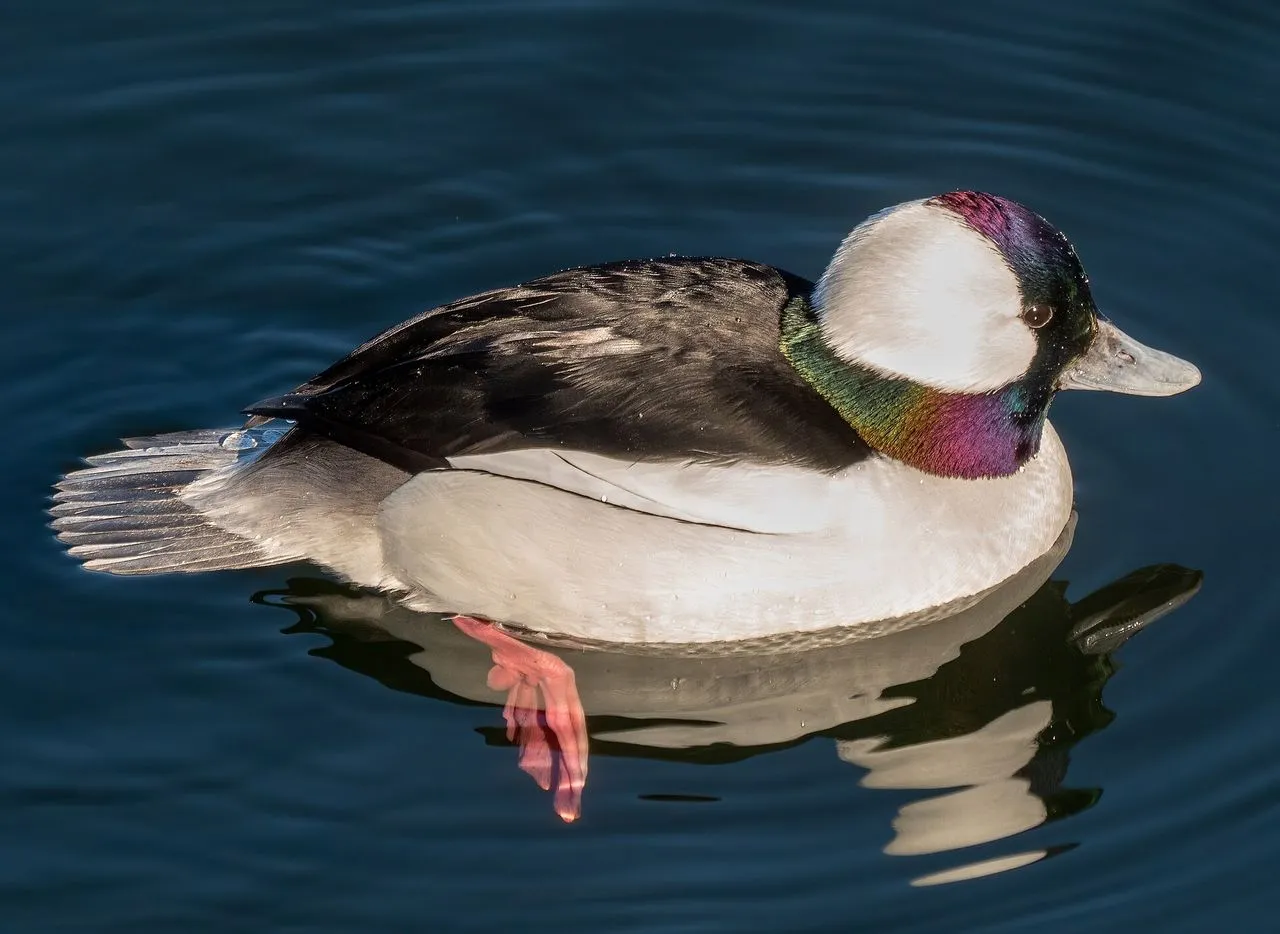
Bufflehead is the smallest North American diving duck, and the round head, tiny bill, and abrupt dives are the quickest way to spot it. Males look black and white at a distance; females carry the pale cheek patch.
Part of the Complete Waterfowl Guide.
Identification at a glance
| Character | Bufflehead | Common Goldeneye |
|---|---|---|
| Length | 32–40 cm (13–16 in) | 40–51 cm (16–20 in) |
| Female head | Grey-brown with oval white cheek patch | Chocolate-brown head with grey body |
| Male face mark | White wedge around rear head | Round white spot before eye |
| Body shape | Tiny, compact, buoyant | Larger, longer-bodied, blockier head |
| Flight sound | Usually quiet wingbeats | Male wing-whistle often audible |
Identification
Visual
The breeding male is black-and-white at distance, with a large white wedge wrapping around the back of the head from eye level across the nape. In good light the dark head shows green and purple iridescence. The body is white below with black back and wings. The bird looks buoyant, short-billed, and large-headed, frequently diving in quick sequences.
The female is grey-brown with a distinct oval white cheek patch below and behind the eye, grey flanks, and a small dark bill. Juveniles resemble females. Female Common Goldeneye is larger, longer-bodied, and has a brown head contrasting with grey body rather than a single oval cheek patch on a small grey-brown bird.
Eclipse males are duller but retain more white in the head and wing than females. The small size remains decisive when direct comparison is available.
Audio
Bufflehead is generally quiet. Courtship includes squeaks, grunts, and soft notes, but winter flocks are usually silent. Rapid wingbeats may produce a faint whirring, but not the ringing whistle of male Common Goldeneye.
Distribution
Bufflehead breeds mainly in the boreal forest and aspen parkland of Alaska and Canada, with smaller numbers in the northwestern United States. It winters across much of the United States, southern Canada where water remains open, Mexico, and coastal bays on both Atlantic and Pacific sides. It is rare but regular as a vagrant in western Europe.
Habitat
Breeding habitat is small lakes, ponds, and slow streams in forest or parkland with suitable woodpecker cavities. Winter habitat includes sheltered coastal bays, estuaries, tidal creeks, reservoirs, ponds, sewage lagoons, and slow rivers. It tolerates small waterbodies and often occurs in pairs or small groups rather than large rafts.
Because Bufflehead can use small cavities and small water, breeding distribution is tied to woodpecker ecology as much as to limnology. Northern Flickers excavate holes of a size Bufflehead can occupy; larger ducks cannot always enter them. Loss of standing dead aspen and birch removes nest sites even where ponds remain intact. On wintering grounds, the same small scale persists: a pair may hold a quiet creek bend while scaup and goldeneye use the larger bay outside.
Diet and Foraging
Bufflehead dives for aquatic insects, crustaceans, molluscs, small fish, fish eggs, and limited plant material. Freshwater wintering birds often take midge larvae and other insect larvae; coastal birds add amphipods, small crabs, snails, and bivalves. Dives are frequent and short, with birds vanishing abruptly and resurfacing after a brief interval.
The small body allows exploitation of shallow prey patches and small ponds where larger divers are less manoeuvrable. Like other Bucephala, it uses rear-set legs and lobed hind toes for underwater propulsion, and it takes off by running across the surface.
Breeding Biology
Pairs form in winter and may persist across years. The female nests in tree cavities, especially old Northern Flicker holes, usually near water. Clutches commonly contain 6-11 eggs. Incubation lasts about 29-31 days and is by the female alone.
The young jump from the cavity within about a day of hatching. They feed themselves immediately, taking small aquatic invertebrates. Broods need productive, fish-light ponds where predation risk is manageable. Fledging occurs at roughly 7-8 weeks.
Notes
Bufflehead is often misjudged in scale by observers watching lone birds. Use body shape: round head, tiny bill, compact body, abrupt dives. The female's white cheek patch is not a vague pale area but a discrete oval mark. In Europe, claims require care because escaped small diving ducks occur; a true wild Bufflehead should fit season, behaviour, and structure as well as plumage.
The male's white head patch wraps behind the head rather than sitting as a cheek spot. This distinction matters when separating distant males from goldeneye. A Bufflehead may look mostly white-headed from the side, then mostly dark-headed when it turns. The pattern is three-dimensional around the nape, not a flat facial mark.
On seawater, Bufflehead often feeds close to shore, especially in sheltered coves with eelgrass beds, small molluscs, and amphipods. It does not usually form the dense offshore rafts typical of scaup or scoters. A wintering pair may use the same short shoreline repeatedly for weeks. That site fidelity can make local birds familiar, but it also means disturbance from dogs, kayaks, or repeated close approach can displace them from a very small feeding area.
The species' small size also affects moult and predation risk. Females nesting in flicker cavities avoid many nest predators simply because larger raccoons or martens cannot enter some holes easily, though snakes and small mammals remain threats. The cavity entrance diameter is therefore biologically meaningful, not a woodworking detail.
Bufflehead pairs are often socially tight in winter. A male and female feeding together, surfacing within a few metres of one another, may remain associated through the season. This behaviour helps separate a pair from a random cluster of small divers gathered on the same prey patch.
See Also
- Hooded Merganser: fellow cavity-nesting diver of wooded freshwater wetlands
- Common Goldeneye: larger Bucephala relative; compare head pattern, size, and winter reservoir use
- Wood Duck: cavity-nesting perching duck that overlaps on wooded ponds and nest boxes
- Attracting Woodpeckers: relevant because flicker holes and standing dead timber create Bufflehead nest sites
- The Complete Waterfowl Guide: full family overview including diver structure, cavity nesting, and winter identification
Frequently Asked Questions
How do I identify a Bufflehead?
Males have a large white wedge wrapping around the back of the head; in good light the dark head shows green and purple iridescence. Females show a distinct oval white cheek patch below and behind the eye on a grey-brown body. The small size and quick diving behaviour are distinctive.
Why are Buffleheads tied to woodpecker cavities?
They are cavity nesters that rely on old Northern Flicker holes. Unlike larger cavity-nesting ducks, Buffleheads can use relatively small holes that are unavailable to Goldeneye or Wood Duck. Loss of standing dead aspen and birch removes nest sites.
How do I separate female Bufflehead from female Common Goldeneye?
Female Common Goldeneye is larger, longer-bodied, and has a brown head contrasting with a grey body rather than a single oval cheek patch on a small grey-brown bird. The Bufflehead's white cheek patch is discrete, not diffuse.
What do Buffleheads eat?
They dive for aquatic insects, crustaceans, molluscs, small fish, and fish eggs. Dives are frequent and short, with birds vanishing abruptly and resurfacing after a brief interval. They exploit shallow prey patches where larger divers are less maneuverable.
Sources & References
- Ehrlich, P.R., Dobkin, D.S. & Wheye, D. (1988). The Birders Handbook. Simon & Schuster.
- Cornell Lab of Ornithology. (2024). All About Birds: Bufflehead. birds.cornell.edu
- Sibley, D.A. (2014). The Sibley Guide to Birds (2nd ed.). Knopf.
- Carboneras, C. & Kirwan, G.M. (2024). Bufflehead (Bucephala albeola). Birds of the World.