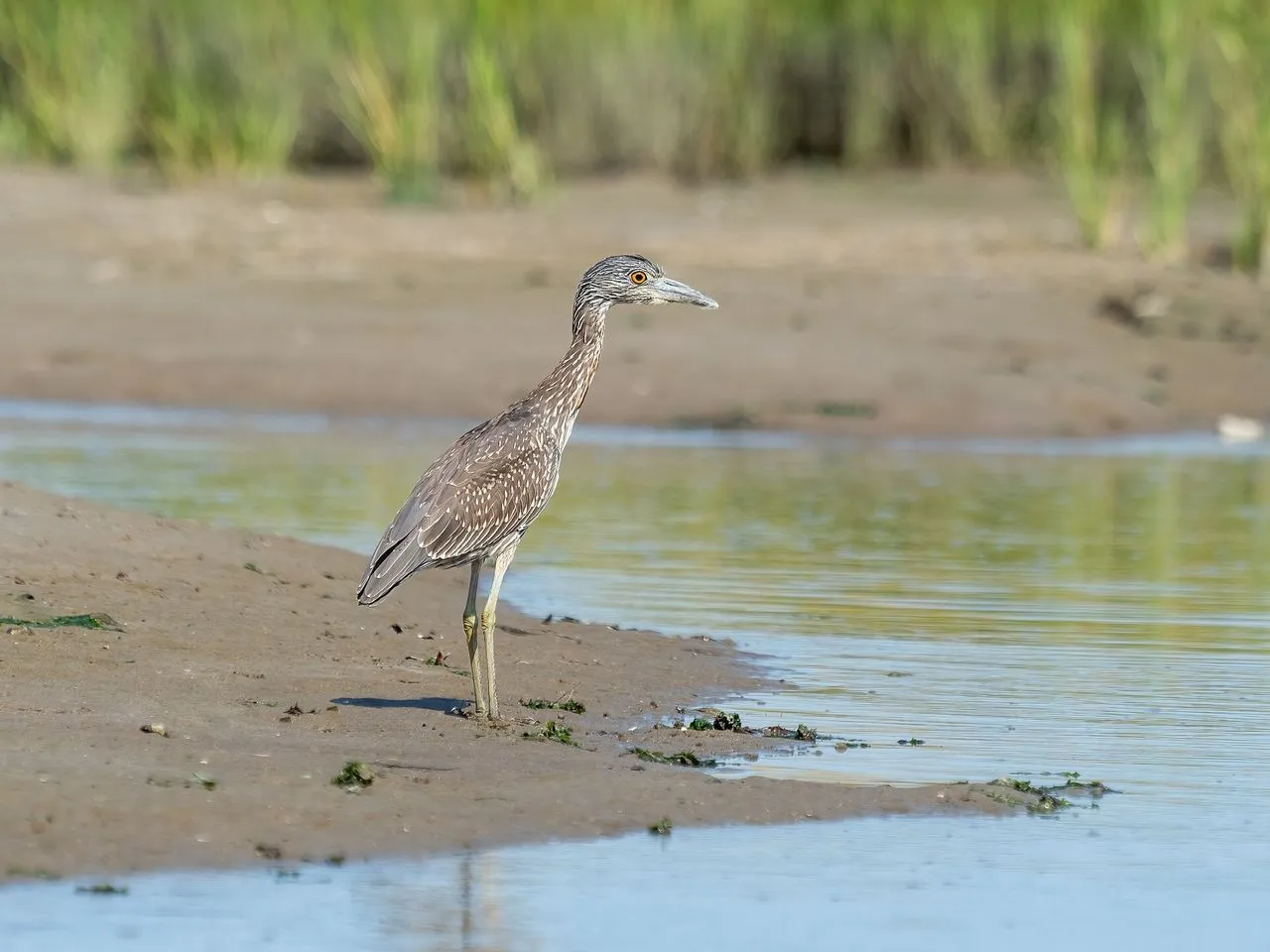
Nyctanassa violacea (Linnaeus, 1758), the Yellow-crowned Night-Heron, is the night-heron most specialised for crabs, with a heavy bill and a coastal distribution shaped by fiddler crab and mangrove crab abundance.
Part of the Complete Waders & Herons Guide.
Identification at a glance
| Character | Yellow-crowned Night-Heron (Nyctanassa violacea) | Black-crowned Night-Heron (Nycticorax nycticorax) |
|---|---|---|
| Length | 55–70 cm (22–28 in) | 58–66 cm (23–26 in) |
| Adult head | Black with pale crown stripe and white cheek | Black crown and back |
| Adult body | Smooth grey | Grey wings; pale underparts |
| Juvenile | Greyer, smaller wing spots, longer-legged | Colder brown, heavier white spotting |
| Feeding | Crabs and crayfish prominent | Broad fish, frogs, insects, eggs, carrion |
Identification
Visual
Adults are 55–70 cm, stocky but longer-legged and more attenuated than Black-crowned Night-Heron. The body is smooth grey, the head is black with a pale yellow to cream crown stripe, and a bold white cheek patch sits below the eye. The eye is red. The bill is thick, dark, and heavy, suited to crab handling. Legs are yellowish to orange, becoming brighter in breeding condition.
Juveniles are brown and streaked, resembling juvenile Black-crowned Night-Herons. Yellow-crowned juveniles tend to be greyer, with smaller white spots on the wing coverts, a longer-legged stance, and a heavier all-dark bill. The head can look blockier. Separation is not always safe from a brief view; habitat and behaviour help, especially if the bird is working crab burrows on a saltmarsh.
In flight adults show broad grey wings and a relatively long-legged profile for a night-heron. The neck remains retracted, confirming it as an ardeid.
Audio
Calls include a harsh quawk or wok, similar in general character to Black-crowned Night-Heron but often sharper. Colony birds give croaks and clucks. As with most night-herons, the flight call at dusk is useful but not always diagnostic without context.
Distribution
The species breeds along the Atlantic and Gulf coasts of the United States, inland along major river systems in the Southeast and lower Midwest, through the Caribbean, Mexico, Central America, and into northern South America. It has expanded northward in parts of the eastern United States during the 20th century, with breeding now regular in some urban and suburban areas beyond its former core.
Northern populations migrate southward in winter. Coastal southeastern populations may be resident or partially migratory. Distribution follows crab availability more closely than generic wetland abundance.
Habitat
Yellow-crowned Night-Herons use saltmarshes, mangroves, tidal creeks, wooded swamps, river floodplains, and urban streams where crayfish or crabs are abundant. Along coasts they are strongly associated with fiddler crab flats and mangrove edges. Inland birds often feed on crayfish in wooded wetlands and drainage channels.
Day roosts may be in trees near feeding areas. The species is more likely than Black-crowned Night-Heron to forage in daylight, especially when tides expose crab flats. A bird walking deliberately across a low-tide marsh at noon is not unusual.
Diet and Foraging
Crabs dominate the diet in many coastal populations. Fiddler crabs are taken from burrow entrances or open mud; mangrove crabs, marsh crabs, crayfish, insects, fish, frogs, and small reptiles are also eaten. The heavy bill is used to seize, crush, and manipulate hard-bodied prey.
Foraging is deliberate. The bird watches burrow fields, steps slowly, then lunges downward. Captured crabs may be shaken, battered, or repositioned before swallowing. Legs and claws can be removed or broken during handling. This is visually distinct from the fish-striking behaviour of Great Egret and from the tactile probing of ibises.
Tides matter. Falling and low tides expose crab activity and concentrate feeding. In urban areas, birds may patrol creek walls, culverts, and lawns where land crabs or crayfish emerge after rain.
Breeding Biology
Yellow-crowned Night-Herons nest singly or colonially. Colonies may be small and loose, sometimes within broader mixed heronries. Nest sites are in trees, shrubs, mangroves, or occasionally on human structures, usually near wetlands but not always directly over water.
The nest is a stick platform. Clutch size is usually three to five eggs. Incubation lasts about 24–25 days, shared by both sexes. Young are fed by regurgitation and leave the nest area gradually as they develop. Fledging occurs around six weeks.
Pairs may reuse nesting areas in successive years. In suburban settings, nests in street trees or yards create predictable conflicts: the birds are legally protected, but guano, noise, and fallen prey remains make colonies conspicuous.
Notes
The species' face pattern is one of the cleanest adult heron identifications in North America: black head, pale crown stripe, white cheek, red eye. The difficulty lies with juveniles, where structure and habitat must be weighed carefully.
Its crab specialisation is strong enough that changes in marsh hydrology affecting fiddler crab populations can affect heron foraging success. A saltmarsh can look intact to a casual observer while losing the prey base that makes it useful to N. violacea.
The bird is often easier to study than its name implies. Many individuals feed in full daylight when low tide exposes crabs, standing almost motionless beside burrow fields before making a short, forceful strike. That behaviour separates it from the more nocturnal stereotype attached to night-herons as a group.
Inland records should be checked against crayfish habitat. A Yellow-crowned Night-Heron along a wooded creek in Tennessee or Missouri is not necessarily lost; it may be using the same crustacean-based feeding niche expressed with freshwater prey.
For ageing juveniles, photographs should include the folded wing, bill depth, and leg length. A written note saying "brown night-heron" is rarely enough in areas where both night-herons occur.
The adult's pale crown can look white in hard sun and yellow-buff in soft evening light; the full face pattern is safer than crown colour alone.
See Also
Frequently Asked Questions
How do I tell an adult Yellow-crowned from a Black-crowned Night-Heron?
Yellow-crowned shows a black head with a pale yellow crown stripe and bold white cheek patch, smooth grey body, and yellow-orange legs. Black-crowned has a solid black crown and back, grey wings, pale underparts, and yellow-green legs. Yellow-crowned is also slightly longer-legged and more attenuated.
Why is the Yellow-crowned called a crab specialist?
Crabs dominate the diet in many coastal populations. Fiddler crabs are taken from burrow entrances, and mangrove crabs, marsh crabs, and crayfish are also eaten. The heavy bill is used to seize, crush, and manipulate hard-bodied prey. Distribution closely tracks crab availability rather than generic wetland abundance.
Are Yellow-crowned Night-Herons strictly nocturnal?
No. The species is more diurnal than the name implies, especially when tides expose crab flats. A bird walking deliberately across a low-tide marsh at noon is not unusual. Day roosts may still be used in trees near feeding areas, but feeding shifts to follow tide and prey activity.
Where do Yellow-crowned Night-Herons nest?
Singly or in small loose colonies, sometimes within broader mixed heronries. Nest sites are in trees, shrubs, mangroves, or occasionally on human structures, usually near wetlands but not always over water. Clutch size is three to five eggs incubated 24–25 days. Suburban nests in street trees can create conflicts despite legal protection.
Sources & References
- Cornell Lab of Ornithology. (2024). All About Birds: Yellow-crowned Night-Heron. birds.cornell.edu
- Sibley, D.A. (2014). The Sibley Guide to Birds (2nd ed.). Knopf.
- Watts, B.D. (2011). Yellow-crowned Night-Heron (Nyctanassa violacea). Birds of North America Online, Cornell Lab of Ornithology.
- Kushlan, J.A. & Hancock, J.A. (2005). The Herons. Oxford University Press.