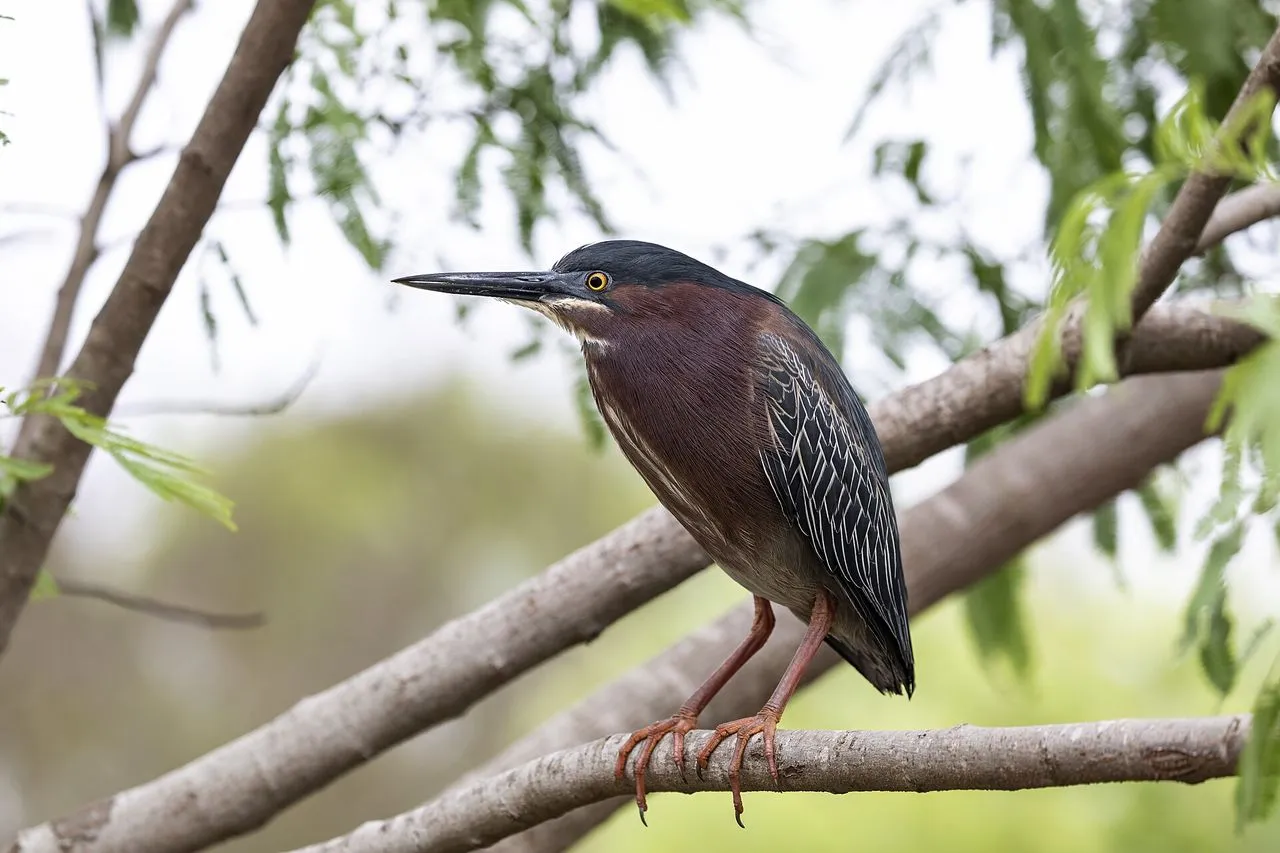
Butorides virescens (Linnaeus, 1758), the Green Heron, is among the small minority of birds repeatedly documented using bait: individuals drop insects, feathers, bread, or small floating objects onto the water surface and strike fish that approach the item.
Part of the Complete Waders & Herons Guide.
Identification at a glance
| Character | Green Heron (Butorides virescens) | Least Bittern (Ixobrychus exilis) |
|---|---|---|
| Length | 41–46 cm (16–18 in) | 28–36 cm (11–14 in) |
| Adult upperparts | Glossy green-black cap; dark green back | Male black crown and back; female browner |
| Neck and body | Chestnut neck sides; compact heron build | Buff neck and narrow reed body |
| Typical perch | Low branch, log, or shaded edge | Cattail and bulrush stems |
| Flight | Low, direct, usually 20–80 m (65–260 ft) | Low, weak, dropping into reeds |
Identification
Visual
At 41–46 cm, B. virescens is a compact, short-legged heron, often looking almost neckless until it extends the cervical S-curve during an alert posture or strike. Adult birds show a glossy green-black cap, dark green upperparts with a bluish sheen, and chestnut sides to the neck. The throat has a pale central stripe, and the underparts are greyish. Legs are orange-yellow in breeding condition and duller yellow-green outside it. The bill is long relative to the head, dark above and yellowish at the base of the lower mandible.
Juveniles are browner, heavily streaked on the throat, breast, and wing coverts, with buff-edged feathers that give the upperparts a scaled appearance. They lack the adult's saturated chestnut neck and glossy cap. A juvenile standing in shade along a pond margin can resemble a small bittern, but the heavier heron bill, greenish upperwing, and habit of perching horizontally on branches are useful separators.
In flight the Green Heron appears broad-winged and blunt-tailed, with the neck tucked tightly. The flight is usually low, direct, and short: a bird flushed from a creek edge often travels only 20–80 metres before dropping into cover again.
Audio
The common call is a sharp, descending skeow or kyow, frequently given when flushed. Around nesting sites a series of harsher kuk-kuk-kuk notes may be heard. The species is not continuously vocal; many backyard records begin with the call of a bird leaving before the observer has seen it.
Distribution
The Green Heron breeds across the eastern and central United States, locally westward through suitable riparian habitat, and south through Mexico, Central America, and the Caribbean into northern South America. Northern populations are migratory, wintering from the southern United States southward; birds in Florida, the Caribbean, and much of Middle America are resident.
The species remains widespread but is more easily overlooked than genuinely scarce. Breeding Bird Survey data have suggested regional declines in parts of North America since the late 20th century, plausibly linked to wetland drainage, channelisation of small streams, and loss of wooded pond margins. It benefits from small artificial wetlands when those sites retain vegetated edges rather than mown banks.
Habitat
This is a bird of edges: wooded ponds, oxbows, sluggish streams, mangrove margins, swamp forest openings, irrigation ditches, and suburban retention basins with overhanging shrubs. It rarely forages in the open expanses favoured by Great Egrets or Snowy Egrets. A typical hunting station is a low branch, log, exposed root, culvert lip, or shaded mud shelf within striking distance of water less than 20 cm deep.
The species tolerates human presence if cover remains intact. Backyard ponds with fish, emergent vegetation, and nearby shrubs may hold a Green Heron for weeks in summer. Remove the shrubs and trim the edge to turf, and the same pond becomes much less useful.
Diet and Foraging
Green Herons are sit-and-wait predators at small scale. Fish dominate many diets, but crayfish, dragonfly larvae, tadpoles, frogs, aquatic beetles, grasshoppers, small snakes, and occasionally nestling birds are taken. The bird usually crouches with the body nearly horizontal, head withdrawn, and bill angled toward the water surface. The strike is a rapid extension of the folded neck rather than a full-body chase.
Tool use deserves precision. The bird does not make tools; it uses bait. Documented objects include live insects, dead insects, earthworms, bits of bread, feathers, and plant fragments. Some objects are edible in themselves, which complicates interpretation, but repeated dropping, retrieval, and repositioning of the same item before a fish strike strongly supports intentional baiting in at least some individuals. The behaviour is locally frequent but not universal. A Green Heron that never baits is still behaving normally.
Compared with the slow-stalking Great Blue Heron, B. virescens spends more time on fixed perches and uses shorter strike distances. It is a precision hunter in cluttered margins, not an open-marsh walker.
Breeding Biology
Green Herons breed solitarily or in loose colonies. The nest is a shallow platform of sticks, usually 1–10 metres above ground or water in a shrub, small tree, mangrove, or vine tangle. Males begin nest construction and display with crest raised, neck extended, and wing-flicking postures. Both sexes complete the nest.
Clutch size is usually three to five pale green-blue eggs. Incubation lasts about 19–21 days and is shared by both adults. Young climb around the nest branches before they fly and may leave the immediate nest cup at roughly two weeks, a behaviour that leads many observers to assume they have fallen. Fledging follows at about 30–35 days. In southern parts of the range, two broods may be attempted in a favourable season.
Notes
The Green Heron is one of the best waders for careful backyard observation because its behaviour occurs at human scale. A large heron in open water can be watched from 200 metres; a Green Heron at a pond edge rewards ten minutes at 12 metres. The useful field mark is often posture rather than colour: crouched, horizontal, compact, and apparently too small to be a heron until the neck extends.
It was formerly treated with the Striated Heron (Butorides striata) as a single species, the Green-backed Heron. Most modern lists separate them. Hybridisation and close similarity in some regions explain the historical treatment, but North American field identification is not usually affected.
See Also
Frequently Asked Questions
Do Green Herons really use tools?
They use bait rather than tools they manufacture. Individuals have been documented dropping insects, earthworms, feathers, bread, and plant fragments onto water and striking fish that approach. Repeated dropping, retrieval, and repositioning of inedible items strongly supports intentional baiting. The behaviour is locally frequent but not universal; many Green Herons never bait.
Where do Green Herons hunt?
At edges: wooded ponds, oxbows, sluggish streams, mangrove margins, swamp forest openings, irrigation ditches, and suburban retention basins with overhanging shrubs. Typical hunting stations are low branches, logs, exposed roots, or shaded mud shelves within striking distance of water less than 20 cm deep.
How do I identify a juvenile Green Heron?
Juveniles are browner overall, heavily streaked on the throat, breast, and wing coverts, with buff-edged feathers giving a scaled appearance. They lack the saturated chestnut neck and glossy cap of adults. A juvenile in shade can resemble a small bittern, but the heavier heron bill and horizontal perched posture separate it.
What is the difference between Green Heron and Striated Heron?
The two were formerly treated as a single species, the Green-backed Heron. Most modern lists separate them. The Green Heron (B. virescens) is the North American form; Striated Heron (B. striata) replaces it through much of the Neotropics, Africa, Asia, and Australia. Hybridisation occurs in some contact areas.
Sources & References
- Cornell Lab of Ornithology. (2024). All About Birds: Green Heron. birds.cornell.edu
- Sibley, D.A. (2014). The Sibley Guide to Birds (2nd ed.). Knopf.
- Davis, W.E. & Kushlan, J.A. (1994). Green Heron (Butorides virescens). Birds of North America Online, Cornell Lab of Ornithology.
- Kushlan, J.A. & Hancock, J.A. (2005). The Herons. Oxford University Press.