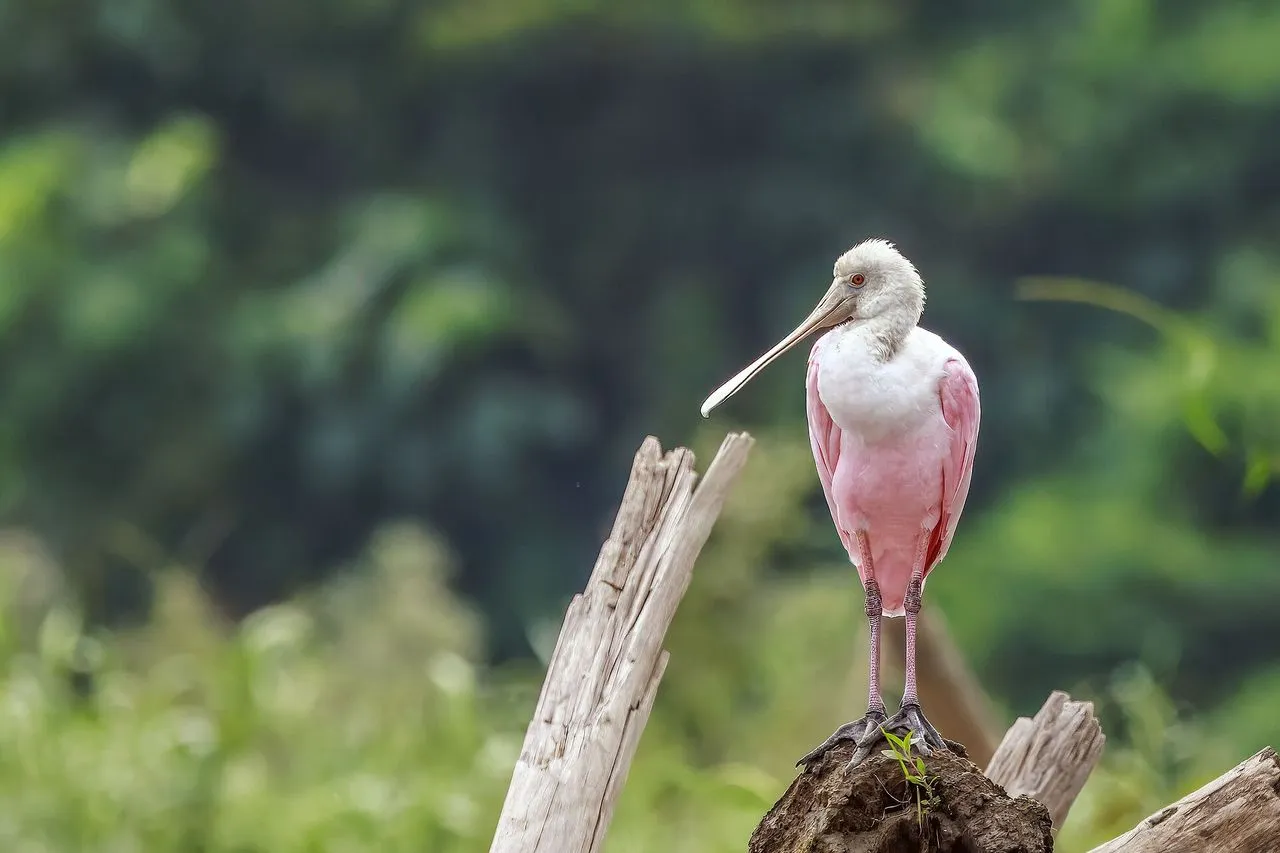
Platalea ajaja (Linnaeus, 1758), the Roseate Spoonbill, owes its pink plumage to carotenoid pigments acquired from aquatic prey, especially crustaceans, rather than to any inherent feather dye independent of diet.
Part of the Complete Waders & Herons Guide.
Identification at a glance
| Character | Roseate Spoonbill (Platalea ajaja) | White Ibis (Eudocimus albus) |
|---|---|---|
| Length | 71–86 cm (28–34 in) | 56–71 cm (22–28 in) |
| Adult body | Pink, brighter on wing coverts | White with black wingtips |
| Bill | Long, flattened, spatulate | Long, red-orange, decurved |
| Juvenile | Pale, feathered head, paler bill | Brown above, white below |
| Feeding | Side-to-side tactile sweeping | Tactile probing in mud or turf |
Identification
Visual
Adults are 71–86 cm, pale to saturated pink, with brighter carmine wing coverts and an orange or buff tail wash in strong plumage. The head is bare and greenish to greyish, the eye is red, and the bill is long, flattened, and expanded into a spatulate tip. Legs are reddish to pink. No other North American wader combines pink plumage with a spoon-shaped bill.
Juveniles are much paler, often nearly white with a faint pink wash. The head is feathered rather than bare, and the bill is smoother and paler. Immatures gradually acquire stronger pink colour as diet and age change plumage pigment deposition.
In flight, spoonbills hold the neck extended like ibises, not folded like herons. The body can look front-heavy because of the bill. Flocks often fly in lines or loose diagonals with steady wingbeats.
Audio
Roseate Spoonbills are generally quiet. At colonies they give low grunts, bill clacks, and harsh contact sounds. Feeding birds may produce soft mechanical bill noises as the mandibles close on prey. Voice is rarely needed for identification.
Distribution
The species occurs along the Gulf Coast of the United States, in Florida, coastal Texas and Louisiana, through Mexico, Central America, the Caribbean, and much of South America east of the Andes. In the United States, the core range is Florida and the Gulf Coast, with post-breeding wanderers increasingly recorded northward and inland.
Roseate Spoonbills were heavily reduced in the United States by plume and egg collecting in the 19th century. Protection allowed recovery, particularly in Florida and Texas. Northward records have increased in recent decades, likely reflecting population growth, dispersal, wetland management, and climate-related changes in winter survival and prey availability.
Habitat
Spoonbills use shallow coastal and inland wetlands: mangrove lagoons, saltmarsh pools, tidal creeks, mudflats, brackish impoundments, freshwater marshes, and flooded fields. The essential condition is shallow water with dense small prey. Depths of 5–20 cm are typical for feeding.
Nesting occurs in mangroves, shrubs, and low trees, usually on islands or over water. In Florida Bay and coastal Texas, colony placement is closely tied to predator access and water conditions.
Diet and Foraging
The bill is a tactile sweeping device. The bird walks through shallow water with the bill partly open and submerged, sweeping it side to side. When small fish, shrimp, aquatic insects, or crustaceans touch the sensitive inner bill surfaces, the mandibles snap shut. This is often called filter-feeding, but it is more accurately tactile sweeping; the bird is not sieving plankton continuously like a baleen whale.
Prey includes killifish, minnows, shrimp, small crabs, crayfish, aquatic beetles, and other invertebrates. Carotenoids from crustaceans and other prey contribute to pink feather colour. Captive birds deprived of pigment-rich diets become paler unless supplemented.
Foraging is often social. Groups sweep in parallel, sometimes driving prey ahead through shallow pools. Individuals may also feed alone along mangrove edges. The side-to-side head motion is diagnostic even when colour is washed out by glare.
Breeding Biology
Roseate Spoonbills nest colonially, frequently with ibises, herons, egrets, and cormorants. Nests are bulky stick platforms placed in mangroves, shrubs, or trees. Courtship includes twig presentation, mutual preening, bill clapping, and display of the coloured wing and tail areas.
Clutch size is usually two to three eggs, whitish with brown markings. Incubation lasts about 22–24 days, shared by both sexes. Chicks hatch with pale down and relatively normal-looking bills; the spoon shape develops as they grow. Young are fed by regurgitation and fledge after roughly six to seven weeks.
Breeding success depends on stable colony islands and productive shallow feeding areas within commuting distance. Disturbance, raccoon access, and sudden hydrological changes can reduce productivity sharply.
Notes
The hat trade affected spoonbills as it affected egrets, though the desired material differed: coloured wings, plumes, and whole skins were used ornamentally. Egg collecting and shooting compounded the losses. By the early 20th century, United States populations were greatly reduced. Legal protection and colony management reversed the decline.
The species is sometimes mistaken for a flamingo by the public. The correction is straightforward: flamingos have strongly kinked filter bills, very long necks, and in North America are rare and local outside escapes; spoonbills have a spatulate bill, shorter neck, and regular Gulf and Florida distribution.
Colour intensity should not be used as a simple age measure without caution. Diet, feather wear, moult timing, and light all affect apparent saturation. The bare or feathered head, bill development, and wing-covert colour give a firmer ageing basis than whether the bird looks "pink enough."
For conservation monitoring, nesting colony location matters as much as adult abundance. Spoonbills may feed widely and conspicuously, yet depend on a small number of predator-resistant islands. Loss of one colony island can remove productivity from a much larger visible foraging population.
The spatulate bill is already apparent on large chicks, but the exaggerated adult shape and full tactile feeding efficiency develop as the young bird matures.
See Also
Frequently Asked Questions
Why are Roseate Spoonbills pink?
Their colour comes from carotenoid pigments acquired through diet, especially crustaceans like shrimp and small crabs. Captive birds deprived of pigment-rich diets become paler unless supplemented. Colour saturation also varies with feather wear, moult timing, and light, so intensity is not a simple age indicator.
How does a spoonbill use its bill?
The bill is a tactile sweeping device. The bird walks through shallow 5–20 cm water with the bill partly open and submerged, sweeping it side to side. When small fish, shrimp, or crustaceans touch the sensitive inner surfaces, the mandibles snap shut. This is tactile sweeping, not continuous filter-feeding.
Are Roseate Spoonbills flamingos?
No. Flamingos have strongly kinked filter bills, very long necks, and in North America are rare and local outside escapes. Spoonbills have a spatulate bill, shorter neck, and regular Gulf Coast and Florida distribution. They are members of family Threskiornithidae alongside ibises, not flamingos.
Where do Roseate Spoonbills nest?
Colonially in mangroves, shrubs, and low trees, usually on islands or over water to deter raccoons and other predators. Clutch size is two to three whitish eggs with brown markings; incubation lasts 22–24 days. Chicks hatch with relatively normal-looking bills; the spoon shape develops as they grow. Fledging takes about six to seven weeks.
Sources & References
- Cornell Lab of Ornithology. (2024). All About Birds: Roseate Spoonbill. birds.cornell.edu
- Sibley, D.A. (2014). The Sibley Guide to Birds (2nd ed.). Knopf.
- Dumas, J.V. (2000). Roseate Spoonbill (Platalea ajaja). Birds of North America Online, Cornell Lab of Ornithology.
- Ehrlich, P.R., Dobkin, D.S. & Wheye, D. (1988). The Birders Handbook. Simon & Schuster.