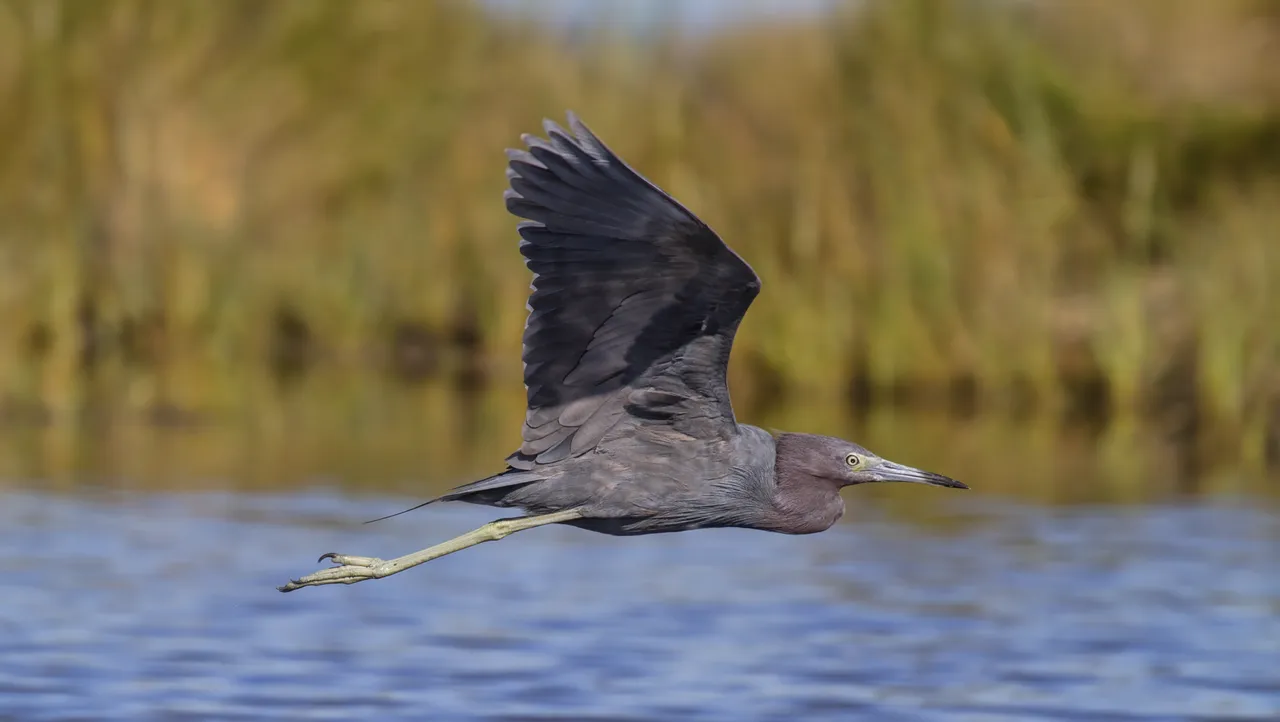
Egretta caerulea (Linnaeus, 1758), the Little Blue Heron, is unusual among North American herons because its juveniles are white for much of the first year while adults are dark slate-blue with a purplish head and neck.
Part of the Complete Waders & Herons Guide.
Identification at a glance
| Character | Little Blue Heron (Egretta caerulea) | Snowy Egret (Egretta thula) | Tricolored Heron (Egretta tricolor) |
|---|---|---|---|
| Length | 56–61 cm (22–24 in) | 56–66 cm (22–26 in) | 56–66 cm (22–26 in) |
| Adult body | Slate-blue; purplish head and neck | Entirely white | Blue-grey above; white belly |
| Juvenile | White with grey-green legs and feet | White with black legs and yellow feet | Rufous-brown neck; white belly |
| Bill | Grey-blue base, dark tip | Uniformly black and slender | Dark tip, yellowish base |
| Foraging | Deliberate slow-stalking | Active foot-stirring | Active-stalking and pivoting |
Identification
Visual
Adults measure 56–61 cm. The body is dark slate-blue to blue-grey, and the head and neck are maroon-purple, most saturated in breeding birds. The bill is grey-blue at the base with a dark tip, thicker and slightly drooped compared with the needle-like bill of a Snowy Egret. Legs and feet are greenish-grey, sometimes darker in stained marsh water. Breeding adults may show elongated head and neck plumes, but the colour pattern, not the plume structure, is the practical field mark.
Juveniles are white. This is the source of most identification errors. A first-year Little Blue Heron lacks the black legs and yellow feet of Snowy Egret. Its legs are greenish, its feet are not bright yellow, and its bill is pale blue-grey basally with a dark terminal third. During the transition to adult plumage the bird becomes pied: white body feathers mixed with irregular blue-grey patches. These calico birds are diagnostic when seen well.
In flight the neck is folded and the wings look broader than those of a Snowy Egret. Adult birds appear uniformly dark at distance; Tricolored Heron shows a white belly and a thinner, more attenuated structure.
Audio
Little Blue Herons are usually quiet away from colonies. Calls include a harsh raak or aak, given in flight or disturbance, and lower croaking notes at nesting sites. Vocalisations are less useful for field detection than plumage and foraging posture.
Distribution
The species breeds from the southeastern United States north along the Atlantic coastal plain into the Mid-Atlantic, west along the Gulf Coast, and locally inland through major wetland systems. It extends through the Caribbean, Mexico, Central America, and much of northern and central South America. Northern breeders withdraw southward in winter; many birds winter from the Gulf Coast through the Neotropics.
Post-breeding dispersal is conspicuous. Juveniles and immatures wander north and inland in late summer, sometimes appearing at small ponds far from breeding colonies. Long-term trends in the United States have been uneven, with regional declines associated with wetland loss and hydrological alteration. The species is not globally threatened but is locally sensitive to colony disturbance.
Habitat
Little Blue Herons use freshwater, brackish, and saltwater wetlands: marsh pools, rice fields, mangrove edges, cypress swamps, tidal creeks, lagoons, and flooded pastures. They are most typical in shallow water with emergent vegetation or soft edges. Compared with Great Egret, the species uses smaller prey patches and denser cover; compared with Cattle Egret, it is much more tied to water.
In mixed heron assemblages, Little Blue Herons often occupy intermediate water depths. They may forage alone, in loose groups, or along the edge of larger mixed flocks where Snowy Egrets and ibises disturb prey.
Diet and Foraging
The diet includes small fish, frogs, tadpoles, crayfish, shrimp, aquatic insects, grasshoppers, and small lizards. The species uses slow-stalking and stand-and-wait foraging, usually with deliberate foot placement and fewer flamboyant movements than Snowy Egret. It may also follow other waders, taking prey flushed by their activity.
The white juvenile plumage has a proposed functional benefit: young birds may be tolerated more readily by Snowy Egrets in mixed feeding groups than dark juveniles would be. Experiments and field observations have suggested that white immature Little Blue Herons can approach feeding Snowy Egrets closely and benefit from prey disturbance. By the second year the bird is no longer dependent on that social advantage and transitions into adult plumage.
Foraging strikes are quick but usually short-range. The bird watches the substrate or water column, advances a step or two, pauses, and strikes downward. In shallow pools with concentrated prey it may become more active, but it does not habitually run with spread wings like a Snowy Egret.
Breeding Biology
Little Blue Herons nest colonially, often with Snowy Egrets, Great Egrets, Tricolored Herons, ibises, and night-herons. Nest sites are in shrubs or trees over water or on islands, generally 1–5 metres high but variable with vegetation structure. The nest is a stick platform, built mostly by the female from material supplied by the male.
Clutch size is commonly three to four pale blue-green eggs. Incubation lasts about 22–24 days, shared by both sexes. Young are fed by regurgitation and remain near the nest after leaving the cup, climbing through surrounding branches before sustained flight. Fledging usually occurs at roughly five to six weeks.
Breeding synchrony is loose in mixed colonies. In warm coastal wetlands, nesting may begin in late winter or early spring; farther north it is later. Colony success depends strongly on water levels. Dry access routes allow raccoons and other mammalian predators into colonies that are safer when surrounded by water.
Notes
The species is a useful test of whether an observer is identifying white waders by structure rather than by colour. A white juvenile Little Blue Heron is not an egret in plumage terms, and the leg-foot pattern settles the question: grey-green legs and feet, not black legs with yellow feet.
The adult's English name understates the bird. In good light the head and neck are not simply blue but a muted wine-purple, contrasting with the darker body. In flat light the same bird can look nearly charcoal. That variability is normal and explains many hesitant field notes.
See Also
Frequently Asked Questions
Why are juvenile Little Blue Herons white?
First-year birds remain white for much of the year and gradually become pied (white with blue-grey patches) before adult plumage. A proposed functional benefit is that white juveniles are tolerated more readily by Snowy Egrets in mixed feeding groups and may benefit from prey disturbance. By the second year the bird transitions to dark adult plumage.
How do I tell a white juvenile Little Blue Heron from a Snowy Egret?
Foot and bill colour. Snowy Egret has black legs and bright yellow feet; juvenile Little Blue Heron has greenish-grey legs and feet without the yellow contrast. The Snowy's bill is uniformly black and slender; the juvenile Little Blue's bill is thicker and shows a pale bluish-grey basal half with a darker tip.
How does the Little Blue Heron forage?
By slow-stalking and stand-and-wait foraging with deliberate foot placement and short-range strikes. It may also follow other waders to take prey flushed by their activity. The behaviour is less frenetic than Snowy Egret and lacks habitual foot-stirring or wing-spread running.
Where do Little Blue Herons breed?
In mixed colonies with Snowy Egrets, Great Egrets, Tricolored Herons, ibises, and night-herons. Nests are stick platforms 1–5 metres up in shrubs or trees over water or on islands. Clutch size is three to four pale blue-green eggs, incubated 22–24 days by both sexes. Colony success depends on water surrounding the site to deter mammalian predators.
Sources & References
- Cornell Lab of Ornithology. (2024). All About Birds: Little Blue Heron. birds.cornell.edu
- Sibley, D.A. (2014). The Sibley Guide to Birds (2nd ed.). Knopf.
- Rodgers, J.A. & Smith, H.T. (2012). Little Blue Heron (Egretta caerulea). Birds of North America Online, Cornell Lab of Ornithology.
- Kushlan, J.A. & Hancock, J.A. (2005). The Herons. Oxford University Press.