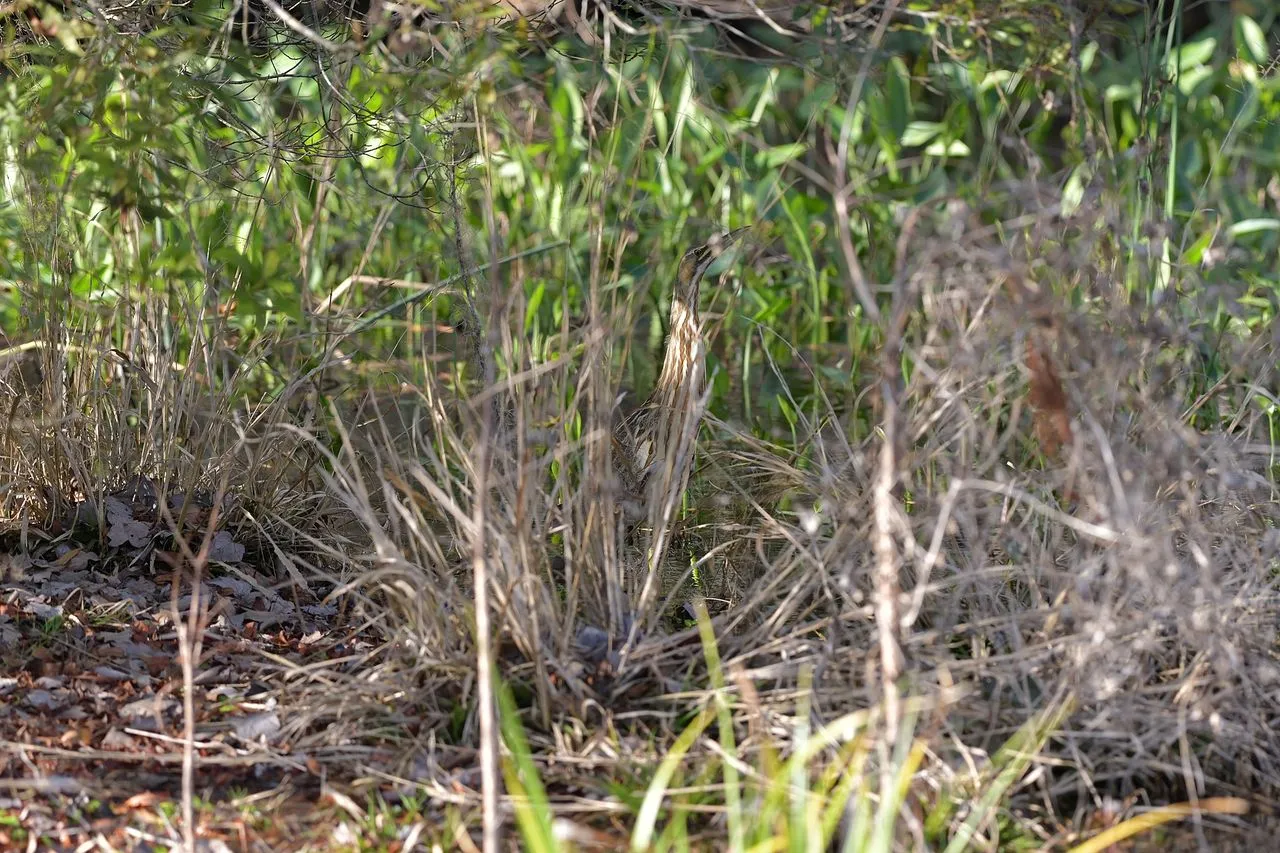
Botaurus lentiginosus (Rackett, 1813), the American Bittern, is a cryptic marsh heron whose resonant breeding call has been rendered as "pump-er-lunk" and can carry over a reed bed before dawn.
Part of the Complete Waders & Herons Guide.
Identification at a glance
| Character | American Bittern (Botaurus lentiginosus) | Least Bittern (Ixobrychus exilis) |
|---|---|---|
| Length | 60–85 cm (24–33 in) | 28–36 cm (11–14 in) |
| Build | Stocky, thick-bodied | Slim, laterally compressed |
| Neck pattern | Heavy vertical brown and buff streaking | Buff sides; less strongly streaked |
| Typical posture | Bill-up reed mimic | Reed-climbing and stem-bracing |
| Call | Deep oong-ka-chunk | Soft coo-coo-coo |
Identification
Visual
At 60–85 cm, the American Bittern is stocky, brown, and vertically streaked. The crown is dark, the throat is pale, and the neck has heavy brown and buff striping. A black stripe runs down each side of the neck, visible when the bird faces forward or stretches. The bill is straight and dagger-like. Legs are greenish-yellow but often hidden in vegetation.
The classic posture is the bittern freeze: body elongated, bill pointed upward, neck stripes aligned with surrounding reeds. The bird may sway slightly with wind-blown vegetation. This is not theatrical behaviour; it is camouflage functioning at close range. A bird two metres away in cattails can vanish if it stops moving.
Juveniles resemble adults but are generally warmer and more buff-toned with less sharply defined markings. In flight, the species looks broad-winged and somewhat owl-like, with the neck retracted and legs trailing. The upperwing shows warm brown tones; the flight is usually low over marsh vegetation.
Audio
The breeding call is the best detection method. Males produce a deep, gulping, pumping series, often written oong-ka-chunk or pump-er-lunk. The sound has a mechanical quality and may be heard at night, dawn, or dusk from April into June. When flushed, the bird may give a harsh kok or remain silent.
Distribution
American Bitterns breed across southern Canada and much of the northern United States, extending south locally where large marshes persist. They winter along the Pacific Coast, Gulf Coast, Atlantic coastal plain, Mexico, Central America, and the Caribbean.
The species has declined in many regions through loss and degradation of freshwater marsh. Drainage, reed-bed conversion, invasive plant changes, and water-level stabilisation all reduce suitability. It is listed as Least Concern globally but is a conservation concern in numerous states and provinces because local breeding populations are sparse and difficult to monitor.
Habitat
This is a bird of large emergent marshes: cattail, bulrush, sedge, reed, wet meadow, and shallow freshwater impoundments. It also uses brackish marshes in migration and winter. The ideal site contains dense cover interspersed with shallow openings where prey can be struck.
Small ornamental ponds do not substitute for marsh. The species needs concealment, nesting substrate, and enough wetland area to hold territories. Water depth is usually shallow, often less than 30 cm, but the presence of standing water through the breeding period matters.
Diet and Foraging
American Bitterns are ambush predators. They stand or move slowly through emergent vegetation, watching for fish, frogs, salamanders, crayfish, aquatic insects, small snakes, and occasionally small mammals. The strike is a rapid forward thrust of the bill, driven by the same ardeid neck mechanics used by larger herons.
Foraging is usually solitary. The bird works concealed edges rather than open mudflats. It may lean over small pools between cattail stems and hold a position for long periods. Prey is swallowed headfirst where possible. Frogs and fish are often repositioned with short bill tosses.
The visual system and behaviour are tuned to short-distance detection in clutter. A bittern is not inefficient because it remains still; stillness is the method. Movement risks detection by prey and predators alike.
Breeding Biology
Unlike many herons, American Bitterns are solitary nesters. Males advertise territories with the pumping call, and pairing systems may include polygyny in some populations. Nests are platforms of dead marsh vegetation, usually built over shallow water within dense cattail, sedge, or bulrush.
Clutch size is commonly three to five eggs, olive-buff to brownish. Incubation is performed primarily or entirely by the female and lasts about 24–28 days. Young are semi-altricial, downy, and remain in the nest initially, later moving through nearby vegetation before flight. Fledging timing is less conspicuous than in colonial herons because family groups are hidden.
Nest success depends on stable water levels. Flooding can destroy nests; drying can permit mammalian predators access. Large marsh complexes buffer these risks better than narrow ditch wetlands.
Notes
The American Bittern is more often heard than seen, and a heard-only record is often the most reliable survey evidence. Visual absence in suitable marsh means little unless surveys include dawn or dusk listening periods during the calling season.
Its resemblance to reeds is not general brownness but directional patterning. The vertical streaks, upward bill posture, compressed body, and swaying response align the bird with emergent stems. Few North American birds demonstrate the link between plumage and behaviour more clearly.
Survey technique matters. Playback can increase detection but should be used sparingly, especially where breeding density is low. Passive listening across several visits, including calm evenings, gives a better measure of occupancy than a single midday walk along a marsh edge.
In winter the species may appear in ditches, rice fields, or brackish marshes where cover is shorter than breeding habitat. Even then it usually selects the densest available edge, and most flushed birds drop back into vegetation within seconds rather than crossing open water.
See Also
Frequently Asked Questions
How do I identify an American Bittern in the field?
Look for a stocky 60–85 cm brown heron with heavy vertical brown and buff neck striping, a black stripe down each side of the neck, and the diagnostic bittern freeze posture with bill pointed straight up. The bird may sway to match wind-blown reeds. Listen for the pumping oong-ka-chunk call at dawn or dusk.
What is the American Bittern's pumping call?
Males produce a deep, gulping, mechanical pumping series, often written oong-ka-chunk or pump-er-lunk, audible at night, dawn, or dusk from April into June. Passive listening surveys are more reliable than visual searches in dense marsh.
What habitat do American Bitterns require?
Large emergent marshes with cattail, bulrush, sedge, or reed beds interspersed with shallow openings, usually less than 30 cm deep. Standing water through the breeding period is essential. Small ornamental ponds do not substitute for marsh, and the species avoids open mudflats.
Why has the American Bittern declined?
Drainage of freshwater marsh, reed-bed conversion, invasive plant changes, and water-level stabilisation all reduce suitable habitat. The species is globally Least Concern but listed as a conservation concern in many states and provinces because breeding populations are sparse and hard to monitor.
Sources & References
- Cornell Lab of Ornithology. (2024). All About Birds: American Bittern. birds.cornell.edu
- Sibley, D.A. (2014). The Sibley Guide to Birds (2nd ed.). Knopf.
- Ehrlich, P.R., Dobkin, D.S. & Wheye, D. (1988). The Birders Handbook. Simon & Schuster.
- Kushlan, J.A. & Hancock, J.A. (2005). The Herons. Oxford University Press.