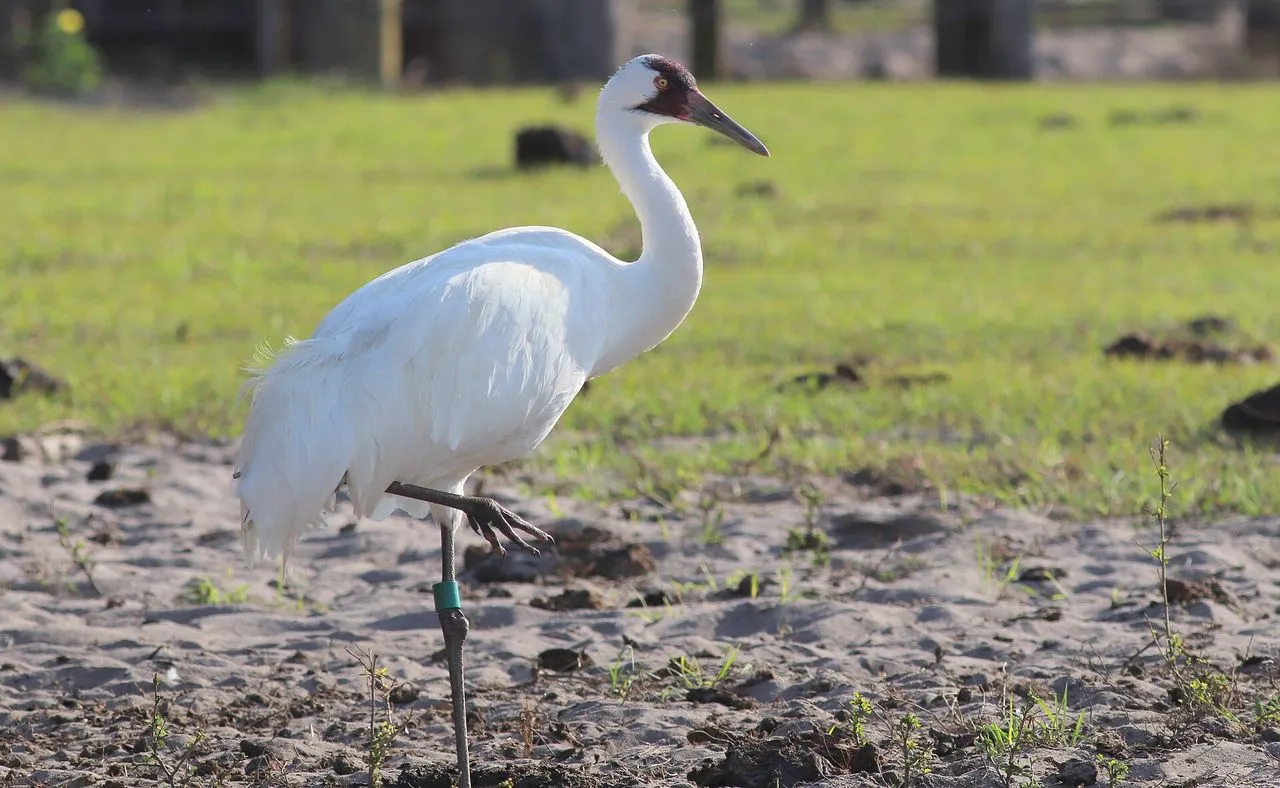
Wood Stork (Mycteria americana) is the only native stork in North America. Adults are large (83-115 cm) white waders with black flight feathers, a bare grey-black scaly head, and a massive curved black bill. The species feeds by touch rather than sight, snapping the bill shut on contact in roughly 25 milliseconds, one of the fastest reflexes in vertebrates. Range: southeastern US wetlands, especially Florida; expanding north as wetland restoration succeeds.
Mycteria americana (Linnaeus, 1758), the Wood Stork, is the only stork native to North America and the only member of family Ciconiidae that breeds on the continent.
Part of the Complete Waders & Herons Guide.
Identification at a glance
| Character | Wood Stork (Mycteria americana) | Great Blue Heron (Ardea herodias) | Great Egret (Ardea alba) |
|---|---|---|---|
| Length | 83–115 cm (33–45 in) | 97–137 cm (38–54 in) | 89–104 cm (35–41 in) |
| Weight | 2.0–3.0 kg | 2.1–3.6 kg | 0.9–1.1 kg |
| Wingspan | ~150 cm | 167–201 cm | 130–170 cm |
| Body colour | White; black flight feathers and tail | Blue-grey | Entirely white |
| Head | Bare, grey-black, scaly | Feathered, white with black stripe | Feathered, all white |
| Bill | Massive, decurved, black | Heavy, yellow | Yellow, slimmer |
| Flight neck posture | Extended | Folded S-curve | Folded S-curve |
| Feeding method | Tactile snap reflex | Visual, still-hunt/slow-stalk | Visual, still-hunt |
Identification
Visual
At 83 to 115 cm and 2.0 to 3.0 kg, the Wood Stork is a large, heavy-bodied wader. Body plumage is entirely white, contrasting sharply with black primary and secondary flight feathers and a black tail. At rest with wings folded, only the black trailing tips are visible; in flight the pattern is bold and diagnostic.
The single most distinctive feature is the head: bare, rough-textured, grey-black skin covering the entire head and neck, with no feathering at any age in adults. The skin has a coarsely scaly texture that gives the bird an unmistakably prehistoric appearance. No other regularly encountered North American wader lacks feathering to this extent. The bill is massive, heavy at the base, and distinctly decurved at the tip; it is entirely black. Legs are dark grey; the feet may show a faint pinkish or reddish flush during breeding.
In breeding condition the facial skin may intensify in tone but body plumage does not change. Eyes are dark brown.
Juvenile: First-year birds have a yellowish or pale yellow bill rather than the adult's black one. The head carries loose partial feathering initially, wearing away through the first two to three years as the bird approaches full adult plumage. In body pattern, juveniles closely resemble adults.
In Flight
The Wood Stork soars readily on thermals, a behaviour no heron shares. In the air it extends both neck and legs fully, producing a long-bodied, cross-shaped profile. This neck-extended posture immediately separates it from all Ardeidae: the Great Blue Heron and Great Egret both retract the neck into a folded S-curve in flight, giving a compact, hunched silhouette.
The combination of white body, bold black wing tips and tail, trailing legs, fully extended neck, and bald head is unmistakable in eastern North America. The Sandhill Crane also extends the neck in flight but is grey-bodied with a red forehead patch. White Ibis shows black wing tips but is much smaller and shorter-legged, with a curved orange-red bill.
Powered wingbeats are slow and deliberate. The species converts efficiently to soaring and can circle in thermals alongside vultures over warm wetlands, gaining altitude at low metabolic cost before gliding long distances to foraging sites.
Voice
The Wood Stork is nearly silent away from breeding colonies. At active nests, adults and chicks produce low grunts, hissing sounds, and bill-clattering: mechanical percussion rather than true vocalisation. Chick begging calls carry within the colony but do not project far. For a bird of this size, the species is conspicuously quiet in the field, which means a large white bird soaring silently overhead with bold black wing tips and a bare grey head is essentially self-identifying.
Distribution and Range
The core North American breeding range covers Florida, with additional colonies in Georgia and South Carolina and smaller numbers along the Gulf Coast of Mississippi, Alabama, and Texas. Florida holds the majority of the approximately 10,000 breeding pairs documented in the United States.
Outside the breeding season, birds disperse widely from natal colonies. Post-breeding wandering regularly extends into the Carolinas and further along the Atlantic coast, and range expansion northward has been documented over recent decades as wetland restoration increases available habitat. Rare individuals stray as far as the northern states.
Through the broader Western Hemisphere, Mycteria americana ranges from Mexico and Central America through the Caribbean and into South America, extending south to northern Argentina. The species is thus a bird of tropical and subtropical wetlands across much of the continent, with the North American population at the northern edge of a much larger range.
Habitat
Wood Storks use freshwater and brackish wetlands across their range, but the critical requirement is shallow water with seasonally declining levels that concentrate prey. Primary habitats in the southeastern US include cypress strands and cypress-tupelo swamp complexes, freshwater wet prairies, mangrove lagoon margins, flooded agricultural fields, and shallow impoundments.
The species forages in water from ankle to knee depth. It is less associated with open or deep water than the Great Blue Heron. Nesting colonies are placed in tall trees standing in or directly adjacent to water, most often bald cypress, pond cypress, or mangrove stands, where water access limits terrestrial predator approach.
Access to extensive shallow wetland within foraging range of the colony is a practical necessity for sustained breeding success. Adults provisioning large chicks may travel considerable distances to productive foraging sites, but proximity to suitable wetland reduces the energetic cost of each provisioning trip.
Tactile Feeding
The Wood Stork's most distinctive biological trait is its feeding method. Unlike herons, which hunt by sight and select individual prey items before striking, the Wood Stork uses a tactile snap reflex. It wades slowly through shallow water with the bill held open and partially submerged. When a fish or other prey contacts the inside of the bill, the mandibles close by reflex at approximately 25 milliseconds. This is among the fastest reflexes documented in any vertebrate and allows effective foraging in turbid water, low light, and dense aquatic vegetation where visual hunting would fail.
The critical implication of tactile feeding is strict dependence on prey concentration. The reflex can only be triggered by physical contact, so the bird requires enough prey in the water column that chance encounters accumulate at an energetically profitable rate. Seasonally declining water levels create this condition: as a freshwater wetland contracts through the dry season, fish (primarily sunfish, killifish, shiners, and similar small species) concentrate in the remaining shallow pools at densities that make tactile foraging viable.
Wood Storks time their breeding season entirely around this dry-season concentration peak. In Florida, nesting commonly begins in October or November so that the maximum-demand phase, large chicks requiring substantial daily food delivery, falls in February and March when dry-season water levels are at their lowest.
Altered hydrology breaks this synchrony. Water management structures that maintain artificially high water levels year-round prevent fish from concentrating, reducing foraging efficiency to the point where chick provisioning fails. Wetlands drained too rapidly or completely eliminate the prey base before chicks fledge. The rate and timing of the drawdown cycle, not merely the presence of wetland habitat, is the operative variable for breeding success.
Breeding
Wood Storks are colonial nesters, placing large stick platforms in the crowns of trees standing over or at the margin of water. Nests are substantial structures, sometimes exceeding 90 cm in diameter after additions across multiple breeding seasons, and are built and maintained by both adults. Preferred nest trees in the southeastern US are bald cypress, pond cypress, and mangrove.
Colony size ranges from a few dozen pairs to several thousand. Both adults share incubation and chick-provisioning. Clutch size is typically two to five eggs, with three being common. Incubation runs approximately 28 to 32 days. Chicks are altricial at hatching and require roughly 60 to 65 days of continuous provisioning before fledging.
The breeding season runs from October or November through April in Florida, structured entirely around the dry-season prey-concentration window described above. This timing is the inverse of most North American waterbirds, which breed in spring and summer. The early start places maximum chick food demand at the period of maximum natural fish concentration.
Conservation
The Wood Stork was listed as Endangered under the US Endangered Species Act in 1984. By that point, the North American breeding population had declined sharply from mid-20th-century levels, driven primarily by hydrological modification of Florida's wetlands through drainage, channelisation, and changes to water management in the Everglades system. Loss of the natural dry-season drawdown cycle removed the prey concentration conditions the species requires for productive breeding.
Recovery work focused on wetland restoration, improvement of water management timing in portions of the Everglades and surrounding systems, and protection of active colonies from disturbance. The 2014 downlisting to Threatened reflected genuine population improvement: approximately 10,000 breeding pairs were documented in the United States, spread across Florida, Georgia, and South Carolina.
The species remains Federally Threatened. Sustained recovery depends on continued management of wetland hydrology at landscape scale across the southeastern US. Because successful breeding requires not just the presence of wetland but the right seasonal water dynamics across large areas, the Wood Stork functions as a practical indicator of wetland system health. A colony that produces fledglings in a given season signals that dry-season water management in surrounding catchments is functioning close to the natural pattern.
The White Ibis, which shares many of the Wood Stork's Florida wetland habitats and also nests colonially in cypress and mangrove, provides useful ecological context for understanding the mixed colonial wading-bird assemblages of the region.
See Also
- The Complete Waders Guide: full taxonomy, hunting strategies, and habitat partitioning for North American wading birds.
- Great Blue Heron: visual hunter and slow-stalk specialist; neck-folded flight posture contrasts directly with the Wood Stork's extended neck.
- Great Egret: tall white heron with black legs and yellow bill; shares colonial nesting habits but hunts by sight.
- White Ibis: colonial Florida wetland wader; probing bill versus Wood Stork snap reflex in the same wetland assemblages.
- Sandhill Crane: also flies with neck extended; grey body and red forehead patch separate it from the Wood Stork at any distance.
Frequently Asked Questions
Is the Wood Stork a heron?
No. The Wood Stork belongs to family Ciconiidae (storks), not Ardeidae (herons). The clearest field difference is flight posture: storks extend the neck fully in flight, while herons retract it into an S-curve. Wood Storks also feed by touch rather than sight, snapping the bill shut on contact, a method no North American heron uses.
Why does the Wood Stork have a bald head?
The bare, scaly grey-black skin covering the adult's head and neck is a thermoregulation and hygiene adaptation common to large birds that probe regularly into warm, shallow water. Feathers on the head would become fouled with mud and fish during feeding; bare skin sheds debris more easily and allows more efficient heat dissipation in subtropical climates.
When is the best time to see Wood Storks?
December through March in Florida is the peak window. This coincides with the dry season, when falling water levels concentrate fish and active breeding colonies are in full operation. Large post-breeding aggregations also form at productive wetlands through summer. The species is a year-round Florida resident but disperses more widely after the breeding season.
What caused Wood Stork populations to recover?
The 2014 downlisting from Endangered to Threatened reflects improved water management timing in parts of the Everglades system, legal protection of active nesting colonies from disturbance, and broader wetland restoration across Florida, Georgia, and South Carolina. The species remains sensitive to hydrology: breeding success in any given year depends on water levels declining at the right rate during the dry season to concentrate fish when chicks are growing fastest.