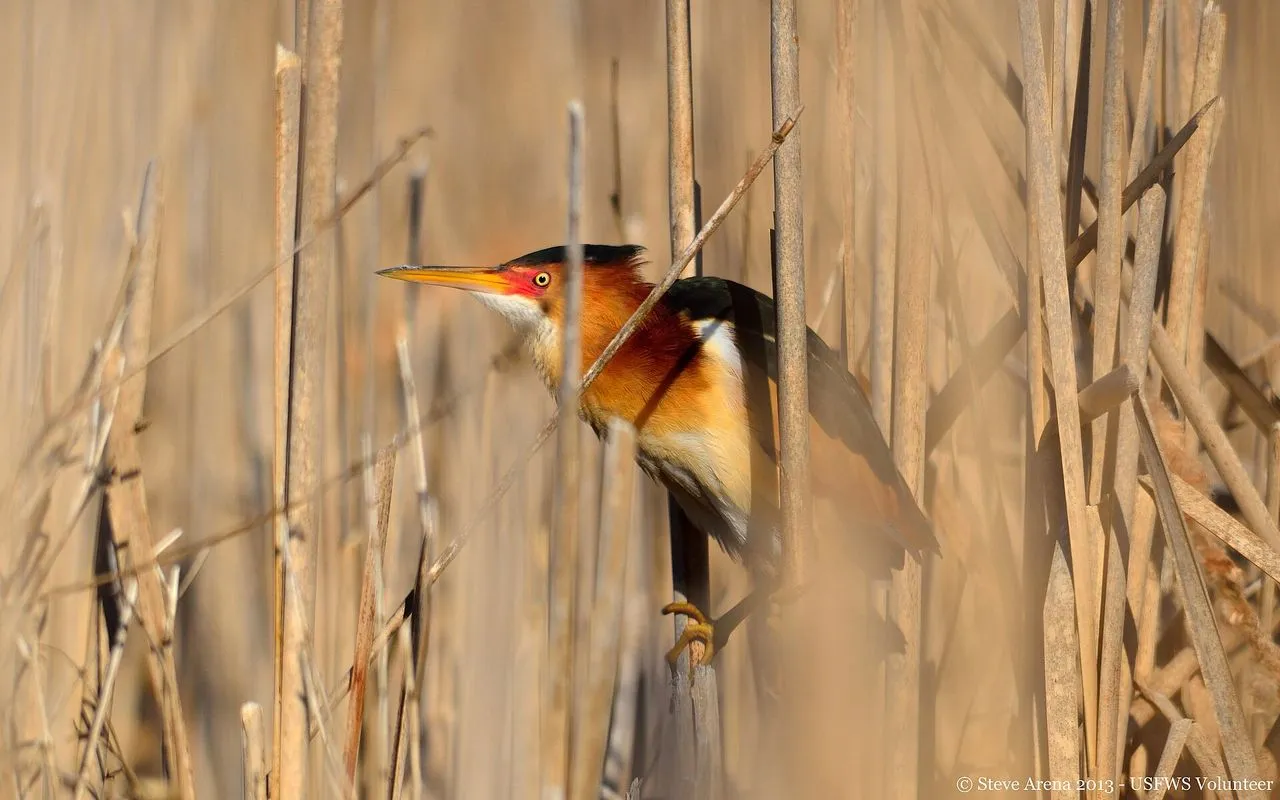
Ixobrychus exilis (Gmelin, 1789), the Least Bittern, is the smallest heron in the Americas, light enough to climb through reeds by grasping separate stems with its feet.
Part of the Complete Waders & Herons Guide.
Identification at a glance
| Character | Least Bittern (Ixobrychus exilis) | American Bittern (Botaurus lentiginosus) |
|---|---|---|
| Length | 28–36 cm (11–14 in) | 60–85 cm (24–33 in) |
| Build | Tiny, narrow, small-headed | Stocky, thick-bodied |
| Adult pattern | Buff wing patches; male black above | Heavy vertical brown and buff streaking |
| Marsh behaviour | Climbs and braces on separate stems | Freezes with bill pointed upward |
| Call | Soft coo-coo-coo or kak-kak-kak | Deep oong-ka-chunk |
Identification
Visual
At 28–36 cm, the Least Bittern is shorter than many rails and far smaller than the American Bittern. Adults are slim, laterally compressed marsh birds with a long pointed bill and short tail. Males have a glossy black to green-black crown and back, buff neck sides, and pale buff wing patches. Females are browner above, with a brown crown and back rather than black. Both sexes show warm buff underparts and a pale line down the throat.
Juveniles resemble females but are more streaked and mottled, with less clean contrast. The bird often appears in fragments: a bill between cattail stems, a buff wing panel, or a small shape sidling upward through vegetation. When it flies, it usually travels low and weakly over the marsh before dropping quickly back into cover.
The size alone separates it from American Bittern, but size is hard to judge in reeds. Structure helps: Least Bittern is narrow, small-headed, and agile; American Bittern is thick-bodied and vertically streaked.
Audio
The common breeding call is a low, repeated coo-coo-coo or kak-kak-kak, often given from dense vegetation. Calls are soft compared with the carrying pump of American Bittern, but they are still the best way to detect the species. Dawn, dusk, and calm humid mornings produce the highest detection rates.
Distribution
Least Bitterns breed across the eastern and central United States, locally in the West, through parts of southern Canada, Mexico, Central America, the Caribbean, and South America. Northern populations migrate to the southern United States, Mexico, Central America, and the Caribbean for winter.
The species is underdetected because standard roadside birding misses it. Population trends are difficult to estimate, but marsh loss has reduced breeding habitat in many regions. It is listed as Least Concern globally, while several states and provinces treat it as a species of concern or threatened at the local level.
Habitat
Least Bitterns require dense emergent vegetation interspersed with shallow water: cattail marsh, bulrush, sedge, reed beds, and vegetated impoundments. They favour edges within the marsh, including narrow channels, muskrat openings, and small pools hidden from open view.
They can occupy surprisingly small wetlands if structure is right, but broad cattail monocultures with no openings are less useful than mixed stands. Water usually needs to persist through nesting. Dry reed beds may provide cover but not feeding access.
Diet and Foraging
The diet includes small fish, tadpoles, frogs, aquatic insects, dragonfly larvae, small crayfish, and occasionally small snakes or leeches. Least Bitterns forage by climbing and bracing among vertical stems, then striking down into small openings. They also stand on floating vegetation mats or bent reeds.
The feet are critical. Long toes grasp stems on either side of the body, allowing the bird to suspend itself over water too deep for standing. This lets it exploit interior marsh pockets inaccessible to larger herons. The strike distance is short, usually less than the length of the neck.
Foraging is quiet and solitary. The bird may shift only a few metres in several minutes, making small adjustments through the stems. Observers who wait at a single marsh opening are often more successful than those who walk continuously.
Breeding Biology
Least Bitterns nest solitarily or semi-colonially where habitat is dense. The nest is a platform of marsh vegetation attached to live stems, usually 15–75 cm above water. Both sexes contribute, bending reeds and adding material until a small cup or platform forms.
Clutch size is usually four to five eggs, pale blue or greenish-white. Incubation lasts about 17–20 days and is shared by both parents. Young are covered in buff down and can climb from the nest before they can fly. This climbing ability is a defence against flooding and disturbance, but premature departure still increases mortality.
Multiple broods may occur in long southern seasons. Nesting success is vulnerable to rapid water changes, marsh cutting, and predator access during drawdowns.
Notes
The Least Bittern is a test of patience and habitat reading. If a marsh has cattails, shallow openings, and calling birds, the species may be common while remaining nearly invisible. A ten-minute scan is often inadequate.
Taxonomically it belongs to a group of small bitterns adapted to vertical marsh structure. Its body is compressed laterally, allowing movement through narrow reed gaps. That anatomy is as important as plumage in explaining why the bird is seen so rarely in the open.
Field records are strongest when they include behaviour and habitat. A brief glimpse of a tiny brown heron is useful, but a calling bird in cattail, a low fluttering flight between reed beds, or a bird climbing with each foot on a separate stem is much more diagnostic.
Least Bitterns also show why small wetlands should not be written off. A stormwater impoundment with the right emergent vegetation and stable water can support breeding, while a visually larger lake with clipped banks and no reed structure cannot.
See Also
Frequently Asked Questions
How small is a Least Bittern?
At 28–36 cm it is the smallest heron in the Americas, shorter than many rails and far smaller than the American Bittern. Its laterally compressed body allows movement through narrow reed gaps, and long toes grasp stems on either side so the bird can suspend itself over water too deep for standing.
How do I find a Least Bittern in dense marsh?
Listen during calm, humid mornings, dawn, and dusk for the soft repeated coo-coo-coo or kak-kak-kak from cattail or bulrush. Then wait at marsh openings rather than walking continuously. The species can be common in suitable habitat while remaining nearly invisible; a ten-minute scan is rarely enough.
How do Least Bitterns nest?
Solitarily or semi-colonially in dense emergent vegetation. The nest is a platform of marsh vegetation attached to live stems, usually 15–75 cm above water. Clutch size is four to five pale blue or greenish-white eggs, incubated 17–20 days by both parents. Young are covered in buff down and can climb from the nest before flying.
What separates Least Bittern from American Bittern?
Size and structure: Least Bittern is much smaller, narrower, and small-headed; American Bittern is thick-bodied with heavy vertical brown and buff neck streaking. Calls also differ: Least Bittern gives a soft coo-coo-coo, while American Bittern produces a deep, mechanical pumping oong-ka-chunk.
Sources & References
- Cornell Lab of Ornithology. (2024). All About Birds: Least Bittern. birds.cornell.edu
- Sibley, D.A. (2014). The Sibley Guide to Birds (2nd ed.). Knopf.
- Poole, A.F., Lowther, P., Gibbs, J.P., Reid, F.A. & Melvin, S.M. (2009). Least Bittern (Ixobrychus exilis). Birds of North America Online, Cornell Lab of Ornithology.
- Kushlan, J.A. & Hancock, J.A. (2005). The Herons. Oxford University Press.