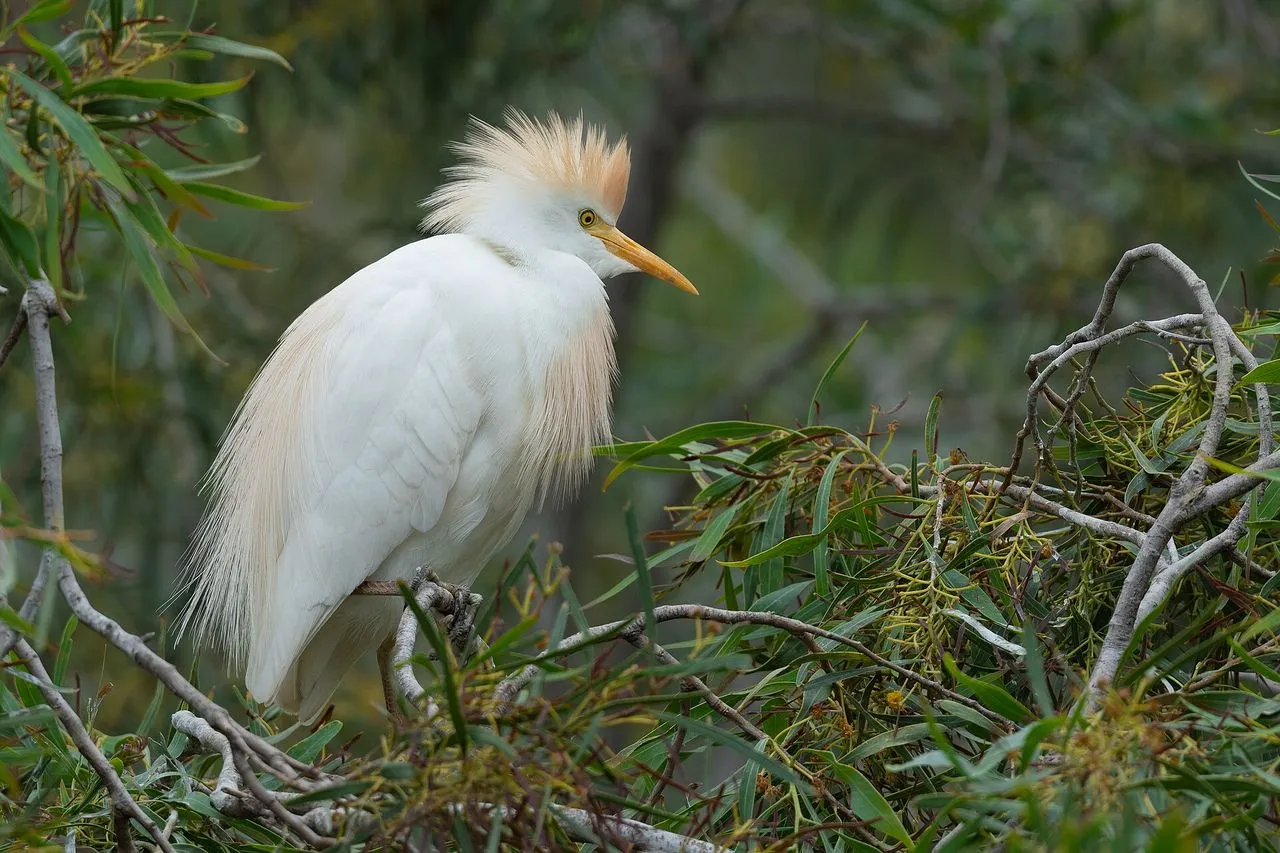
Bubulcus ibis (Linnaeus, 1758), the Cattle Egret, colonised the Americas naturally after crossing the Atlantic from Africa, becoming established in South America in the late 19th century and spreading through North America during the mid-20th century.
Part of the Complete Waders & Herons Guide.
Identification at a glance
| Character | Cattle Egret (Bubulcus ibis) | Great Egret (Ardea alba) | Snowy Egret (Egretta thula) |
|---|---|---|---|
| Length | 46–56 cm (18–22 in) | 89–104 cm (35–41 in) | 56–66 cm (22–26 in) |
| Bill | Yellow to orange-yellow | Yellow to yellow-orange | Black |
| Legs and feet | Yellow-green to orange | Black | Black legs; yellow feet |
| Neck and build | Short-necked, stocky | Long-necked, tall | Slim, medium-small |
| Typical foraging | Dry pasture and livestock | Shallow wetland margins | Active shallow-water foot-stirring |
Identification
Visual
At 46–56 cm, the Cattle Egret is shorter-necked, stockier, and more terrestrial than the white egrets with which beginners confuse it. The bill is yellow to orange-yellow, relatively short and stout. Legs are yellow-green outside breeding condition, becoming brighter orange or reddish in peak display. The neck is thick at the base and usually held retracted, producing a hunched profile.
Non-breeding adults are mostly white, sometimes with a faint buff wash on the crown or breast. Breeding adults develop buff-orange plumes on the crown, breast, and back. In intense breeding condition, the bill, lores, and legs can flush reddish-orange for a short period. Juveniles are white with a darkish bill initially, then acquire the yellow bill as they mature.
The ecological field mark is often more reliable than plumage: a white egret walking through dry pasture among cattle, horses, tractors, or mowing equipment is usually a Cattle Egret. Snowy Egret has a black bill and yellow feet; Great Egret is much taller and longer-necked with black legs.
Audio
Cattle Egrets are mostly quiet while feeding. At colonies they give harsh, nasal rick-rack and croaking calls. The voice is typical of a small ardeid colony bird: functional at close range, not a primary identification tool in open fields.
Distribution
The species is now nearly cosmopolitan across warm temperate and tropical regions. Its original Old World range centred on Africa, southern Europe, and parts of Asia. After natural arrival in northeastern South America, it expanded rapidly: breeding was recorded in Florida by the 1950s, and within decades the species occupied much of the southern and eastern United States.
The expansion was aided by deforestation, pasture creation, irrigated agriculture, and livestock husbandry. Unlike most herons, B. ibis did not require extensive marsh networks to colonise new landscapes. Northern populations disperse or withdraw in winter; birds remain year-round in the Gulf Coast, Florida, Caribbean, and much of Latin America.
Habitat
Cattle Egrets are waders by ancestry more than by daily behaviour. They use pastures, hayfields, roadsides, feedlots, burned grassland, sports fields, ploughed fields, and rubbish tips. Wetlands are used for nesting and roosting, but much foraging occurs on dry ground.
The key habitat feature is disturbance that exposes prey. Large mammals flush insects with their feet and grazing movements. Tractors, mowers, and fires do the same mechanically. The bird's association with cattle is therefore not sentimental or dependent on cattle specifically; cattle are simply mobile prey-flushers.
Diet and Foraging
Grasshoppers, crickets, flies, beetles, moths, spiders, frogs, small lizards, and occasionally small mammals form the diet. Around livestock the egret walks just ahead of or beside the animal's feet, striking at insects displaced from grass. Around tractors it may follow within metres of blades or tyres. The risk of injury is outweighed by dense prey availability.
This is active terrestrial foraging, not classic still-hunting. The bird advances steadily, head bobbing slightly, then jabs downward. It may run short distances after large insects. In breeding colonies and wetlands it also takes aquatic prey, but that is not the behaviour that explains its global success.
Cattle Egrets sometimes feed on ticks and flies directly from mammals, but the popular image of a bird cleaning cattle is incomplete. Most food is prey flushed by mammal movement rather than parasites picked from the animal.
Breeding Biology
Cattle Egrets nest colonially, often with other herons, egrets, ibises, and cormorants. Colonies are in trees, shrubs, reed beds, or mangroves, usually near water even when feeding occurs far away in fields. Nesting close to water reduces mammalian predator access and provides structural vegetation.
The nest is a stick platform. Clutch size is usually three to five eggs, pale blue-green. Incubation lasts about 22–26 days. Both adults incubate and feed young by regurgitation. Chicks are aggressive competitors within the brood; in poor food conditions, smaller young may die through starvation or direct sibling competition.
The species can breed at high density. In mixed colonies it often occupies lower or peripheral vegetation, though exact placement depends on local plant structure and arrival timing. Colony noise and guano load can be substantial, leading to conflicts when colonies form near houses or public facilities.
Notes
The Cattle Egret is one of the clearest examples of a bird exploiting anthropogenic habitat without being deliberately introduced. Its Atlantic crossing appears to have been natural, probably aided by winds and the species' capacity for long-distance dispersal. Its subsequent expansion was accelerated by human land conversion.
Taxonomy has shifted. Western Cattle Egret (Bubulcus ibis) and Eastern Cattle Egret (Bubulcus coromandus) are split by some authorities; North American birds are Western Cattle Egrets. The distinction rarely matters for field identification in the Americas, but it matters in global lists.
The species also illustrates why habitat labels can mislead. It is taxonomically a heron, often nests in wetland colonies, and still has the folded-neck flight of Ardeidae, yet its daily field ecology may be closer to that of a grassland insectivore than a pond-edge fish hunter.
See Also
Frequently Asked Questions
How do I distinguish a Cattle Egret from other white egrets?
Cattle Egret is short-necked, stocky, and terrestrial, with a yellow-orange bill and yellow-green legs. Snowy Egret has a black bill and yellow feet; Great Egret is much taller with a yellow bill and black legs. The strongest field mark is ecological: a white egret walking through dry pasture among cattle is almost always a Cattle Egret.
Why do Cattle Egrets follow livestock?
Cattle, horses, and other large mammals flush grasshoppers, crickets, flies, beetles, and other insects from grass as they graze and walk. The egret follows to strike at displaced prey. Tractors, mowers, and fires produce the same effect mechanically, so the association is with mobile prey-flushers rather than cattle specifically.
How did Cattle Egrets reach North America?
The species colonised the Americas naturally, crossing the Atlantic from Africa to northeastern South America in the late 19th century, likely aided by winds and long-distance dispersal capacity. It expanded rapidly through deforestation and pasture creation, reaching Florida by the 1950s and most of the southern and eastern United States within decades.
Where do Cattle Egrets nest?
Colonially in trees, shrubs, reed beds, or mangroves, usually near water, often alongside other herons, egrets, ibises, and cormorants. Clutch size is three to five pale blue-green eggs; incubation lasts 22–26 days. Colony noise and guano load can be substantial and create conflicts when colonies form near houses.
Sources & References
- Cornell Lab of Ornithology. (2024). All About Birds: Cattle Egret. birds.cornell.edu
- Sibley, D.A. (2014). The Sibley Guide to Birds (2nd ed.). Knopf.
- Kushlan, J.A. & Hancock, J.A. (2005). The Herons. Oxford University Press.
- Telfair, R.C. (2006). Cattle Egret (Bubulcus ibis). Birds of North America Online, Cornell Lab of Ornithology.