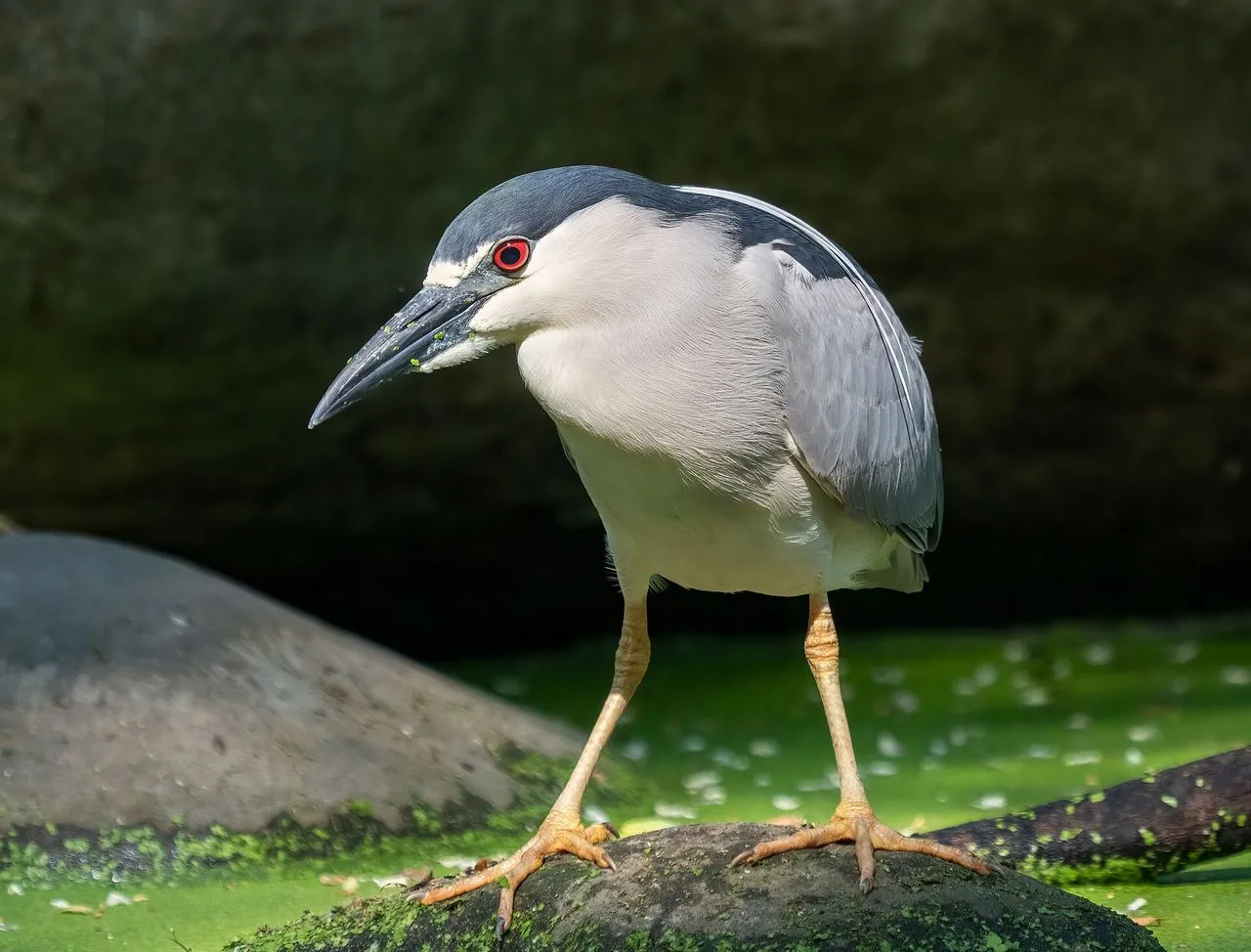
Nycticorax nycticorax (Linnaeus, 1758), the Black-crowned Night-Heron, is the most widespread heron in the world and the stocky, red-eyed bird whose evening quok often passes overhead before it is seen.
Part of the Complete Waders & Herons Guide.
Identification at a glance
| Character | Black-crowned Night-Heron (Nycticorax nycticorax) | Yellow-crowned Night-Heron (Nyctanassa violacea) |
|---|---|---|
| Length | 58–66 cm (23–26 in) | 55–70 cm (22–28 in) |
| Adult head | Black crown and back | Black head with pale crown stripe |
| Adult legs | Yellow-green; pinkish in breeding | Yellowish to orange |
| Juvenile pattern | Colder brown; heavier white spotting | Greyer; smaller wing spots |
| Usual feeding | Broad wetland prey | Crabs and crayfish prominent |
Identification
Visual
Adults are 58–66 cm, compact, short-necked, and relatively short-legged. The crown and back are black with a greenish gloss, the wings are grey, and the underparts are pale grey to whitish. The eye is red in adults. Legs are yellow-green, flushing pinkish or reddish in breeding condition. Two or three long white occipital plumes develop in breeding adults.
Juveniles are brown with heavy white or buff streaking and spotting across the body and wings. The eye is yellow to orange, not adult red. Juvenile night-herons cause regular confusion. Black-crowned juveniles are generally colder brown, more heavily spotted above, and thicker-billed than Yellow-crowned Night-Herons. The bill is stout and mostly dark.
In flight the adult looks broad-winged, chunky, and short-necked, with legs trailing only modestly. The silhouette is very different from the long-necked Great Egret or Tricolored Heron.
Audio
The common call is a flat, barking quok or wok, typically given in flight at dusk or night. Colonies produce harsh croaks and squabbles. The flight call is one of the most useful nocturnal heron sounds in North America.
Distribution
The species occurs on every continent except Antarctica and Australia, with breeding populations across much of North America, Eurasia, Africa, and South America. In North America it breeds locally from southern Canada through the United States and Mexico, with year-round populations along many coasts and in warmer regions.
Although globally secure, it has declined or shifted locally where wetlands were drained or colony trees removed. Conversely, it persists in some heavily urban landscapes if roosting trees, fish-bearing water, and limited disturbance remain. City park colonies are not unusual.
Habitat
Black-crowned Night-Herons use marshes, river edges, lake margins, mangroves, tidal creeks, fish ponds, sewage lagoons, harbour edges, and urban ponds. Day roosts are usually dense trees or shrubs near water. Birds may stand quietly in shade through the day, becoming active toward dusk.
The species is less tied to crab-rich coastal habitat than Yellow-crowned Night-Heron and more catholic in wetland use. It is also more likely to use artificial water bodies, including ornamental lakes and aquaculture sites.
Diet and Foraging
Fish are important, but the diet is broad: frogs, crayfish, crabs, aquatic insects, leeches, small mammals, eggs, nestlings, and carrion may be taken. The species often forages by standing still at water edges in low light, striking at prey that comes within reach. It also walks slowly along shorelines and may exploit artificial lights that attract fish or insects.
Crepuscular and nocturnal activity reduces competition with day-feeding herons and allows exploitation of prey moving into shallows after dark. The large eyes are functional, not merely a field mark. In urban settings, birds may feed under bridge lights or near illuminated fountains.
Black-crowned Night-Herons are opportunistic at colonies and waterbird nesting sites. Predation on eggs and young birds is documented. That behaviour is normal for the species and should not be treated as aberrant.
Breeding Biology
The species nests colonially, often in mixed heronries with egrets, ibises, and cormorants. Nests are stick platforms in trees, shrubs, mangroves, or reed beds, frequently over water or on islands. Urban colonies may occupy park trees, zoo grounds, or protected reservoirs.
Clutch size is usually three to five eggs. Incubation lasts about 24–26 days, shared by both sexes. Young are fed by regurgitation and become mobile in the nest tree before fledging at roughly six to seven weeks. As with other colonial herons, repeated disturbance can cause chicks to leave nests prematurely.
Courtship includes twig presentation, bowing, plume display, and vocal exchanges. Adults at colonies can be conspicuous by day even though much feeding occurs at night.
Notes
The English name is accurate only for adults. Juveniles do not show a black crown in the clean adult sense, and many records of "brown herons" at dusk are young night-herons. Ageing matters because immature birds wander widely after breeding.
The bird's tolerance of cities should not be confused with independence from wetlands. Urban night-herons still require prey-bearing water and secure roost or nest sites. Remove either component and the apparent adaptability ends.
Age structure is often visible at evening roosts. Adults leave first or sit higher in trees; streaked juveniles may remain restless on lower branches. Counting age classes at a roost provides more information than a simple total, especially after breeding season when local productivity can be inferred roughly from the proportion of young birds.
The species has a documented habit of feeding at fish hatcheries and ornamental ponds, which creates conflict. Exclusion netting is preferable to harassment at colonies. Once chicks are present, disturbance shifts the cost from fish loss to breeding failure.
Black-crowned Night-Herons are also useful in teaching nocturnal migration awareness. A single quok over a suburban street in October may be the only evidence of a bird moving between wetlands under cloud cover.
Winter roost checks should be made from outside the roost whenever possible; repeated entry into dense roost trees can move birds from otherwise secure daytime cover.
See Also
Frequently Asked Questions
How do I tell a juvenile Black-crowned Night-Heron from a Yellow-crowned juvenile?
Black-crowned juveniles are colder brown with heavier white spotting on the wing coverts and a thicker, mostly dark bill. Yellow-crowned juveniles are greyer with smaller spots, longer legs, and a blockier head. Habitat helps: a juvenile working saltmarsh crab burrows is more likely a Yellow-crowned.
Why are Black-crowned Night-Herons active at dusk?
Crepuscular and nocturnal feeding reduces competition with day-feeding herons and allows the species to exploit fish, frogs, and insects moving into shallow water after dark. The large red eyes are functional adaptations, not merely a field mark. Urban birds may feed under bridge lights or near illuminated fountains.
What habitats do Black-crowned Night-Herons use?
Marshes, river edges, lake margins, mangroves, tidal creeks, fish ponds, sewage lagoons, harbour edges, and urban ponds. Day roosts are usually dense trees or shrubs near water. The species is more catholic in wetland use than the Yellow-crowned and readily uses artificial water bodies including aquaculture sites.
Are Black-crowned Night-Herons predators of other birds?
Yes. They are opportunistic at colonies and waterbird nesting sites, taking eggs and small chicks. This behaviour is normal for the species and not aberrant. Diet otherwise includes fish, frogs, crayfish, crabs, aquatic insects, small mammals, and occasional carrion.
Sources & References
- Cornell Lab of Ornithology. (2024). All About Birds: Black-crowned Night-Heron. birds.cornell.edu
- Sibley, D.A. (2014). The Sibley Guide to Birds (2nd ed.). Knopf.
- Kushlan, J.A. & Hancock, J.A. (2005). The Herons. Oxford University Press.
- Ehrlich, P.R., Dobkin, D.S. & Wheye, D. (1988). The Birders Handbook. Simon & Schuster.