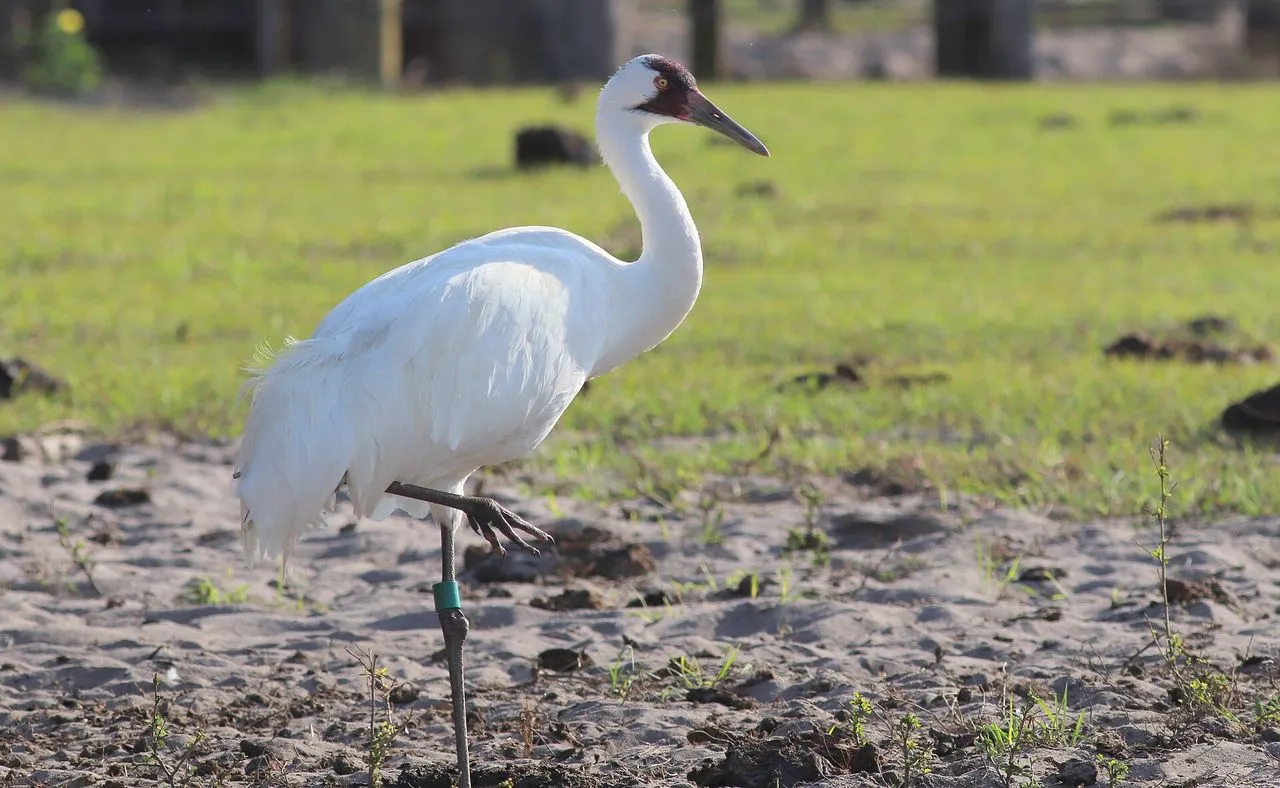
Grus americana (Linnaeus, 1758), the Whooping Crane, fell to roughly 21 birds in the wild in the early 1940s; the total population now exceeds 800 individuals when wild and captive birds are counted.
Part of the Complete Waders & Herons Guide.
Identification at a glance
| Character | Whooping Crane (Grus americana) | Sandhill Crane (Antigone canadensis) | Great Egret (Ardea alba) |
|---|---|---|---|
| Height | About 150 cm (59 in) | 80–120 cm (31–47 in) | 89–104 cm (35–41 in) |
| Adult body | White with black primaries | Grey, often rusty-stained | Entirely white |
| Flight neck | Fully extended | Fully extended | Folded S-curve |
| Crown and face | Red crown; black moustachial marks | Bare red crown patch | No red crown; green lores in breeding |
| Status cue | Endangered; reports require care | Common in many populations | Common wetland heron |
Identification
Visual
At about 150 cm tall, the Whooping Crane is the tallest bird in North America. Adults are white with black primary feathers visible in flight, a red crown and facial patch, black moustachial markings, and long black legs. The bill is long, straight, and dark olive-grey to horn-coloured. In flight the neck and legs are fully extended, and the black wingtips contrast sharply with the white wing coverts.
Juveniles are cinnamon-brown and white, with brown strongest on the head, neck, and upperparts. They acquire adult white plumage gradually during the first year. Family groups on the wintering grounds may include one or two brownish juveniles with white adults.
Snow Goose flocks, American White Pelicans, and Great Egrets cause distant white-bird confusion. Size, extended neck and legs, black wingtips, and slow crane wingbeats resolve most views. Great Egret is much smaller and folds the neck in flight.
Audio
The call is a loud, clear bugle or whoop, carrying long distances. Like other cranes, the trachea is elongated and coiled, giving resonance. Pair duets are structured and can be heard on breeding and wintering territories.
Distribution
The only self-sustaining natural migratory population breeds in and around Wood Buffalo National Park in Canada and winters at and near Aransas National Wildlife Refuge on the Texas Gulf Coast. This Aransas-Wood Buffalo population has grown from the 1940s bottleneck to several hundred birds.
Reintroduced populations have been attempted in the eastern United States, including a migratory population taught migration routes using ultralight aircraft by Operation Migration from 2001 to 2015, and non-migratory efforts in Louisiana and Florida. Some projects produced wild birds but also revealed persistent problems with reproduction, predator pressure, imprinting, and habitat management.
The species remains Endangered under the U.S. Endangered Species Act and Endangered in Canada. Recovery is real but incomplete.
Habitat
Breeding habitat in Wood Buffalo consists of shallow boreal wetlands, muskeg, sedge marsh, and small ponds in remote terrain. Nest sites are built in shallow water, reducing predator access. Winter habitat on the Texas coast includes saltmarsh, tidal flats, estuarine ponds, and adjacent uplands.
Migration stopovers include shallow wetlands, riverine sandbars, reservoir edges, and agricultural fields. The migration corridor through the Great Plains is narrow enough that collision risk, drought, disturbance, and habitat loss at stopover sites remain significant concerns.
Diet and Foraging
Whooping Cranes are omnivorous. On the Texas wintering grounds, blue crabs, clams, wolfberries, crayfish, insects, fish, frogs, and waste grain may be eaten. During migration they use waste corn and other agricultural foods. On breeding territories they take aquatic invertebrates, small vertebrates, roots, and berries.
Foraging is by walking, probing, picking, and shallow digging. The bird is not a fish-spearing heron and not a tactile ibis specialist. It uses a crane's generalist bill and long stride to work marsh, upland, and agricultural substrates.
Food availability on the wintering grounds has conservation consequences. Drought and reduced freshwater inflow can lower blue crab availability and increase salinity in coastal marshes. Supplemental freshwater management and coastal protection are therefore not peripheral issues.
Breeding Biology
Whooping Cranes form long-term pair bonds. Courtship includes unison calling, dancing, bowing, wing spreading, and leaping. Pairs defend large territories. The nest is a mound of wetland vegetation, usually surrounded by shallow water.
Clutch size is normally two eggs. Incubation lasts about 29–31 days and is shared by both adults. Although two chicks may hatch, sibling aggression and food limitation often result in only one fledging. Young remain with parents through migration and winter, learning routes and feeding sites.
Captive breeding has been central to recovery. Eggs from the wild population were used to establish captive flocks, and captive-reared birds supplied reintroduction efforts. Techniques have included costume-rearing to reduce human imprinting and aircraft-led migration training.
Notes
Operation Migration's ultralight-led flights became the public face of Whooping Crane recovery, but the full programme was more complex: captive breeding, genetic management, wetland acquisition, predator control, powerline marking, legal protection, and long-term monitoring all mattered. Ultralights solved one problem, teaching a migration route, while creating others related to human association and reproductive performance.
The species' recovery numbers should be read with caution. More than 800 birds is a profound improvement over 21, but a single hurricane, disease event, prolonged drought, or major habitat failure could still affect a large fraction of the population. Recovery is in progress, not complete.
Every field record should be treated carefully. Whooping Cranes are individually monitored in many populations, and reports may affect management decisions. Observers should record location, time, group size, age class, leg bands or transmitters if visible, behaviour, and direction of travel, while maintaining distance and avoiding any attempt to approach for a better photograph.
The commonest field mistake is scale failure. A distant white bird in a wet field becomes a crane in imagination. The extended black-tipped wings, fully stretched neck, trailing legs, and deliberate crane gait must all fit before the identification is credible.
See Also
Frequently Asked Questions
How endangered is the Whooping Crane?
The species remains Endangered under the U.S. Endangered Species Act and Endangered in Canada. The 800-plus total population is a profound recovery from 21 birds in the 1940s, but a single hurricane, disease event, prolonged drought, or major habitat failure could still affect a large fraction of the population. Recovery is in progress, not complete.
Where does the only natural migratory population breed and winter?
Breeding occurs in and around Wood Buffalo National Park in northern Canada in shallow boreal wetlands, muskeg, and sedge marsh. Wintering occurs at and near Aransas National Wildlife Refuge on the Texas Gulf Coast, in saltmarsh, tidal flats, estuarine ponds, and adjacent uplands.
What was Operation Migration?
An ultralight aircraft programme from 2001 to 2015 that taught reintroduced Whooping Cranes a migration route between Wisconsin and Florida. It became the public face of recovery, but the full programme also required captive breeding, costume-rearing to reduce human imprinting, predator control, powerline marking, and long-term monitoring.
How do I separate Whooping Crane from other large white birds?
Size, structure, and the combination of fully extended neck and legs in flight with black-tipped white wings. Great Egret is much smaller and folds the neck; Snow Goose flocks lack the size and crane wingbeats; American White Pelican has the heavy bill. Most distant white-bird mistakes are scale failures rather than plumage confusion.
Sources & References
- Cornell Lab of Ornithology. (2024). All About Birds: Whooping Crane. birds.cornell.edu
- Sibley, D.A. (2014). The Sibley Guide to Birds (2nd ed.). Knopf.
- Urbanek, R.P. & Lewis, J.C. (2015). Whooping Crane (Grus americana). Birds of North America Online, Cornell Lab of Ornithology.
- U.S. Fish and Wildlife Service. (2007). International Recovery Plan for the Whooping Crane (Grus americana), Third Revision.