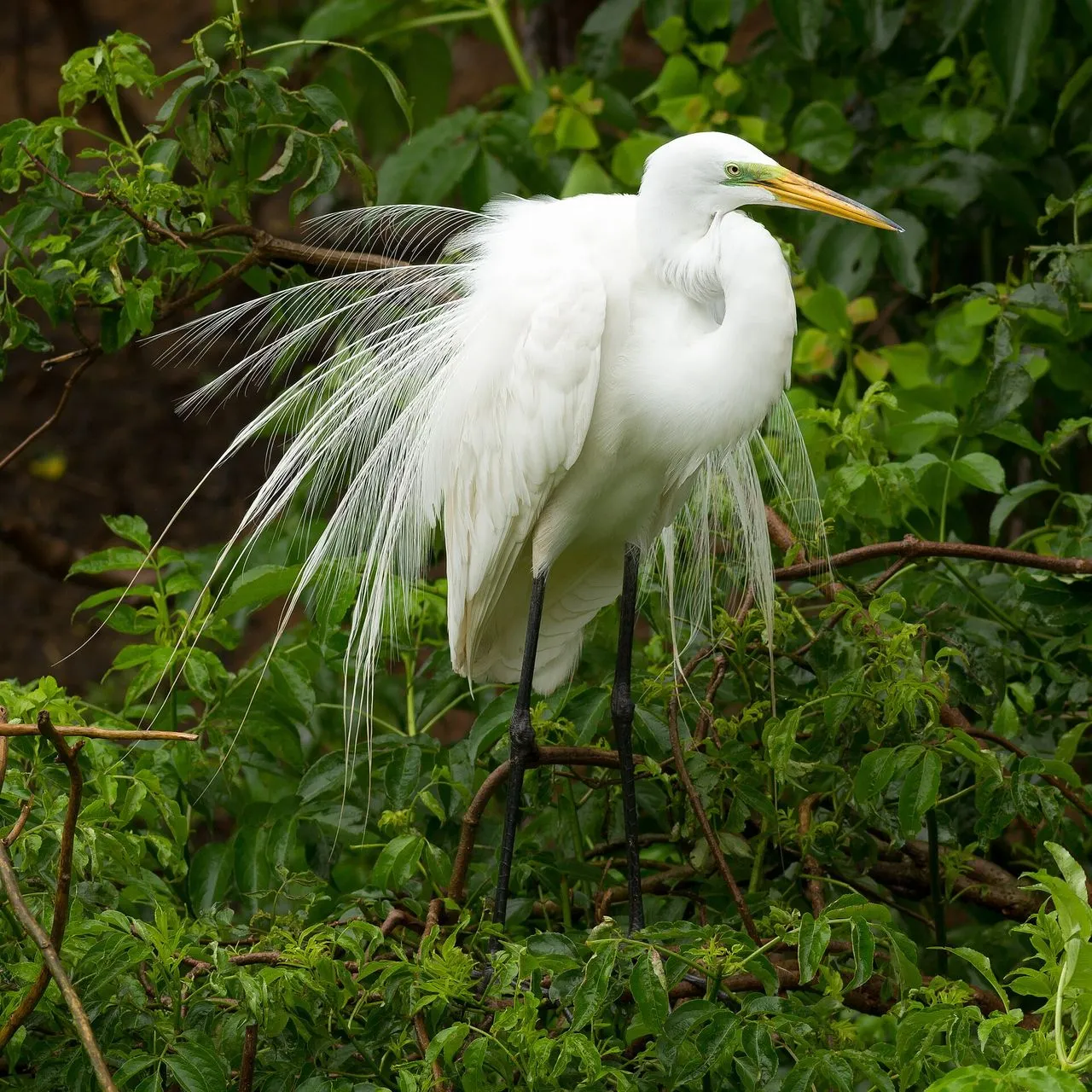
Ardea alba (Linnaeus, 1758), the Great Egret, is the large white heron whose breeding plumes became a central symbol of the anti-plume movement and later of the National Audubon Society.
Part of the Complete Waders & Herons Guide.
Identification at a glance
| Character | Great Egret (Ardea alba) | Snowy Egret (Egretta thula) | Great White Heron (A. h. occidentalis) |
|---|---|---|---|
| Length | 89–104 cm (35–41 in) | 56–66 cm (22–26 in) | 97–137 cm (38–54 in) |
| Bill | Yellow to yellow-orange | Black | Heavy yellow |
| Legs and feet | Black | Black legs; yellow feet | Yellowish legs |
| Structure | Tall, long-necked | Slim, medium-small | Bulkier, heavier-billed |
| Breeding plumes | Long scapular aigrettes | Recurved aigrettes | Great Blue Heron morph |
Identification
Visual
At 89–104 cm, the Great Egret is tall, long-necked, and long-legged, clearly larger than Snowy Egret, Little Blue Heron, or Cattle Egret. Plumage is entirely white at all ages. The bill is long, straight, and yellow to yellow-orange outside the breeding season. Legs and feet are black. This combination, white body plus yellow bill plus black legs, is the standard field identification.
In breeding condition the lores become green, the bill may darken slightly toward orange or blackish near the tip, and long filamentous scapular plumes extend beyond the tail. These are aigrettes, the feathers hunted heavily in the 19th century. Juveniles resemble non-breeding adults but may have duller soft-part colours.
The principal confusion is the Great White Heron, the white Florida form of Great Blue Heron. Great White Heron is bulkier, heavier-billed, and has yellowish legs rather than black legs. Snowy Egret is much smaller, has a black bill, and shows yellow feet.
Audio
Great Egrets are quiet while foraging. At colonies they give low croaks, guttural kroow notes, and harsh disturbance calls. The voice is deeper than Snowy Egret but not usually heard at distance except around active nesting colonies.
Distribution
The species is nearly cosmopolitan, breeding on every continent except Antarctica. In North America it breeds widely across the United States, especially in the eastern half, along the Pacific Coast, and through the Gulf states, with winter concentration along the southern coasts, Mexico, Central America, the Caribbean, and South America.
North American populations were severely reduced by plume hunting in the late 19th and early 20th centuries. Legal protection under the Lacey Act of 1900 and the Migratory Bird Treaty Act of 1918 allowed recovery. The species is now common in many regions and listed as Least Concern globally, but local breeding success still depends on colony protection and wetland hydrology.
Habitat
Great Egrets use freshwater marshes, saltmarshes, mangrove lagoons, lake margins, river shallows, impoundments, flooded agricultural fields, and tidal flats. They tolerate more open water than smaller egrets but still concentrate where prey is reachable in shallow margins.
They also forage in dry fields for insects, amphibians, and small mammals, though less characteristically than Cattle Egret. In mixed wader assemblages they often occupy slightly deeper water than Snowy Egrets and Tricolored Herons. The long legs permit foraging where smaller species would be belly-deep.
Diet and Foraging
Fish are the dominant prey in many wetlands, supplemented by frogs, crayfish, aquatic insects, snakes, small mammals, and grasshoppers. The main technique is still-hunting: the bird stands motionless, neck compressed, then strikes with a rapid extension. It also slow-stalks, placing each foot carefully to avoid alarming prey.
Compared with Great Blue Heron, Great Egret takes smaller average prey and uses shallower water, but the mechanics are similar. Compared with Snowy Egret, it is less frenetic and rarely depends on foot-stirring. The strike is visually clean: a long white neck uncoils, the yellow bill enters the water, and the bird usually swallows small fish headfirst after brief manipulation.
Foraging success is influenced by water level. Drawdowns in impoundments can create dense prey concentrations and large feeding aggregations. Conversely, deep flooded marshes may hold many fish but make them unavailable to waders.
Breeding Biology
Great Egrets nest colonially in heronries, often with Great Blue Herons, Snowy Egrets, Little Blue Herons, ibises, and night-herons. Nests are stick platforms placed in trees, shrubs, mangroves, or reed beds over water or on islands. Males claim nest sites and display with plumes raised, neck extended, and bill pointed upward.
Clutch size is usually three to four pale blue-green eggs. Incubation lasts about 23–27 days and is shared by both sexes. Young are fed by regurgitation and fledge at roughly six to seven weeks. Sibling competition can be severe, especially when food delivery is low.
Breeding chronology varies by latitude. In Florida and the Gulf Coast, nesting may begin in winter or early spring; farther north it occurs later. Colonies are vulnerable to disturbance because adults flushed repeatedly from nests expose eggs and chicks to heat, cold, gulls, crows, and vultures.
Notes
The Great Egret is often treated as a generic white bird by non-birders, but it is structurally distinctive: tall, angular, long-necked, black-legged, and yellow-billed. Those characters hold even in poor light. In flight, the folded neck confirms it as a heron rather than an ibis or spoonbill.
The species' conservation history is not ornamental background. The killing of breeding adults for plumes removed parents at the moment chicks were dependent, amplifying mortality beyond the shot birds themselves. Its recovery is one of the practical successes of bird-protection law.
For field notes, record soft-part colour as well as presence. Green lores, long back plumes, and a flushed bill indicate breeding condition; black legs remain the anchor character. A tall white heron with yellow legs in south Florida should trigger consideration of Great White Heron rather than automatic Great Egret.
See Also
- Snowy Egret
- Great Blue Heron
- Cattle Egret
- Little Blue Heron
- The Complete Waders Guide
- Snowy Egret vs Great Egret: yellow bill vs black bill, and black feet vs golden feet; the canonical white-egret diagnostic.
- Wood Stork: the larger southeastern wader often seen alongside Great Egrets; bare-headed and curve-billed.
Frequently Asked Questions
How do I distinguish a Great Egret from a Great White Heron?
Great Egret has black legs, a yellow bill, and a slimmer angular structure. Great White Heron, the white Florida form of Great Blue Heron, is bulkier, heavier-billed, and has yellowish legs. A tall white heron with yellow legs in south Florida should be checked carefully rather than called Great Egret automatically.
What is the conservation history of the Great Egret?
Late-19th and early-20th-century plume hunting for the breeding aigrettes severely reduced North American populations. Adults shot at active nests left dependent chicks to starve. Legal protection under the Lacey Act of 1900 and the Migratory Bird Treaty Act of 1918 allowed recovery; the species is now common and listed as Least Concern globally.
How does a Great Egret feed?
Mostly by still-hunting and slow-stalking. The bird stands motionless or steps carefully through shallow margins, then strikes with a rapid neck extension. Prey includes fish, frogs, crayfish, aquatic insects, snakes, small mammals, and grasshoppers. Drawdowns in impoundments concentrate prey and produce large feeding aggregations.
Where do Great Egrets nest?
Colonially in heronries, often alongside Great Blue Herons, Snowy Egrets, Little Blue Herons, ibises, and night-herons. Stick platform nests are built in trees, shrubs, mangroves, or reed beds over water or on islands. Clutch size is usually three to four pale blue-green eggs, incubated for 23–27 days by both sexes.
Sources & References
- Cornell Lab of Ornithology. (2024). All About Birds: Great Egret. birds.cornell.edu
- Sibley, D.A. (2014). The Sibley Guide to Birds (2nd ed.). Knopf.
- Kushlan, J.A. & Hancock, J.A. (2005). The Herons. Oxford University Press.
- McCrimmon, D.A., Ogden, J.C. & Bancroft, G.T. (2011). Great Egret (Ardea alba). Birds of North America Online, Cornell Lab of Ornithology.