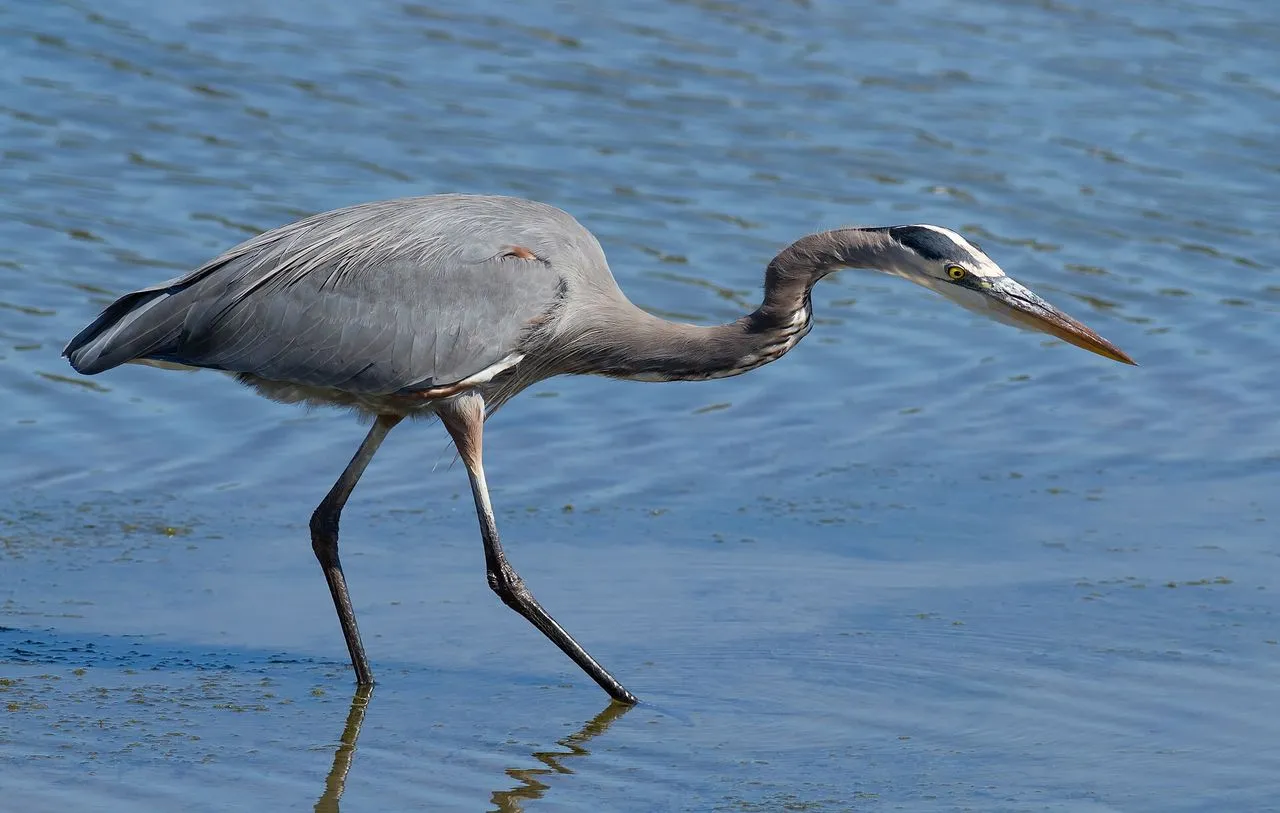
Ardea herodias, the Great Blue Heron, is the largest heron in North America and the one most North American birders encounter first.
Part of the Complete Waders & Herons Guide.
Identification at a glance
| Character | Great Blue Heron (Ardea herodias) | Great Egret (Ardea alba) | Great White Heron (A. h. occidentalis) |
|---|---|---|---|
| Length | 97–137 cm (38–54 in) | 89–104 cm (35–41 in) | 97–137 cm (38–54 in) |
| Body colour | Blue-grey with chestnut shoulders | Entirely white | Entirely white |
| Bill | Heavy yellow dagger | Yellow, slimmer | Heavy yellow dagger |
| Legs | Dark grey-black | Black | Yellowish |
| Range cue | Widespread North America | Widespread wetlands | Florida, Florida Keys, Cuba |
Identification
At 97–137 cm from bill tip to tail, with a wingspan of 167–201 cm, A. herodias has no close competitor in North American Ardeidae for size. Plumage in the nominate adult:
- Head. White crown with a broad black supercilium stripe extending into a long black occipital plume in breeding birds. Face white; throat and foreneck white with dark streaking.
- Body. Blue-grey above. The shoulder region shows chestnut-rufous patches at the leading edge of the wing. Thighs are chestnut-rufous. Underparts are whitish with dark streaking on the foreneck continuing onto the breast.
- Bill. Heavy, dagger-shaped, yellow to yellow-orange; deepens toward orange at the peak of breeding condition.
- Legs. Dark grey-black. Feet dark grey.
- Juvenile. Duller throughout; crown solidly dark grey without the adult white-and-black pattern; lacks the occipital plume. Bill paler, tending greenish-grey.
In flight, the neck folds into the characteristic Ardeidae S-curve, producing the hunched, short-necked silhouette that separates herons from cranes in any light condition. The wingbeat runs at approximately two strokes per second, distinctively slow, with a characteristic downward bow at the bottom of the downstroke.
Subspecies and Colour Morphs
Four subspecies are recognised. The nominate A. h. herodias covers most of the continental range. A. h. occidentalis, the Great White Heron, is a large all-white morph resident in Florida, the Florida Keys, and Cuba; most current authorities maintain it at subspecific rather than full species status. It differs from the similar Great Egret (Ardea alba) in larger body size, yellow rather than black legs, and a proportionally heavier bill. Natural hybrids between A. h. occidentalis and nominate birds produce intermediate forms, white-headed, blue-bodied, occasionally recorded in southern Florida under the informal name Würdemann's Heron.
Hunting Behaviour
Ardea herodias uses two primary foraging strategies, often switching between them within a single session: still-hunting and slow-stalk. Both rely on the same terminal mechanism, the rapid uncoiling of the S-curved neck, but approach the moment of the strike differently.
Still-Hunt
The bird stands motionless at the water's edge or in water up to approximately thigh depth and waits for prey to move within strike distance. The neck of a Great Blue Heron is not simply held in position: the S-curve is a mechanically loaded posture, with the modified cervical vertebrae functioning as a compressed spring. When the strike is triggered, the neck extends in under half a second, the bill entering the water at high velocity. Still-hunting is the energetically cheaper strategy and dominates in cold months, when the metabolic cost of continuous movement through cold water would reduce the net caloric return of a foraging session.
Slow-Stalk
The bird advances through shallow water in slow, deliberate steps, each foot placed carefully to avoid bow waves that would alarm fish. The head moves incrementally forward with each step, maintaining visual alignment with the water surface. This is the behaviour that makes Great Blue Herons worth extended observation: at slow-stalk speed the bird's movements are easy to follow in real time, and the final commitment to a strike, when the measured advance breaks suddenly into a full-extension lunge, is abrupt enough to be startling even when anticipated.
Prey Size
Primary prey is fish, across a wide size range. The gape width and oesophageal flexibility of A. herodias allow prey items that appear disproportionate to the bird's body size. Large-mouth bass exceeding 30 cm, bullfrogs, large crayfish, water snakes up to 50 cm, and occasionally small mammals taken at the water's margin are all documented prey. The standard handling sequence is to orient prey headfirst before swallowing; a large fish may be tossed, repositioned, and re-struck several times before the correct orientation is achieved. A visible bulge travelling down the neck is the reliable field indicator that a large item has been taken and is in transit.
Prey that proves genuinely too large to pass the oesophageal sphincter has caused documented mortalities, typically fish with erected lateral spines that catch during swallowing. These events are infrequent but indicate that the upper size threshold is one the birds test regularly and occasionally misjudge.
The species is also an opportunistic aerial predator. Individual birds have been documented taking ducklings, and reliable records exist of birds consuming adult Common Moorhen (Gallinula chloropus) in brackish marsh settings.
Colonial Breeding
Great Blue Herons nest in colonies, heronries, most commonly in tall trees above or immediately adjacent to water. Colony size ranges from a handful of pairs to several hundred; established heronries in mature forest in eastern North America have persisted at the same site for decades. The accumulated weight of stick nests, combined with guano deposition, can kill the canopy trees at the core of a large colony within 15–20 years, eventually forcing the colony to relocate to adjacent unaffected stands.
Breeding begins early. In the northeastern USA, pairs are on territory from late February; egg laying runs from March into April. Clutch size is typically two to four eggs, pale blue-green. Incubation takes 27–29 days, shared by both adults. Chicks are altricial, helpless at hatching, and are fed entirely on regurgitated fish until fledging at approximately 60 days. Post-fledging young continue to return to the heronry for several weeks, are fed intermittently by adults, and practise their own foraging at the colony's edges.
Single-species heronries are common; mixed colonies containing Great Blue Herons alongside Great Egrets, Snowy Egrets, and Double-crested Cormorants (Nannopterum auritum) are equally so, with nest placement loosely stratified by species across canopy height.
Range and Habitat
Ardea herodias breeds from southern Alaska and coastal British Columbia east through Canada and south through the continental USA into Mexico and Central America, with island populations in the Caribbean. It is a year-round resident across most of the lower 48 states; northern breeding populations move south to follow open water in winter.
Habitat requirements are minimal beyond proximity to foraging water. The species uses freshwater, brackish, and saltwater environments interchangeably, and forages in dry upland habitats, including fields, roadsides, and rough grassland, when prey such as voles and large grasshoppers are locally abundant. It adapts readily to suburban ponds and stocked aquaculture facilities; conflicts with commercial fish farms are documented across the species' range.
See Also
Frequently Asked Questions
How does a Great Blue Heron strike prey?
The S-curved neck functions as a mechanically loaded spring; modified cervical vertebrae allow rapid uncoiling in under half a second. The bird either still-hunts standing motionless at the water's edge or slow-stalks through shallow water, placing each foot carefully to avoid bow waves before committing to a full-extension lunge.
What is the Great White Heron?
An all-white morph of Great Blue Heron (A. h. occidentalis) resident in Florida, the Florida Keys, and Cuba, currently maintained at subspecific rather than full species status. It differs from Great Egret in larger body size, yellow rather than black legs, and a heavier bill. Intermediate hybrids called Würdemann's Heron are occasionally seen in southern Florida.
How big are heron colonies?
Heronries range from a handful of pairs to several hundred, often in tall trees above or adjacent to water. Established colonies in mature forest can persist for decades, though accumulated nest weight and guano deposition often kill canopy trees within 15–20 years, forcing relocation to nearby unaffected stands.
What do Great Blue Herons eat?
Fish dominate across a wide size range, but the gape and oesophageal flexibility allow large prey including large-mouth bass over 30 cm, bullfrogs, crayfish, water snakes up to 50 cm, and occasionally small mammals or ducklings. Prey is oriented headfirst before swallowing; large items may be repositioned several times before transit.
Sources & References
- Cornell Lab of Ornithology. (2024). All About Birds: Great Blue Heron. birds.cornell.edu
- Sibley, D.A. (2014). The Sibley Guide to Birds (2nd ed.). Knopf.
- Kushlan, J.A. & Hancock, J.A. (2005). The Herons. Oxford University Press.
- Vennesland, R.G. & Butler, R.W. (2011). Great Blue Heron (Ardea herodias). Birds of North America Online, Cornell Lab of Ornithology.