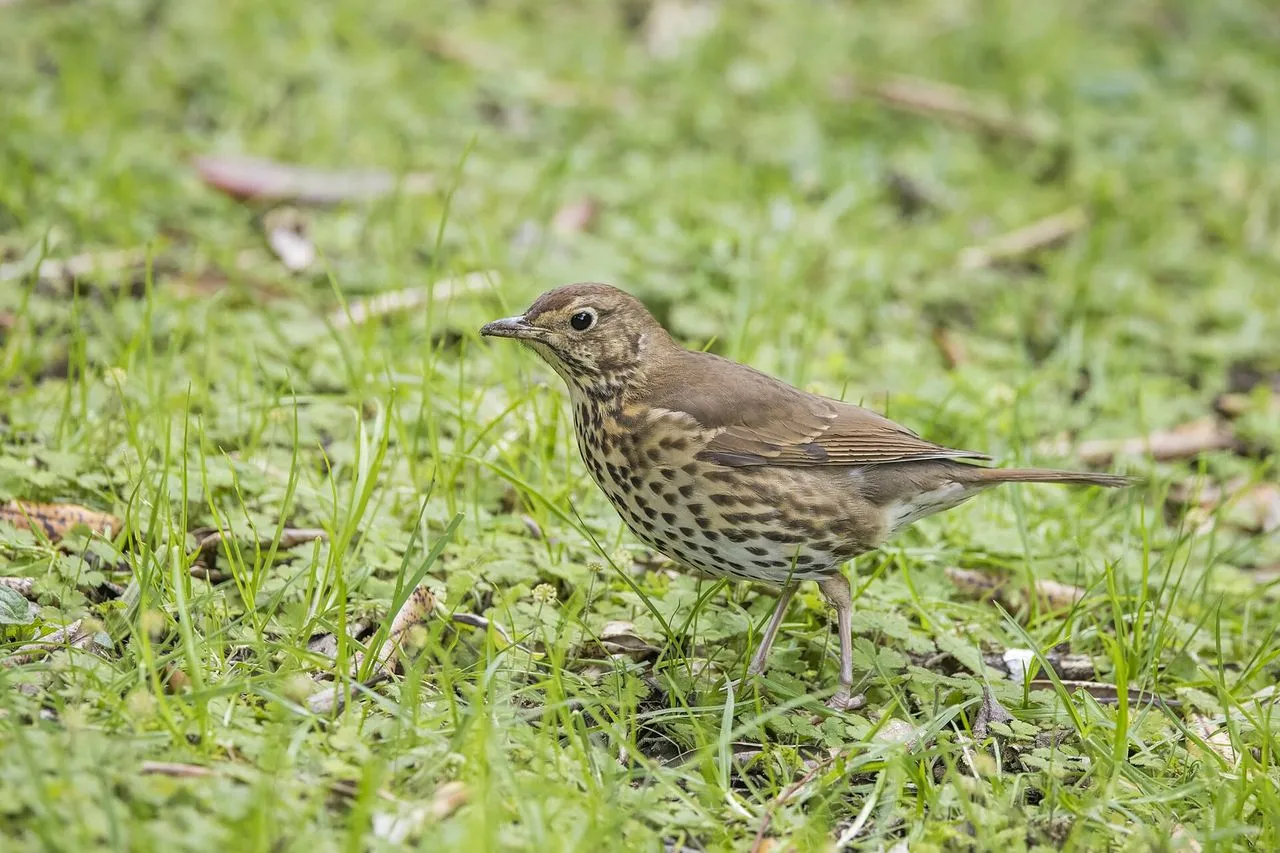
Song Thrush (Turdus philomelos) is a medium European thrush (20-23cm). Warm brown above, arrowhead spots below, buff underwing. Famous for repeating song phrases. Uses stone anvils to break snail shells.
Turdus philomelos C. L. Brehm, 1831, the Song Thrush, is the European thrush whose repeated song phrases and snail-breaking anvils make it one of the most behaviourally recognisable garden-edge birds.
Part of the Complete Thrushes Guide.
Identification at a glance
| Character | Song Thrush (T. philomelos) | Mistle Thrush (T. viscivorus) | Redwing (T. iliacus) |
|---|---|---|---|
| Length | 20–23 cm (7.9–9.1 in) | 26–29 cm (10.2–11.4 in) | 19–23 cm (7.5–9.1 in) |
| Tone | Warm brown, compact | Cold grey-brown, rangy | Brown, sharper face pattern |
| Spots | Small arrowheads or inverted hearts | Large round spots down belly | Fine streaks, red flanks |
| Underwing | Buff to orange-buff | White | Rusty-red flank and underwing flash |
| Song | Phrases repeated 2–4 times | Loud, wilder winter phrases | Brief whistles and warble on breeding grounds |
Identification
Visual
Song Thrush is a medium-sized Turdus, 20–23 cm long and usually 65–90 g, smaller and warmer than Mistle Thrush and neater than Common Blackbird. The upperparts are plain warm brown. The underparts are pale cream to buff, marked with dark spots that are shaped like small arrowheads or inverted hearts, especially across the breast and flanks. The spots are more orderly and less blotchy than those of Mistle Thrush.
The face is rather plain, with a pale eye ring and fine bill. The underwing in flight is warm buff to orange-buff, a useful distinction from Redwing when the flank stripe is not seen. Sexes are alike. Juveniles are more heavily mottled above, with buff streaking on the wing coverts and scapulars, but they are still recognisable as small warm-brown thrushes.
Compared with Mistle Thrush, Song Thrush is smaller, shorter-tailed, warmer brown above, and more compact. Mistle Thrush stands more upright, looks colder and grayer, and carries larger, rounder spots scattered down a whiter belly. Compared with Redwing, Song Thrush lacks the bold creamy supercilium and red flank patch.
Audio
The song is the species' most reliable field mark. A male Song Thrush repeats each phrase two to four times before changing to the next: chew-it chew-it chew-it, did-he-do-it did-he-do-it, see-you see-you. This repeated-phrase structure separates it from Blackbird, which sings in richer, less repetitive fluted passages, and from Mistle Thrush, which gives louder, more open, slightly wild phrases.
Song begins early in the year, often from January or February in mild Britain, and is delivered from tree tops, roof ridges, or exposed branches. The alarm call is a sharp tic or chack. At dusk the repeated phrases carry well through gardens and hedgerows, making the species easier to confirm by ear than by sight in suburban landscapes.
Distribution
Song Thrush breeds across much of Europe and western Asia, with introduced populations in New Zealand and Australia. In Britain and Ireland it is widespread but uneven, declining sharply in some farmland and urban areas during the late 20th century. Northern and eastern European birds are more migratory, while British birds are largely resident with local movements in hard weather.
Winter distribution shifts south and west, with migrants reaching the Mediterranean basin, North Africa, and the Middle East. Cold-weather movements can bring continental birds into Britain and concentrate local birds around berry crops, unfrozen ground, and sheltered gardens.
Habitat
The species uses deciduous woodland, mixed woodland, hedgerows, orchards, parks, large gardens, scrub, and farmland with enough cover. It is less tied to open lawns than Blackbird and less tolerant of treeless intensive agriculture. Dense hedges, ivy, bramble, and damp leaf litter are important.
Garden territories usually include a singing perch, nesting cover, and access to soft ground. Over-tidied gardens reduce value by removing the leaf litter, snails, and shaded soil on which the bird depends. Native hedges and shrubs are more useful than isolated ornamental lawn with no cover.
Diet and Foraging
Song Thrush feeds on earthworms, beetles, caterpillars, slugs, snails, spiders, millipedes, and fruit. It forages on the ground by hopping, pausing, and probing, often under shrubs or along hedge bases. In dry weather it shifts to shaded soil, compost edges, irrigated borders, and damp woodland paths.
Snails are a major component where available. The bird carries a snail to a favoured stone, root, paving edge, or other hard object and strikes the shell repeatedly until it breaks. These anvils can accumulate shell fragments from dozens or hundreds of meals. In autumn and winter the diet broadens to include hawthorn, rowan, holly, ivy, elder, yew, and fallen orchard fruit.
Supplementary feeding is secondary. Mealworms, soft fruit, and soaked raisins may be taken from ground trays, but dense cover and pesticide-free invertebrate habitat matter more than feeder provision.
Breeding Biology
The nest is a neat cup placed in dense shrubs, hedges, ivy, young conifers, or low trees, usually 1–3 m above ground. The outer structure is made of grass, leaves, moss, and twigs. The inner cup is lined with a smooth layer of mud, rotten wood, and dung, drying into a hard shell. Unlike Blackbird nests, Song Thrush nests lack a soft grass lining over this inner plaster.
Clutch size is usually 3–5 eggs, bright blue with blackish spots. Incubation lasts 12–14 days and is performed by the female. Nestlings fledge after about 13–14 days. Two broods are common, and three are possible in long seasons with good food supply.
Predation by corvids, cats, mustelids, and rats is significant in gardens and farmland edges. Drought reduces earthworm access and can depress breeding success. Slug pellet use has also been implicated in local food-chain risk, especially where metaldehyde was historically used.
Notes
The snail anvil is not a curiosity but a feeding adaptation that gives Song Thrush access to prey unavailable to many similar-sized birds. A regular anvil under a shrub or beside a path indicates a territory being worked repeatedly, often by the same individual. The behaviour also explains why gardens with small stones, old paving edges, rough walls, and undisturbed corners can be more valuable than immaculate lawns. The bird needs a place to break food as well as a place to find it.
See Also
- Mistle Thrush (Turdus viscivorus)
- Common Blackbird (Turdus merula)
- Fieldfare (Turdus pilaris)
- The Complete Attracting Guide
- The Complete Thrushes Guide
- Dawn Chorus and Bird Watching Times: the thrush family's contribution to dawn singing and ideal listening times.
Frequently Asked Questions
How do I identify Song Thrush?
Warm brown above, pale below with dark arrowhead spots across breast. Buff-orange underwing in flight. Smaller than Mistle Thrush, warmer-toned. Plain face with pale eye ring.
What makes Song Thrush song distinctive?
Each phrase repeated 2-4 times before switching: 'chew-it chew-it chew-it, did-he-do-it did-he-do-it'. Repeats phrases like this, unlike Blackbird's longer passages.
Why do Song Thrushes use anvils?
Smash snails against stones to eat them. Each thrush has favourite anvil stones, returning repeatedly. This tool use is one of the species' most noted behaviours.
How is Song Thrush different from Mistle Thrush?
Song is smaller, warmer brown, shorter-tailed, has buff not white underwing, smaller arrowhead spots. Mistle is larger, greyer, bigger round spots down belly.