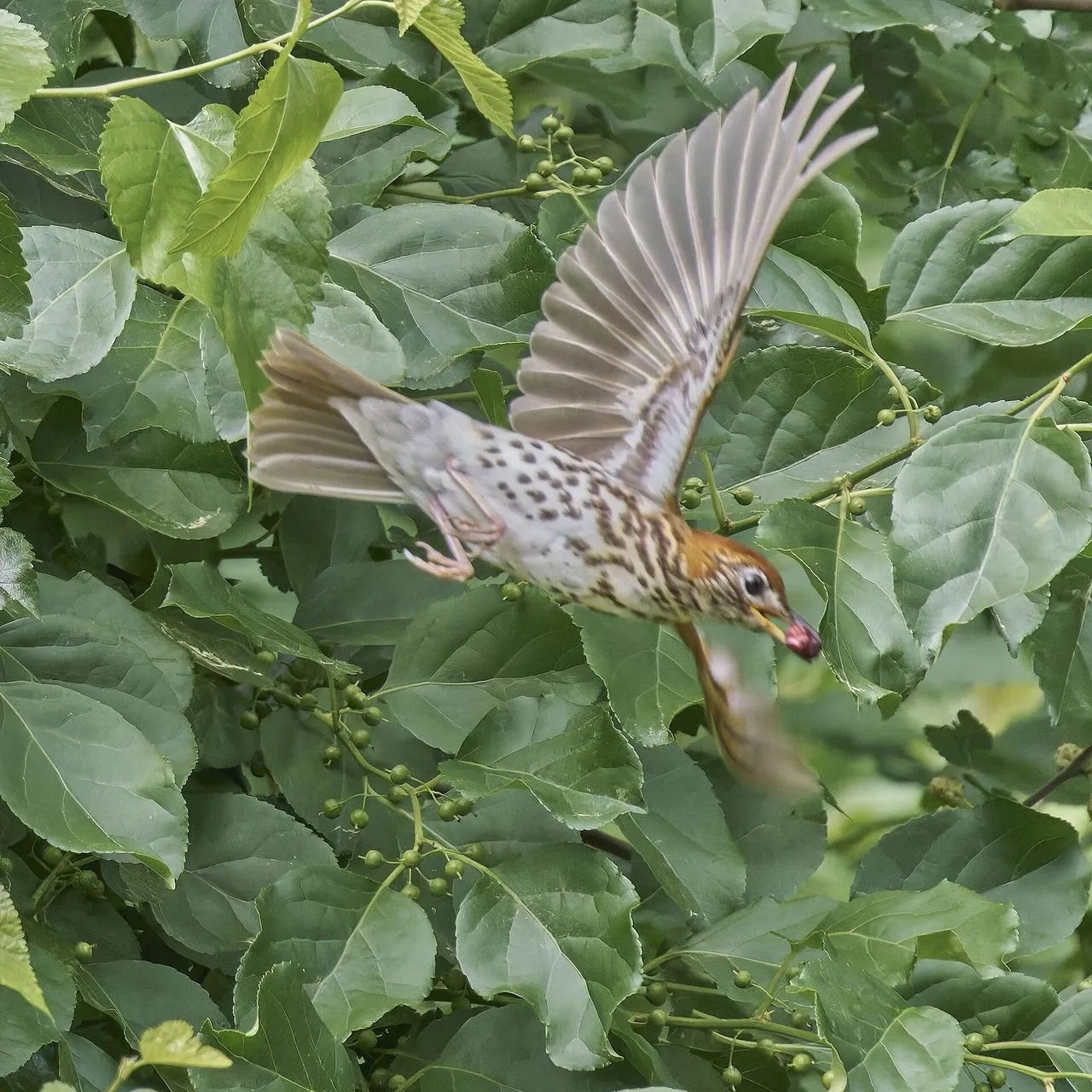
Wood Thrush (Hylocichla mustelina) is a large spotted thrush (18-21cm) of eastern mature forest. Cinnamon-brown head, large black spots below. Complex paired-flute song. Population declined 50%+ since 1960s.
Hylocichla mustelina (Gmelin, 1789), the Wood Thrush, is a mature-forest thrush of eastern North America whose population has fallen by more than half since the late 1960s in long-term Breeding Bird Survey data.
Part of the Complete Thrushes Guide.
Identification at a glance
| Character | Wood Thrush (H. mustelina) | Swainson's Thrush (C. ustulatus) | Hermit Thrush (C. guttatus) |
|---|---|---|---|
| Length | 18–21 cm (7.1–8.3 in) | 16–20 cm (6.3–7.9 in) | 15–18 cm (5.9–7.1 in) |
| Structure | Broad-headed, pot-bellied, short-tailed | Slim, medium-small Catharus | Small, upright Catharus |
| Upperparts | Cinnamon head, duller back | Olive-brown, often buff-faced | Olive-brown back, rufous tail |
| Spotting | Large blackish spots to flanks | Softer spots on buff wash | Dark triangular breast spots |
| Song | Paired ee-oh-lay and trill | Upward-spiralling flutes | Flute-like phrases with pauses |
Identification
Visual
Wood Thrush is larger and heavier than the spotted Catharus thrushes, 18–21 cm long and about 40–50 g, with a broad head, short tail, and distinctly pot-bellied profile when standing on the forest floor. The upperparts are warm cinnamon-brown on the crown and nape, becoming duller brown across the back and wings. The underparts are white with large, round, blackish spots that extend from throat through breast and down the flanks.
The face is bold for a forest thrush. A white eye ring and pale lores give a spectacled appearance, but not the buffy, soft-faced look of Swainson's Thrush. The bill is relatively strong, with a pale base to the lower mandible. Sexes are alike. Juveniles show buff spotting above in late summer, but the large black underpart spots and cinnamon head still separate them from juvenile robins and smaller Catharus species.
At distance, structure matters. Wood Thrush moves deliberately, often with a few hops followed by a long pause, rather than the nervous, more horizontal movements of Veery or Swainson's Thrush. It is a forest-floor bird, but when alarmed it often rises to a low branch and freezes rather than disappearing immediately.
Audio
The song is among the most technically complex sounds produced by a North American passerine. A typical phrase begins with soft introductory notes, then a clear, ringing ee-oh-lay, followed by a rapid terminal trill. The syrinx can produce two tones at once, creating the paired, organ-like quality that carries through deciduous forest at dawn and dusk.
Song is most frequent from May through July, with peak delivery in the first hour after sunrise and again near sunset. The common call is a sharp, emphatic pit-pit-pit when alarmed, and a rolling bup-bup-bup in agitation. A singing Wood Thrush may remain concealed for ten minutes at a time; the voice is usually the first and best evidence of presence.
Distribution
The breeding range covers the eastern United States and southeastern Canada, from the Great Plains edge eastward to the Atlantic, and from southern Ontario and Quebec south to the Gulf states. It is absent as a breeder from most heavily urbanised corridors unless substantial forest patches remain.
Migration occurs mostly at night. Spring arrival in the southeastern United States begins in April, with northern breeders reaching territory in May. Autumn departure begins in August and continues through September. Wintering range lies in southern Mexico and Central America, especially humid broadleaf forest from Veracruz and the Yucatan south through Honduras, Nicaragua, Costa Rica, and Panama.
Habitat
Breeding Wood Thrush requires deciduous or mixed forest with tall trees, moderate canopy closure, moist leaf litter, and a shrub or sapling layer suitable for nesting. Productive sites often include beech, maple, oak, tulip tree, hemlock, or mixed mesic hardwoods. Ravines, stream bottoms, and north-facing slopes are particularly reliable because soil moisture supports invertebrate prey.
The species can occur in suburban woodlots, but occupancy is not the same as successful reproduction. Small fragments expose nests to raccoons, Blue Jays, crows, domestic cats, and cowbirds. Forest patches below roughly 100 ha often hold singing males while producing too few young to replace adult mortality. That distinction is central to understanding the decline.
Diet and Foraging
Wood Thrush feeds mainly on ground invertebrates during the breeding season: beetles, ants, caterpillars, millipedes, spiders, snails, and earthworms. It forages by flipping leaves with the bill and probing damp soil. Calcium-rich prey, including snails and millipedes, are important during egg formation and nestling growth.
Fruit becomes important in late summer and autumn, particularly dogwood, spicebush, viburnum, pokeweed, elderberry, and grapes. On migration, fruiting shrubs along woodland edges can hold several birds briefly, though they rarely behave as conspicuously as robins. Garden feeding has little direct value. Retained leaf litter, native shrub layers, and reduced pesticide use matter far more than mealworms or platform feeders.
Breeding Biology
The nest is an open cup placed in a sapling, shrub, or low tree fork, usually 1–3 m above ground. Materials include dead leaves, grasses, rootlets, and paper or bark fragments, with an inner lining of fine roots. The structure is less mud-reinforced than an American Robin's nest but still substantial.
Clutch size is usually 3–4 turquoise-blue eggs. Incubation lasts 12–14 days and is performed by the female. Nestlings fledge after 12–13 days, still short-tailed and weak-flying. Pairs may attempt two broods in a season, especially after early success or early failure. Males continue feeding fledglings while females prepare a subsequent nest.
Brown-headed Cowbird parasitism is a major pressure in fragmented forest. Wood Thrush often accepts cowbird eggs, and parasitised nests produce fewer thrush fledglings. Nest survival declines sharply near agricultural edges and suburban openings where generalist predators and cowbirds are common.
Notes
The conservation decline is not a single-cause story. Breeding habitat fragmentation in North America, loss and degradation of winter forest in Central America, acid rain effects on soil invertebrates and calcium availability, and elevated nest predation all contribute. The most misleading garden-scale interpretation is that a singing male in a wooded neighbourhood indicates a healthy local population. In this species, song may mark an ecological trap: territory defended, mate attracted, nest built, and no young recruited because the forest patch is too small or too exposed.
See Also
Frequently Asked Questions
How do I identify Wood Thrush?
Large for a thrush, cinnamon-brown head/nape, duller brown back/wings. Large blackish spots from throat down flanks. White eye ring, pot-bellied profile. Larger than Catharus thrushes.
What makes Wood Thrush song special?
Technically complex, paired flute-like quality: soft intro, clear 'ee-oh-lay', rapid terminal trill. Both sides of syrinx can produce different tones. Among finest eastern songs.
Why have Wood Thrush populations declined?
Long-term decline linked to forest fragmentation. Breeding Bird Survey shows 50%+ drop since late 1960s. Vulnerable to cowbird parasitism and habitat loss on breeding and wintering grounds.
Where does Wood Thrush breed?
Mature deciduous and mixed forest in eastern US. Needs large forest patches. Nests in saplings or forks, 1-5m up. Returns to same general area each year.