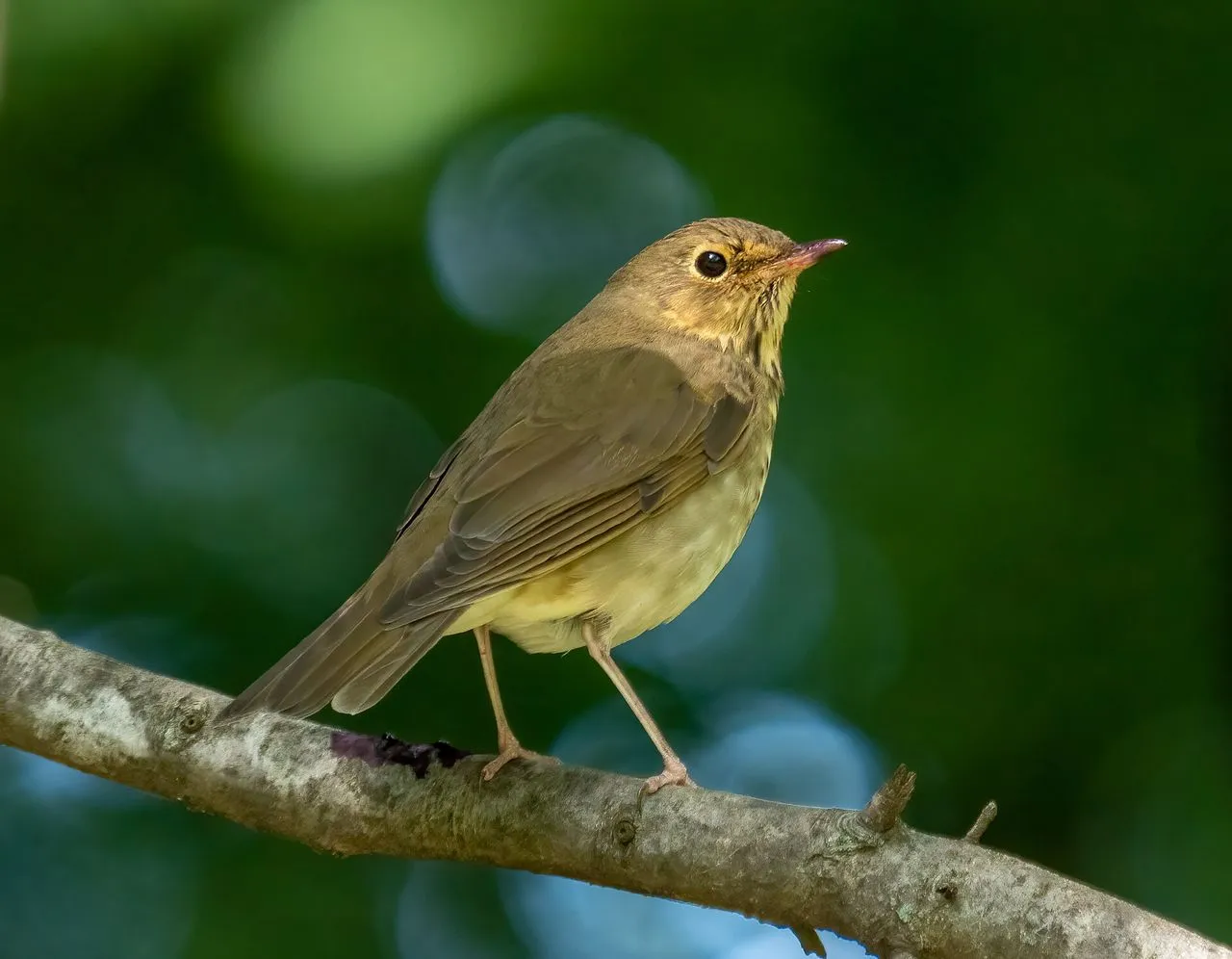
The two species are not closely related. American Robin (Turdus migratorius) is a 25 cm thrush native to North America, with a grey-brown back, brick-red breast covering the whole front, and a yellow bill. European Robin (Erithacus rubecula) is a 13 cm Old World flycatcher of Eurasia, with a brown back and a distinct orange face and breast patch limited to the chest and face. They were both named robin by English speakers for the orange breast, but they share no recent ancestor.
Turdus migratorius and Erithacus rubecula share a common English name and a similarly coloured breast patch. They share nothing else of biological significance. Placing them side by side is a textbook case of convergent naming: two unrelated birds that English-speaking observers connected by a single visible character, producing a confusion that has persisted for three centuries.
Part of the Complete Thrushes & Robins Guide.
Quick answer: American Robin (Turdus migratorius) is a large North American thrush, 23-28 cm, with an orange-red breast covering the entire front and a yellow bill. European Robin (Erithacus rubecula) is a small Old World flycatcher of Eurasia, 12-14 cm, with an orange face and breast patch that is sharply bordered by grey on the sides. They belong to different families and are not closely related.
Best first step: Check size. A bird roughly the bulk of a Common Blackbird with orange covering the whole front is American Robin. A round, sparrow-sized bird with a sharply defined orange face patch is European Robin.
Avoid: Assuming a shared name implies a shared family. The name transferred across the Atlantic on the basis of breast colour alone. Taxonomy did not follow.
The Big Comparison Table
| Character | American Robin (Turdus migratorius) | European Robin (Erithacus rubecula) |
|---|---|---|
| Scientific name | Turdus migratorius Gmelin, 1789 | Erithacus rubecula (Linnaeus, 1758) |
| Family | Turdidae (true thrushes) | Muscicapidae (Old World flycatchers) |
| Body length | 23-28 cm (9-11 in) | 12-14 cm (4.7-5.5 in) |
| Body mass | 72-94 g | 16-22 g |
| Back colour | Cool grey-brown | Warm olive-brown |
| Breast colour and extent | Brick-red to orange-red; covers entire breast and belly | Orange-red; limited to face and upper breast; bordered by blue-grey on neck sides |
| Bill | Yellow (breeding season); duller in winter | Dark, fine, insectivorous |
| Eye markings | Broken white eye ring | Large dark eye; no ring |
| Song | Rolling dawn carol; sustained; among the first voices of the dawn chorus | Thin, sweet warbled phrases; variable; delivered year-round, often from dense cover |
| Habitat | Lawns, suburbs, open woodland, parks | Dense shrubs, hedgerows, woodland edges, gardens with low cover |
| Range | North America | Europe, western Asia, North Africa |
| Conservation status | Least Concern (IUCN) | Least Concern (IUCN) |
| Sociality | Forms post-breeding flocks of hundreds to thousands | Solitary and territorial year-round |
| Cultural prominence | Symbol of spring in North America | British Christmas card bird; consistently voted UK's favourite bird |
Why Both Are Called Robin
The naming collision is a direct product of British colonisation of North America. English settlers arriving in the seventeenth and eighteenth centuries carried a mental image of the bird they had grown up with: a small, round, garden-friendly bird with an orange breast. When they encountered American Robin on the lawns and woodland edges of eastern North America, the brick-red breast was close enough to prompt an immediate comparison. The name transferred on the spot, despite the American bird being twice the size and belonging to a different family entirely.
Colonial naming in the New World was pragmatic and often imprecise. Settlers applied familiar bird names freely to whatever local species most closely resembled their remembered equivalents. American Robin shares this naming pattern with the American Blackbird, the American Sparrowhawk, and several others whose English names reflect British reference points rather than biological relationships.
The consequence for modern birders is straightforward: the name is useless as a taxonomic guide. American Robin is more closely related to Common Blackbird than it is to European Robin. The two robins' most recent shared ancestor was far more distant than the name suggests.
Plumage Differences That Matter
Both species have orange on the breast. How that orange is distributed is the most practically useful distinction after size.
On American Robin, the brick-red colour covers the entire front of the bird from the base of the throat to the lower belly. There is no contrasting border on the sides; the orange floods the whole underside. The grey-brown of the back meets the red at the shoulder, but the red itself is not framed or contained by any other colour. The visual effect is a large, unbroken expanse of warm red dominating the bird's front.
On European Robin, the orange patch is sharply bounded. It covers the face, the throat, and the upper breast, and it is bordered on both sides of the neck by a band of blue-grey that separates it from the olive-brown of the back and the white of the lower belly. The patch reads as a defined panel rather than a flood. At any distance where the bird is visible clearly, this bordered quality is obvious and distinctive.
Additional plumage markers: American Robin has a broken white eye ring and a yellow bill, neither of which is present on European Robin. European Robin has a noticeably large dark eye relative to its head, contributing to the round, alert expression that makes the species so recognisable as a cultural icon.
Juvenile American Robin is heavily spotted below, resembling the default thrush pattern of the family. Juvenile European Robin is mottled buff-brown with no orange, a plumage that suppresses territorial attacks from adults during the vulnerable post-fledging period.
Size
The size difference is larger than most people expect from photographs.
American Robin is 23-28 cm long and typically weighs 72-94 g. European Robin is 12-14 cm long and typically weighs 16-22 g. That is roughly twice the length and between four and five times the mass. Standing side by side, the comparison would look approximately like a starling next to a wren.
In the field, the two species are never found together in the wild, so direct comparison is not available. But for a European observer encountering American Robin for the first time in North America, the most common reaction is surprise at the size. A person whose mental model of "robin" is built from years of watching Erithacus rubecula at a garden feeder will find Turdus migratorius substantially, sometimes startlingly, larger than expected.
Size also anchors the comparison when photographs lack a reliable scale reference. American Robin is roughly the size of a Common Blackbird. European Robin is roughly the size of a Dunnock or a Great Tit. Knowing those reference points resolves most photographic ambiguity immediately.
Behavioural Contrasts
Foraging style is the most consistently different behaviour between the two species, and it reflects their different ecological niches.
American Robin is a lawn bird. It forages by running across short grass, stopping, tilting the head laterally to align its fovea downward toward the soil surface, and lunging to grab earthworms near the surface. This head-cocking behaviour is visual, not auditory: the bird is positioning its high-acuity foveal zone to detect prey movement, not listening for sounds underground. American Robin works open ground, is comfortable far from cover, and is undeterred by human proximity when foraging. Post-breeding flocks can number in the hundreds or thousands. The species is gregarious outside the breeding season in a way that no European Robin approaches.
European Robin is a shrub-edge bird. It forages by watching from a low perch, typically no more than a metre from the ground, and dropping onto prey spotted in the leaf litter below. It follows disturbance actively: a gardener turning soil brings a European Robin within seconds, because it has learned to associate the activity with exposed worms and beetle larvae. The species is strongly territorial year-round, with both males and females defending feeding territories through winter, and will chase conspecifics from garden feeding stations without hesitation.
Song timing also differs. American Robin is among the first voices in the North American dawn chorus, typically beginning thirty to forty minutes before sunrise. European Robin sings through the winter months, often in near-darkness, and is one of the few species reliably audible in a British garden on a mild February evening.
A Note on the Christmas Card
The robin on a British Christmas card, perched on a snowy postbox or a frost-covered spade handle, is European Robin. This association has two roots. First, Erithacus rubecula is one of the few British birds that sings and remains conspicuous through December, maintaining its garden presence when most other small passerines are cryptic or absent. Second, Victorian postal workers in Britain wore red uniforms and acquired the informal nickname "robins." When the Christmas card tradition developed in the mid-nineteenth century, robins appeared as stand-ins for the letter-carriers who delivered cards. The iconography became self-reinforcing and has persisted ever since.
American Robin plays no role in this tradition. In North American culture it is associated with spring rather than winter: it is the first conspicuous lawn bird to return after snow retreats, and its arrival is treated in many parts of the United States and Canada as a reliable seasonal marker. The cultural valence of the two species runs in almost exactly opposite directions. European Robin is a winter-garden icon. American Robin is a spring-arrival icon.
See Also
- American Robin (Turdus migratorius): full species account covering lawn foraging, head-cocking behaviour, diet, and garden breeding.
- European Robin (Erithacus rubecula): full species account covering year-round song, territorial behaviour, and garden habitat requirements.
- Common Blackbird (Turdus merula): the closest European equivalent to American Robin in size, family, and lawn-foraging style.
- Hermit Thrush (Catharus guttatus): another New World thrush often compared to American Robin; spotted underparts in all plumages.
- The Complete Thrushes & Robins Guide: full family reference covering identification, biology, and garden management for all thrush species on this site.
Frequently Asked Questions
Why are they both called robin?
English settlers in North America saw the brick-red breast of Turdus migratorius and recalled the orange-breasted bird they knew from British gardens. The name transferred on the basis of colour alone. The two birds belong to different families and the resemblance is superficial.
Are they ever found in the same place?
Not in the wild under normal circumstances. American Robin is native to North America and European Robin is native to Eurasia and North Africa. Vagrant American Robins have been recorded in western Europe, but the two species do not share any breeding or wintering range in a meaningful sense.
How big is each?
American Robin is 23-28 cm long and weighs 72-94 g. European Robin is 12-14 cm long and weighs 16-22 g. American Robin is roughly twice the length and four to five times the mass.
Which is the model for the Christmas card robin?
European Robin. The Victorian British Christmas card tradition depicted Erithacus rubecula, which remains conspicuous and singing through December in British gardens. American Robin is not associated with this tradition and is more typically a symbol of spring arrival in North American culture.