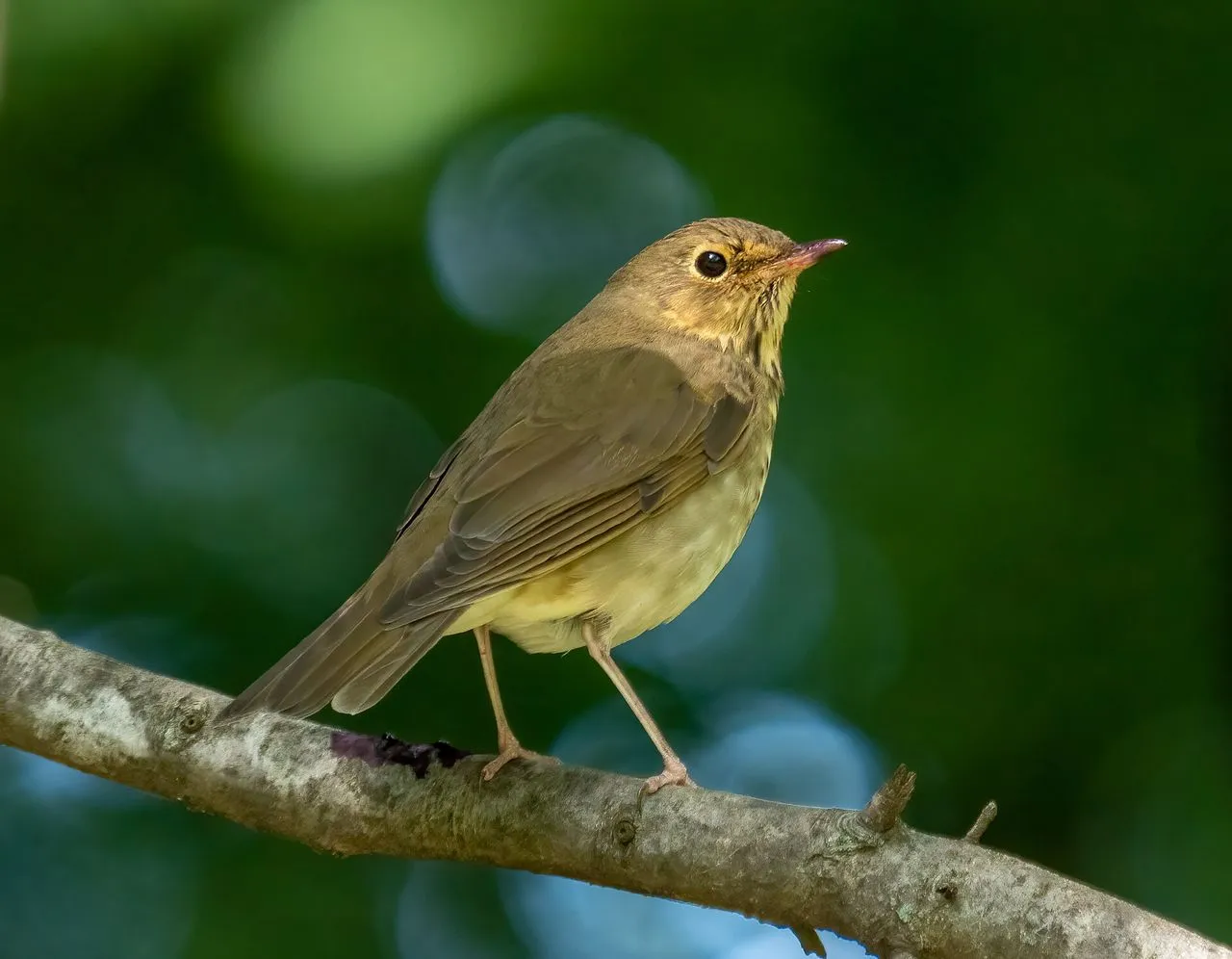
Swainson's Thrush (Catharus ustulatus) is a medium-small thrush (16-20cm). Buff spectacles around eye, olive-brown above, buff breast wash. Song spirals upward. Migrates at night through North America.
Catharus ustulatus (Nuttall, 1840), Swainson's Thrush, is a long-distance migrant whose western and eastern populations take different routes to wintering forests from Mexico to South America.
Part of the Complete Thrushes Guide.
Identification at a glance
| Character | Swainson's Thrush (C. ustulatus) | Hermit Thrush (C. guttatus) | Wood Thrush (H. mustelina) |
|---|---|---|---|
| Length | 16–20 cm (6.3–7.9 in) | 15–18 cm (5.9–7.1 in) | 18–21 cm (7.1–8.3 in) |
| Face | Broad buff eye ring and lores | Narrow pale eye ring, plain face | White eye ring, stronger bill |
| Tail | Similar tone to back | Rufous, contrasting; lift-drop flick | Shorter, no rufous contrast |
| Breast | Buff wash, softer spots | Darker triangular spots | Large black spots on white |
| Song | Upward-spiralling flutes | Clear phrases with pauses | Paired flute phrase and terminal trill |
Identification
Visual
Swainson's Thrush is a slim, medium-small Catharus, 16–20 cm long and generally 26–34 g, with olive-brown upperparts, pale underparts, and dark breast spotting. The face is the central field mark. A broad buff eye ring and buff lores create a spectacled expression, strongest in fresh autumn plumage and in western birds. The breast is washed buff, with spots that are dark but usually softer-edged than those of Wood Thrush.
The tail is not contrastingly rufous as in Hermit Thrush. The back, rump, and tail are broadly similar in tone, though western coastal birds can be warm brown. The bill has a pale base to the lower mandible. Sexes are alike. Juveniles show buffy marks on the upperparts and wing coverts, but by autumn the facial spectacles remain the most useful feature.
Separation from Gray-cheeked Thrush requires care. Swainson's has a warmer, buffier face, a more obvious eye ring, and usually a warmer breast wash. Gray-cheeked is colder, grayer, plainer-faced, and less likely to pause in garden edges during the day. Separation from Hermit Thrush rests on tail colour and behaviour: Swainson's lacks the rufous tail and repeated tail lift-drop.
Audio
The song is an upward-spiralling series of fluted notes, thin at the start and rising in pitch and intensity, as though the sound is winding upward through the canopy. This is the opposite contour of the Veery's descending spiral and less segmented than Hermit Thrush song. On breeding grounds, males sing from concealed perches in spruce, fir, alder, or mixed woodland, especially at dawn and dusk.
The common call is a sharp, liquid whit or whit-burr, often heard from dense cover during migration. Nocturnal flight calls are frequent over eastern North America in May and September, and automated recording stations detect the species far more often than daytime garden lists suggest.
Distribution
The breeding range spans boreal and montane North America, from Alaska across Canada to Newfoundland, and south through the Rocky Mountains, Cascades, Sierra Nevada, and parts of the northeastern United States. Two broad population groups are often recognised: olive-backed eastern and interior birds, and russet-backed Pacific coastal birds. Genetic and migratory differences between them are real, even where field separation is imperfect.
Migration is extensive. Spring movement through the eastern United States occurs mainly from late April through May, with northern breeding territories occupied into June. Autumn movement begins in August and peaks in September. Winter range extends from southern Mexico through Central America and into northern and western South America, including Andean foothills and humid forest edges.
Habitat
Breeding habitat varies by region but usually includes cool forest with a moist understorey. In the boreal zone it uses spruce, fir, tamarack, alder thickets, willow margins, and mixed conifer-hardwood stands. In the West it occupies coastal conifer forest, riparian woodland, and montane fir-spruce zones. Dense lower vegetation is more important than tree species alone.
During migration it appears in woodland edges, shaded gardens, ravines, stream corridors, urban parks, and fruiting shrub patches. It often remains low and quiet, especially after sunrise. A garden record usually depends on a bird briefly exposing itself at a berry shrub, bird bath, or damp leaf-litter patch before retreating to cover.
Diet and Foraging
During breeding, Swainson's Thrush takes insects, spiders, beetles, ants, caterpillars, flies, and small molluscs. It forages both on the ground and in low shrubs, more frequently above ground than Hermit Thrush and less openly than American Robin. The typical movement is a hop through shaded litter, a pause, and a quick pick from a leaf surface or soil surface.
Fruit is important during migration and on wintering grounds. Dogwood, elderberry, serviceberry, viburnum, chokecherry, and wild grape are used in North America. In tropical wintering areas the diet includes a wide range of small forest fruits, and the species acts as a seed disperser. Garden support is therefore seasonal: native berry shrubs near cover, no pesticide use in leaf litter, and water in dry migration weather.
Breeding Biology
The nest is an open cup of twigs, grasses, bark strips, moss, and rootlets, lined with finer material. It is usually placed in a small conifer, deciduous sapling, alder, or dense shrub, commonly 0.5–3 m above ground. Coastal and montane birds may nest higher in conifers where suitable branch platforms exist.
Clutch size is usually 3–4 eggs, pale blue to greenish blue and variably marked or unmarked. Incubation lasts about 12–14 days, chiefly by the female. Nestlings fledge after roughly 10–12 days. The season is short across much of the boreal range, so one brood is normal; replacement attempts follow early failures.
Migration timing imposes a narrow breeding window. Birds that winter as far south as the Andes must arrive, establish territories, breed, moult partially, and depart within a few months. Weather during May arrival can affect nesting density in northern forests by delaying territory settlement and insect emergence.
Notes
Swainson's Thrush is one of the better examples of migratory connectivity within a common songbird. Western populations moving down the Pacific slope and eastern populations crossing the Gulf or moving through Central America do not simply mix at random in winter. Their routes, stopover ecology, and winter destinations differ enough that habitat loss in one part of the non-breeding range can affect one breeding population more than another. A bird heard over an eastern city at 02:00 in September may be part of a population spending the northern winter thousands of kilometres away in Andean forest.
See Also
Frequently Asked Questions
How do I identify Swainson's Thrush?
Olive-brown above, pale below with dark spots. Broad buff eye ring and buff lores create 'spectacled' look. Tail not rufous like Hermit Thrush. Western birds warmer brown.
What does Swainson's Thrush song sound like?
Upward-spiralling series of fluted notes, rising in pitch and intensity. Opposite of Veery's descending spiral. Thin at start, fuller at end. From concealed perches.
How is Swainson's different from Gray-cheeked Thrush?
Swainson's has warmer, buffier face, more obvious eye ring, buff breast wash. Gray-cheeked is colder, grayer, plainer-faced. Best identified by face pattern.
Where does Swainson's Thrush breed?
Boreal and montane forest across Canada, Alaska, and western US. Western and eastern populations take different migration routes to wintering grounds in Mexico and South America.