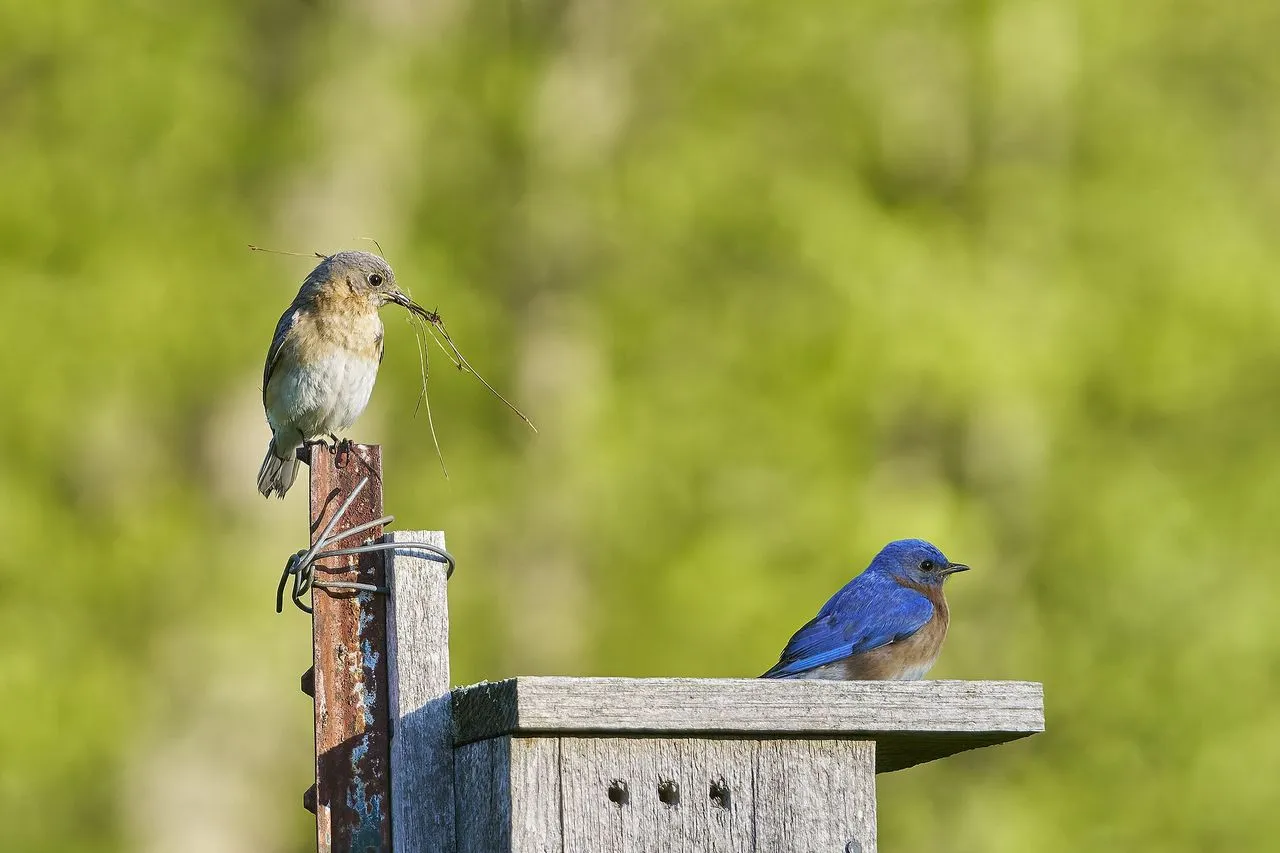
Eastern Bluebird (Sialia sialis) is a small thrush (16–21cm). Males vivid blue above, rusty chest; females duller. Native cavity nester, needs nest boxes with 38mm holes. Population recovered via nest box programs.
Sialia sialis (Linnaeus, 1758), the Eastern Bluebird, is a small thrush of open country across eastern North America, from southern Canada through the eastern United States to Nicaragua, and the subject of one of the better-documented population collapses and recoveries in North American ornithology.
Part of the Complete Thrushes & Robins Guide.
Identification at a glance
| Character | Eastern Bluebird (S. sialis) | Western Bluebird (S. mexicana) | Mountain Bluebird (S. currucoides) |
|---|---|---|---|
| Length | 16–21 cm (6.3–8.3 in) | 16–19 cm (6.3–7.5 in) | 16–20 cm (6.3–7.9 in) |
| Male | Blue above, rusty chest, white belly | Blue throat, chestnut breast and scapulars | Pale sky-blue, no orange |
| Female | Blue-grey above, pale orange chest | Grey-brown, blue wings, subdued orange breast | Grey-brown, blue wings and tail, no orange |
| Habitat | Open eastern country with boxes | Western oak and pine woodland | Open grassland, sagebrush, alpine meadow |
| Nest box | 38 mm (1.5 in) entrance | 38 mm (1.5 in) entrance | 38 mm (1.5 in) entrance |
Identification
Adult male: the most vivid blue of any common eastern garden bird. Upperparts from crown to tail are a deep cobalt-blue; breast and flanks are warm chestnut-orange; belly and undertail coverts are white. The blue is structural colour, produced by light scattering at the microscopic level in the feather barbules rather than by pigment; its intensity shifts with viewing angle and light.
Adult female: structurally identical but consistently paler throughout. The blue on the upperparts is reduced to a wash, most visible on the wings and tail; the back reads grey-brown. The breast is a subdued warm buff rather than chestnut. In flat overcast light, a female can appear almost entirely grey-brown; the faint blue on the primary coverts and the upright posture are the key identifiers.
Juvenile: grey-brown overall with pale spotting on the underparts, the standard Turdidae juvenile pattern shared with young American Robins and Catharus thrushes. Blue is restricted to faint hints on the wing feathers. Observers expecting an obviously blue bird frequently overlook juveniles entirely; the habitat context (near a nest box or dead snag in open grassland) is often the most useful identification aid.
Size. Total length 16–21 cm; weight 27–34 g. Noticeably smaller and slimmer than the American Robin, closer in size to a large sparrow.
In flight. Adult males are unmistakable in good light: the combination of rich blue upperparts and chestnut breast visible simultaneously is not shared by any other common eastern species.
Ecology and Foraging
Eastern Bluebirds are perch-and-drop hunters rather than ground foragers in the manner of American Robins. The typical sequence: a glide from a low exposed perch (fence post, wire, snag) to open ground where a grasshopper, beetle, or caterpillar is taken, then a return to the perch. This hunting method requires open ground below the perch with good sight lines: mown pasture, short meadow, cut verge. Dense grass or shrub cover makes it unworkable.
In autumn and winter, when insects are scarce, fruit replaces invertebrates. Dogwood berries, holly, mistletoe, and viburnum are all taken readily. Eastern Bluebirds are less inclined to ground-forage for earthworms than American Robins, and less likely to visit supplementary feeders except during cold spells.
Decline, Recovery, and the Nest Box Record
The mid-20th century decline of the Eastern Bluebird was steep and well-documented. Population estimates suggest numbers had dropped to 17–33% of pre-1900 levels in the most affected regions by the late 1970s. Two introduced species drove most of the collapse: the European Starling (Sturnus vulgaris), which outcompetes bluebirds for cavities, and the House Sparrow (Passer domesticus), which does the same and also destroys eggs and kills nestlings of competing species. Simultaneously, agricultural modernisation removed dead snags, wooden fence posts, and old orchards, the natural cavity supply the species had relied upon.
The recovery since the mid-1970s was driven almost entirely by nest box programmes. The North American Bluebird Society, founded in 1978, standardised box designs and trail management protocols based on data accumulated from tens of thousands of monitored boxes across the continent. That evidence base is specific enough to act on directly.
Nest Box Dimensions
Entrance hole diameter: 38 mm (1.5 inches). This admits Eastern Bluebirds while excluding European Starlings, which require a minimum of approximately 45 mm. The 7 mm difference is the single most consequential dimension in the design.
Interior floor: approximately 10 × 10 cm (4 × 4 inches). Bluebird nests average 7–9 cm in diameter; the slightly larger floor allows normal construction without the bird working against the walls.
Box depth: 18–23 cm from floor to entrance hole. Shallower boxes show higher rates of nest predation by reaching predators. Deeper boxes reduce light entry and are occupied less consistently.
Placement
Mount at 1.2–1.8 m above ground on a smooth metal pole with a predator baffle. Wooden fence posts and tree trunks are used less successfully in monitored programmes; raccoons, snakes, and domestic cats climb them with little difficulty. A smooth metal pole fitted with a cone or stovepipe baffle eliminates most climbing predation.
Face the entrance away from prevailing weather, typically north or east across most of eastern North America. Direct afternoon sun on the entrance raises internal box temperature to levels that cause abandonment and nestling mortality.
Space boxes at minimum 90 m apart. Eastern Bluebirds defend a territory around the nest box and will disrupt pairs placed closer. Tree Swallows (Tachycineta bicolor), which also occupy boxes readily, tolerate tighter spacing and can be accommodated alongside bluebirds by placing two boxes 5–10 m apart, one for each species.
Monitor weekly through the breeding season. House Sparrow nest-building should be removed immediately and repeatedly; the species re-attempts within days. Weekly checks generate occupancy and productivity data that improve placement decisions over successive seasons.
Attracting Eastern Bluebirds to a Garden
The requirements are specific and not easily substituted. Open ground with good sight lines from a low perch structure is the first constraint. A correctly dimensioned box on a baffled metal pole is the second. A mealworm feeder during cold snaps, and fruit plantings of native dogwood or winterberry for winter foraging, supplement the core habitat requirements but do not replace them.
If the garden is predominantly wooded or enclosed by dense shrubs, Eastern Bluebirds are unlikely to establish regardless of what else is on offer.
The population recovery, while substantial, is not complete. Eastern Bluebird numbers remain below pre-20th-century levels in much of the range, and the species continues to depend on active human management: maintained boxes, monitored trails, preserved open habitat. Setting up a box and monitoring it is not optional; it is what the programme runs on.
See Also
- American Robin (Turdus migratorius)
- Western Bluebird (Sialia mexicana)
- Mountain Bluebird (Sialia currucoides)
- The Complete Attracting Guide
- The Complete Thrushes & Robins Guide
- Why Is My Nest Box Empty?: common reasons a bluebird box stays unused, with the entrance-hole rules and habitat checklist.
- Eastern vs Western Bluebird: throat colour decides; rusty throat is Eastern, blue throat is Western.
Frequently Asked Questions
How do I identify Eastern Bluebird?
Male: bright blue above, rusty-orange chest, white belly. Female: blue-grey above, pale orange chest. Compare to Western (more extensive blue) and Mountain (all blue males).
What are correct nest box dimensions?
100x100mm floor, 200mm interior height, 38mm entrance hole (no perch). Mount 1.5–2m high on smooth pole with predator baffle, facing away from prevailing winds.
Why did bluebirds decline?
Competition from introduced House Sparrows and Starlings for nest cavities. Nest box programs with proper dimensions (no perch, 38mm hole) excluded these competitors and enabled recovery.
Do bluebirds use feeders?
Rarely at seed feeders. They eat insects (grasshoppers, beetles, caterpillars) and occasionally mealworms. Attract with appropriate nest boxes and open habitat.