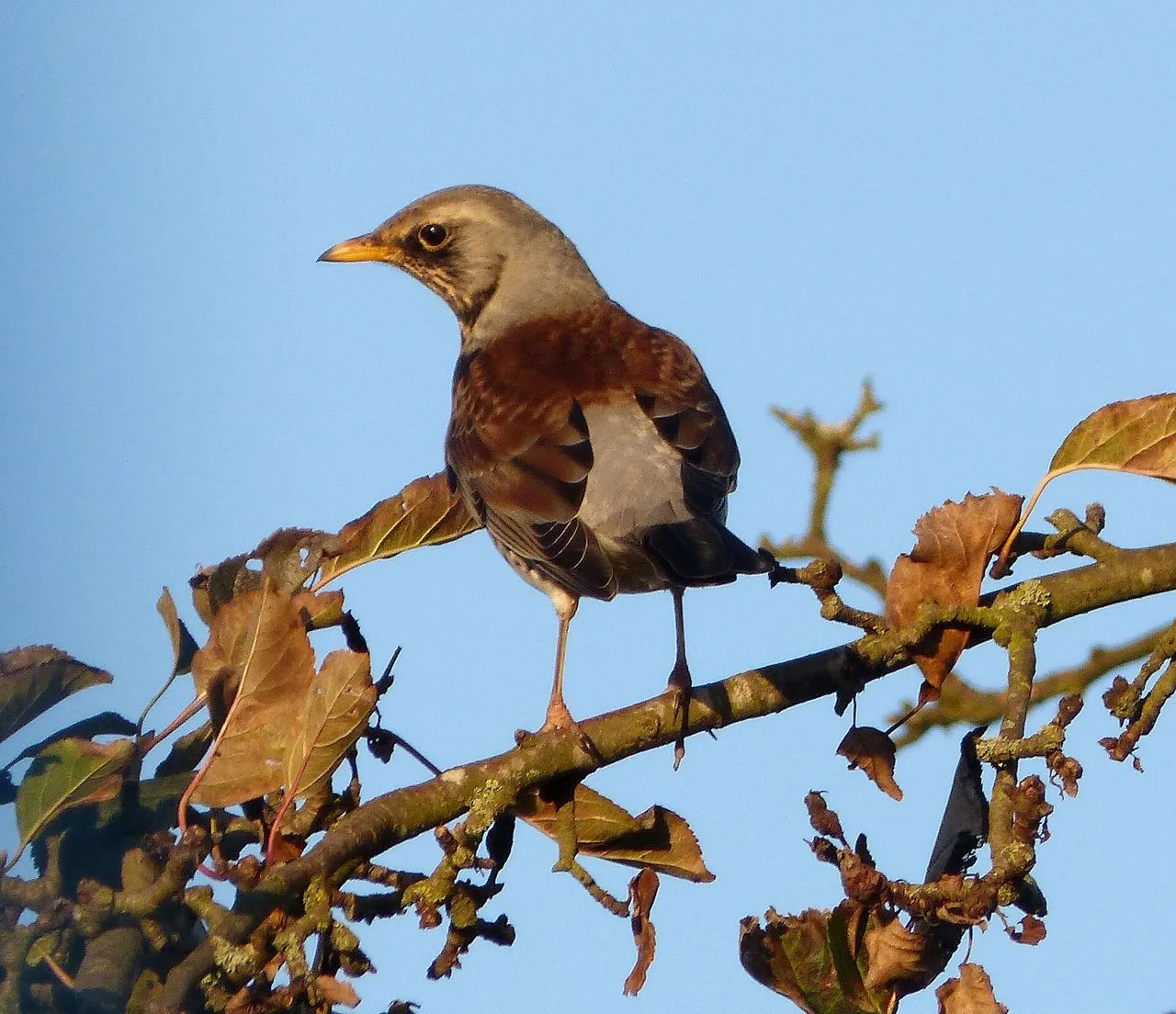
Fieldfare (Turdus pilaris) is a large northern thrush (22-27cm). Grey head and rump, chestnut back, spotted breast. Winter visitor to Britain and western Europe from Scandinavia. Noisy flocks in orchards and fields.
Turdus pilaris Linnaeus, 1758, the Fieldfare, is a large northern thrush that reaches Britain and western Europe in winter flocks, often moving into orchards and gardens when frost locks pasture.
Part of the Complete Thrushes Guide.
Identification at a glance
| Character | Fieldfare (T. pilaris) | Redwing (T. iliacus) | Mistle Thrush (T. viscivorus) |
|---|---|---|---|
| Length | 22–27 cm (8.7–10.6 in) | 19–23 cm (7.5–9.1 in) | 26–29 cm (10.2–11.4 in) |
| Upperparts | Grey head and rump, chestnut back | Brown, bold cream eyebrow | Cold grey-brown |
| Underparts | Ochre breast, heavy spots | Fine streaks, red flanks | Large round spots down belly |
| Winter behaviour | Noisy flocks in orchards and fields | Nervous flocks near hedges | Often solitary, fruit-defending |
| Call | Dry chattering chak-ak-ak | Thin seeip flight call | Dry rattling trrrrrr |
Identification
Visual
Fieldfare is a big, bold Turdus, 22–27 cm long and usually 80–140 g, close to Mistle Thrush in size but more strongly patterned. The head, nape, and rump are gray; the back is chestnut-brown; the tail is blackish; the breast is ochre-washed with heavy dark spotting. In flight, the pale gray rump and dark tail are conspicuous.
The structure is long and strong, with a direct flight and upright stance in open fields. Sexes are similar, though males can show cleaner gray and richer chestnut. Juveniles are duller and more mottled but still show the gray rump and general Fieldfare shape by autumn.
Compared with Redwing, Fieldfare is much larger, paler, and more contrasting, with no red flank patch or bold cream eyebrow. Compared with Mistle Thrush, Fieldfare has a gray head and rump, chestnut back, and flocking behaviour. Mistle Thrush is more solitary in winter and colder-toned overall.
Audio
The common call is a dry, chattering chak-ak-ak-ak, often given as flocks rise from fields or trees. It is harsher and more clattering than Redwing calls and less rattling than Mistle Thrush alarm. Winter flocks are noisy when disturbed, and the call carries across open farmland.
The song, heard on breeding grounds, is a mixture of chattering, squeaks, and thrush-like phrases, less musical than Blackbird or Song Thrush. For most British observers, call is the relevant vocalisation. A noisy flock leaving an apple orchard in January is almost certainly Fieldfare before binoculars are raised.
Distribution
Fieldfare breeds across northern and eastern Europe into western and central Siberia, with strong populations in Scandinavia, Finland, the Baltic region, and Russia. It has expanded westward in parts of Europe over the last two centuries, but remains mainly a winter visitor in Britain, where breeding is rare and irregular.
Autumn arrivals in Britain begin in October and November, often alongside Redwings. Numbers vary with Scandinavian berry crops, snow cover, and easterly weather. Winter range extends through western and central Europe, with movements south and west during severe cold. Birds return north from March into April.
Habitat
Breeding habitat includes birch woodland, forest edge, riverine woodland, farmland groves, and open areas with scattered trees. Colonies often form in trees near open feeding grounds, and the species tolerates northern settlements and agricultural margins.
Winter habitat is open farmland, pasture, hedgerow country, orchards, playing fields, parkland, and large gardens with fruiting trees. Fieldfares feed in open fields when ground is soft, then retreat to tall trees or hedges. During frost and snow they concentrate at orchards, hawthorn hedges, rowan, cotoneaster, and fallen apples.
Diet and Foraging
In mild winter weather, earthworms and soil invertebrates form a major part of the diet. Flocks spread across pasture and move in a loose front, running and stopping like oversized robins. Frozen ground shifts feeding toward fruit. Hawthorn, rowan, rose hips, holly, yew, cotoneaster, and apples are all important.
Fieldfares defend fruit sources aggressively in hard weather, but defence is unstable because flocks constantly challenge one another. A single bird may dominate a small garden apple tree for hours, only to be displaced by a larger flock. Cut apples on snow can attract Fieldfares, especially in rural or edge-of-town gardens, but they prefer open visibility and are wary of enclosed spaces.
Breeding Biology
The nest is a substantial cup of grass, twigs, moss, and mud, lined with fine grass. It is placed in trees or large shrubs, often 2–10 m above ground. Fieldfares frequently nest colonially, with several to dozens of pairs in loose groups. This is unusual among familiar European thrushes and shapes their predator defence.
Clutch size is usually 5–6 eggs, blue-green with reddish markings. Incubation lasts about 12–14 days, mostly by the female. Nestlings fledge after 12–16 days. One brood is typical in northern areas, though replacement clutches and occasional second attempts occur.
Colonies mob predators with intensity. Adults dive at crows, raptors, squirrels, and mammals, and they defecate on intruders, a behaviour that can foul plumage and impair insulation or flight in small predators. Group defence allows nesting in semi-open northern woodland that would be risky for isolated pairs.
Notes
Fieldfare winter abundance in Britain is governed less by calendar than by weather and fruit geography. In a mild December, birds may remain scattered across farmland and barely enter gardens. After a week of frozen ground and snow cover, the same region can suddenly hold Fieldfares in orchards, supermarket rowans, school playing fields, and suburban apple trees. Their appearance in gardens is therefore a hard-weather signal: not domestication, but displacement from pasture to fruit.
See Also
Frequently Asked Questions
How do I identify Fieldfare?
Large thrush with grey head, nape, rump, chestnut-brown back, blackish tail, ochre breast with dark spots. In flight shows pale grey rump and dark tail. Much larger than Redwing.
Where does Fieldfare come from in winter?
Breeds across northern Europe and Scandinavia. Arrives in Britain September-November as a winter visitor. Moves into orchards, fields, and gardens when ground freezes.
What do Fieldfares eat in gardens?
Fruit: apples, rowan berries, hawthorn. Also earthworms, insects. Often noisy flocks in apple orchards in hard weather. Attract with fruit on ground feeders.
How is Fieldfare different from Mistle Thrush?
Fieldfare has grey head/rump, chestnut back, flocks in winter. Mistle Thrush is colder grey-brown, more solitary, bigger spots on belly, sings in winter storms.