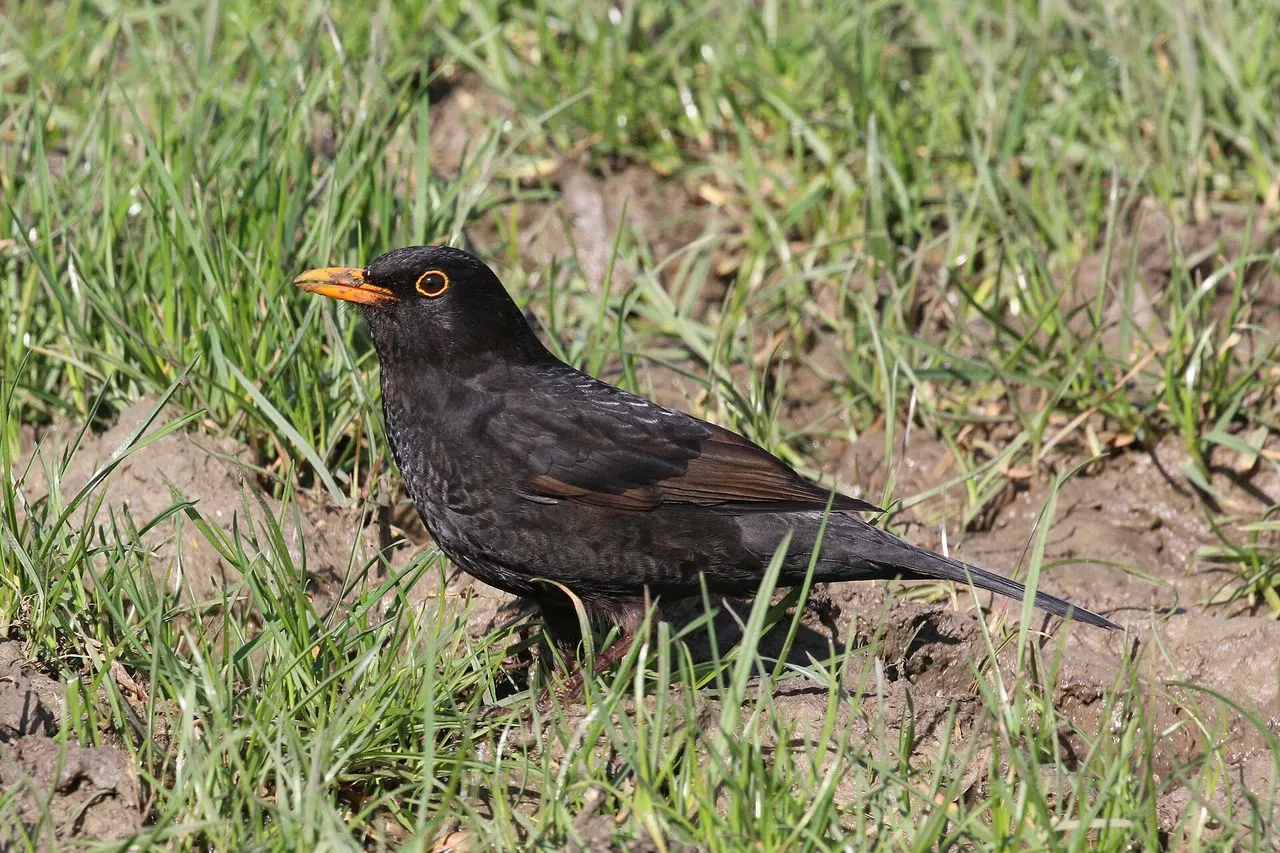
Common Blackbird (Turdus merula) is Europe's garden thrush (23-29cm). Males are glossy black with yellow bill and eye ring; females are brown. Found across Europe and temperate Asia. Runs on lawns hunting worms, fluted song from rooftops. More territorial than American Robin, less flocking.
Turdus merula Linnaeus, 1758, the Common Blackbird, is the familiar large garden thrush of Europe and is ecologically closer to the American Robin than the European Robin is.
Part of the Complete Thrushes Guide.
Identification at a glance
| Character | Common Blackbird (T. merula) | American Robin (T. migratorius) | Song Thrush (T. philomelos) |
|---|---|---|---|
| Length | 23–29 cm (9.1–11.4 in) | 23–28 cm (9.1–11 in) | 20–23 cm (7.9–9.1 in) |
| Male | Glossy black, yellow bill | Grey-brown, orange-red breast | Warm brown, spotted below |
| Female | Brown, mottled below | Paler grey-brown and brick-orange | Sexes alike |
| Song | Rich fluted phrases | Rolling carolling | Repeated phrases |
| Garden role | Territorial lawn and hedge thrush | Open lawn forager, often flocking | Cover-edge snail and worm forager |
Identification
Visual
Adult male Common Blackbird is glossy black with a yellow to orange-yellow bill and a yellow eye ring. Total length is 23–29 cm, weight commonly 80–125 g, very close to American Robin in size. The legs are dark, the tail fairly long, and the stance upright when feeding on lawns or borders.
Adult female is dark brown rather than black, with a browner bill, faint throat streaking, and mottled brown underparts. Many females show a warmer breast and paler throat, leading to confusion with juvenile thrushes. Juveniles are reddish-brown to dark brown with buff streaking and spots, especially below and on the wing coverts. By late autumn males begin to darken, but first-winter birds may retain dull bills.
The black male is unmistakable in most of Europe. The female requires context: larger and longer-tailed than Song Thrush, less spotted below, more uniform, and more likely to run across open lawn. Compared with Starling, male Blackbird has a longer tail, softer body shape, and a thrush's run-and-stop movement rather than a strutting walk.
Audio
The song is a rich, fluted sequence of mellow phrases, usually delivered from a rooftop, tree, aerial, or high shrub from March through July. It is slower and more liquid than Song Thrush, without repeated phrases. Many males include quiet subsong and local improvisation, and older birds can develop recognisable neighbourhood themes.
Calls are varied. The sharp chink-chink-chink alarm call is common at dusk when cats, owls, or people disturb roosting birds. A thin, high seee call signals aerial predators. The loud, frantic evening alarm of a Blackbird in a garden hedge is one of the most reliable indicators of a hunting cat or Tawny Owl nearby.
Distribution
Common Blackbird breeds across Europe, North Africa, the Middle East, and much of temperate Asia, with introduced populations in Australia and New Zealand. In Britain and western Europe it is abundant and largely resident. Northern and eastern populations are more migratory, adding winter birds to resident populations farther west.
Urbanisation has favoured the species in many regions. Forest Blackbirds and urban Blackbirds now differ in behaviour, breeding timing, migratory tendency, and tolerance of humans. British garden birds may begin breeding earlier than rural birds because urban heat and supplementary feeding alter winter survival and spring condition.
Habitat
The species uses woodland, hedgerows, parks, gardens, orchards, farmland edges, scrub, and urban streets with shrubs. It needs ground access for foraging and cover for nesting. Dense evergreen shrubs, ivy, bramble, hedges, and leaf litter are particularly valuable.
In gardens, Blackbirds occupy a role similar to American Robins in North America: visible ground thrushes working lawns, borders, and fruiting shrubs. They are more territorial and less flocking than robins, but the foraging niche is comparable. Bare patios and sterile gravel offer little; mixed shrub borders and damp lawns offer much more.
Diet and Foraging
Earthworms are central to the breeding-season diet, supplemented by beetles, caterpillars, leatherjackets, slugs, snails, and spiders. Blackbirds run, stop, cock the head, and lunge, using visual cues in the same broad manner as other thrushes. They also toss leaves vigorously under shrubs, often creating small cleared patches in mulch.
Fruit becomes important in late summer and winter. Elder, blackberry, hawthorn, rowan, holly, ivy, yew, apples, pears, and cotoneaster are taken. At feeders Blackbirds use ground trays and low tables for mealworms, suet pellets, soaked raisins, and chopped fruit. They rarely use hanging seed feeders effectively and are easily excluded by designs made for tits or finches.
Breeding Biology
The nest is a cup of grass, leaves, moss, and small twigs, reinforced with mud and lined with fine grass. It is placed in shrubs, hedges, ivy, climbers, sheds, small trees, or dense evergreen cover, usually below 3 m but sometimes higher. Females build the nest and incubate.
Clutch size is usually 3–5 eggs, blue-green with reddish-brown mottling. Incubation lasts 12–14 days. Nestlings fledge after 13–14 days, often before they can fly well, and spend several days hidden on or near the ground. Two or three broods are common in Britain; early nests may begin in March in mild urban areas.
Predation is heavy. Cats, Magpies, Carrion Crows, rats, squirrels, and Sparrowhawks all take eggs, young, or adults. High productivity, repeated nesting, and close use of human gardens compensate for these losses in many urban populations.
Notes
For transatlantic observers, Common Blackbird is the European bird most comparable to American Robin in size, posture, and lawn foraging. The European Robin shares a red breast with the American Robin but not its ecology. A male Blackbird pulling worms from a British lawn in April is performing the role that Turdus migratorius performs on a New England lawn, though with a different social system and a more concealed nesting style. This comparison corrects more field misunderstandings than the shared word robin ever has.
See Also
Frequently Asked Questions
How do I identify Common Blackbird?
Male: glossy black with yellow bill, yellow eye ring, dark legs. Female: dark brown with mottled breast, brownish bill. Both are robin-sized with upright stance and run-and-stop foraging.
What does Common Blackbird song sound like?
Rich, mellow fluted phrases, slower and more liquid than Song Thrush. Males sing from March through July on rooftops, trees, and shrubs. No repeated phrases like Song Thrush.
What do Common Blackbirds eat in gardens?
Earthworms, beetles, caterpillars in breeding season. Fruit in late summer: elder, blackberries, hawthorn, rowan. Takes mealworms, soaked raisins on ground feeders.
How is Common Blackbird different from American Robin?
Both are similar-sized thrushes using lawns, but Common Blackbird is more territorial, less flocking, nests in dense cover rather than open ledges. Not closely related, different genus.