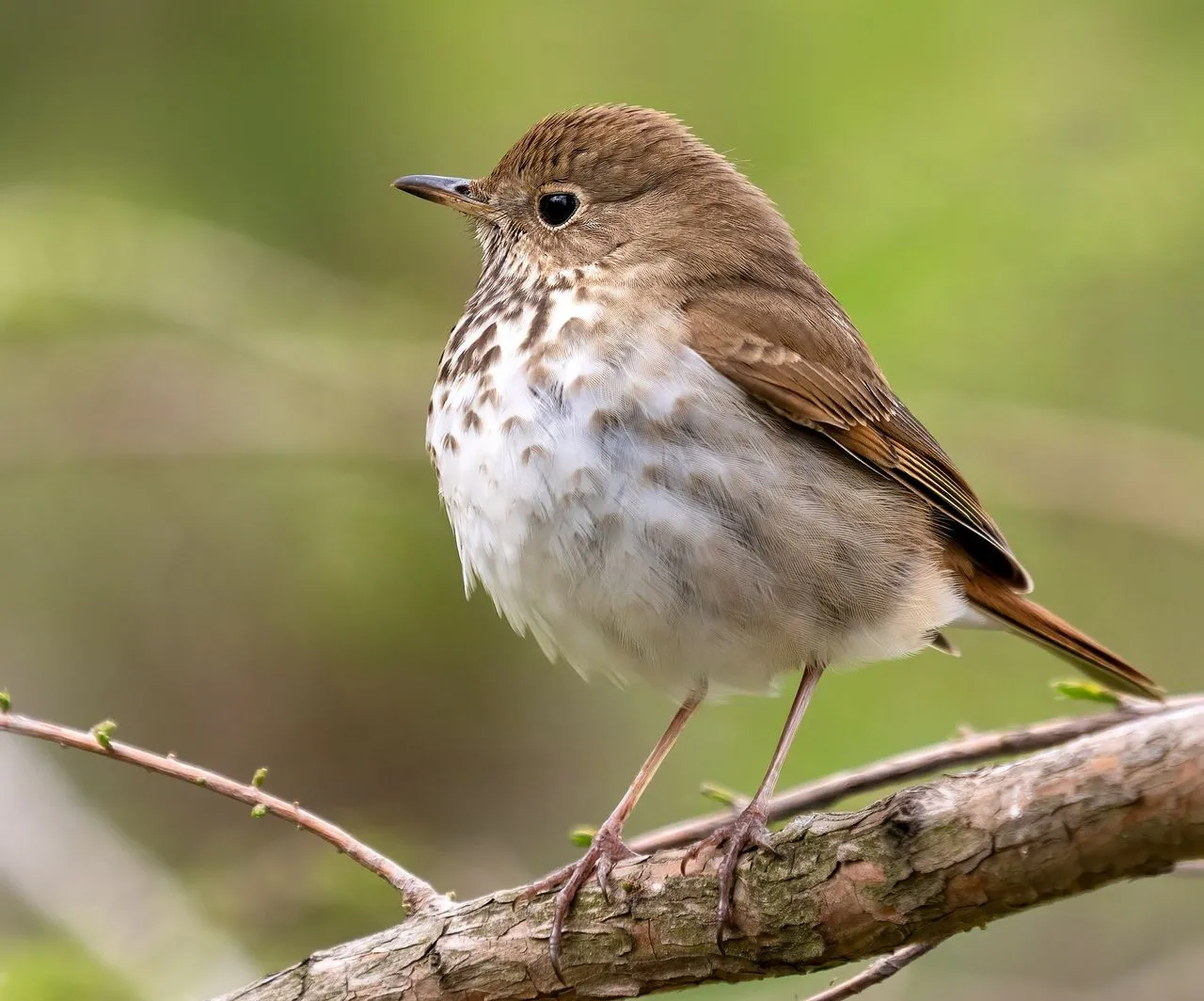
Hermit Thrush (Catharus guttatus) is a small brown spotted thrush (15-18cm). Key mark: rufous tail contrasting with olive-brown back. Upright posture, distinctive tail-flicking. Ethereal flute-like song. Breeds in boreal forest.
Catharus guttatus (Pallas, 1811), the Hermit Thrush, is the hardiest North American Catharus, breeding into boreal forest and wintering farther north than its congeners wherever unfrozen berries and sheltered cover persist.
Part of the Complete Thrushes Guide.
Identification at a glance
| Character | Hermit Thrush (C. guttatus) | Swainson's Thrush (C. ustulatus) | Wood Thrush (H. mustelina) |
|---|---|---|---|
| Length | 15–18 cm (5.9–7.1 in) | 16–20 cm (6.3–7.9 in) | 18–21 cm (7.1–8.3 in) |
| Spotting | Dark triangular breast spots | Softer dark spots on buff wash | Large blackish spots to flanks |
| Face | Narrow pale eye ring | Broad buff spectacles | Bold white eye ring and pale lores |
| Tail | Rufous, contrasts with back; lift-drop flick | Concolor with back | Shorter, less contrasting |
| Song | Flute-like phrases with pauses | Upward-spiralling flutes | Paired ee-oh-lay phrase and trill |
Identification
Visual
The Hermit Thrush is a small, brown, spotted thrush, 15–18 cm long and usually 24–37 g, with the upright posture and large dark eye typical of the Turdidae. The key field mark is contrast: warm rufous tail and rump against a colder olive-brown back. In good light the tail looks noticeably redder than the mantle; in poor light it still gives a warmer flash when the bird moves.
The face is plain, with a narrow pale eye ring and weak buff spectacles. The underparts are white to dull buff, with dark triangular spots concentrated on the breast and fading down the flanks. The legs are pinkish. Sexes are alike in plumage. Juveniles in late summer show additional buff spotting on the upperparts, but they already carry the reddish tail and the habitual tail movement.
The tail behaviour is diagnostic at garden distance. A Hermit Thrush often raises the tail slowly, then drops it with a sharper downward flick while standing still or after a short hop. Other Catharus thrushes may twitch or shift the tail, but the repeated lift-and-drop pattern, combined with a rufous tail, is the most reliable visual separation in autumn migration.
Audio
The song is a sequence of clear, flute-like phrases, each opening with a single sustained note followed by a delicate, descending or spiralling flourish. Individual phrases are separated by pauses long enough for the listener to hear the structure rather than a continuous stream. The dominant impression is spatial: the opening tone seems projected from a shaded conifer stand, then the phrase dissolves into thinner overtones.
Call notes are more useful outside the breeding season. The common contact call is a low, soft chup or tuck, less metallic than the call of Swainson's Thrush and less liquid than Veery. On migration, Hermit Thrushes also give thin nocturnal flight calls, but these are not as distinctive to most human ears as the daytime tail movement.
Distribution
Hermit Thrush breeds across Canada, Alaska, the northeastern United States, the Appalachian highlands, and montane forests of the western United States. The northern breeding limit reaches close to the tree line where spruce, fir, and tamarack remain available. Western populations occupy coniferous and mixed forests from sea level in the Pacific Northwest to above 2,500 m in the Rocky Mountains and Sierra Nevada.
Migration is relatively late for a Catharus. Spring passage through the eastern United States is concentrated from April into mid-May; autumn passage often extends through October and into November. Winter range covers the Pacific Coast, the southern United States, Mexico, and parts of Central America. Small numbers winter regularly north to southern New England, the Great Lakes margins, and sheltered urban ravines when fruit supplies are adequate.
Habitat
Breeding habitat is usually cool, shaded forest with a developed understorey: spruce-fir forest, mixed northern hardwoods, hemlock ravines, damp conifer edges, and montane woodland. It is less strictly tied to deep forest interior than Wood Thrush, but it still requires cover near the ground for nesting and foraging.
During migration and winter it becomes a bird of edges, thickets, stream corridors, cemetery plantings, suburban woodlots, and berry-bearing garden margins. It will enter gardens with dense shrubs, especially where leaf litter has not been removed. Open lawn alone is of little value; the bird works the dark boundary between cover and exposed feeding ground.
Diet and Foraging
In the breeding season the diet is dominated by beetles, ants, caterpillars, flies, spiders, and other ground invertebrates. Earthworms are taken where available, but Hermit Thrush is less dependent on lawns and saturated turf than American Robin. It forages by hopping and pausing in leaf litter, turning leaves with the bill, and making short lunges at surface prey.
Fruit becomes increasingly important from late summer onward. Dogwood, viburnum, serviceberry, elderberry, poison ivy, holly, and juniper are all used. Wintering birds survive in northern areas only where fruit persists above snow level and cover reduces wind exposure. The best garden support is not a feeder but a structurally messy edge: native shrubs, fallen leaves, and fruit that remains after the first frosts.
Breeding Biology
The nest is a cup of grasses, leaves, rootlets, bark strips, and moss, usually placed on or near the ground, often in a small conifer, fern clump, stump cavity, or low shrub. Heights from ground level to 1.5 m are typical, although higher nests occur. The female performs most nest construction.
Clutch size is usually 3–4 eggs, pale blue to greenish blue and unmarked. Incubation lasts about 12 days, carried out by the female. Nestlings fledge after 10–12 days and remain dependent for roughly another two weeks. Two broods are possible in southern parts of the breeding range, but single brooding is more typical in boreal and high-elevation sites where the season is short.
Nest failure is driven by ground predators, cold rain, and Brown-headed Cowbird parasitism in fragmented landscapes. The species tolerates some edge habitat outside the breeding season, but breeding success is highest where low cover is continuous rather than reduced to isolated ornamental shrubs.
Notes
The Hermit Thrush's tail-flick is not ornamental display in the usual sense. It is most often expressed while the bird is foraging alone, and it may function as a low-cost signal of alertness to predators or as a movement cue that flushes small invertebrates from leaf litter. Whatever the exact mechanism, it is field-useful because it persists across age, sex, season, and light conditions. A brown spotted thrush that repeatedly lifts and drops a reddish tail in October is almost never anything else.
See Also
Frequently Asked Questions
How do I identify Hermit Thrush?
Small brown thrush with warm rufous tail and rump contrasting with colder olive-brown back. Pale eye ring, spots on breast. The tail lift-and-drop is diagnostic.
What makes Hermit Thrush tail-flicking special?
Repeated slow lift, sharper drop, other Catharus thrushes may twitch tail but not show this pattern. Combined with rufous tail, it's the best visual separation.
What does Hermit Thrush song sound like?
Clear flute-like phrases, each opening with sustained note followed by descending flourish. Long pauses between phrases. Often from shaded conifer stands at dawn/dusk.
Where does Hermit Thrush breed?
Boreal and montane forests across Canada, Alaska, and northern US. Winters in southern US, Mexico, Central America. One of the hardiest Catharus, winters farther north.