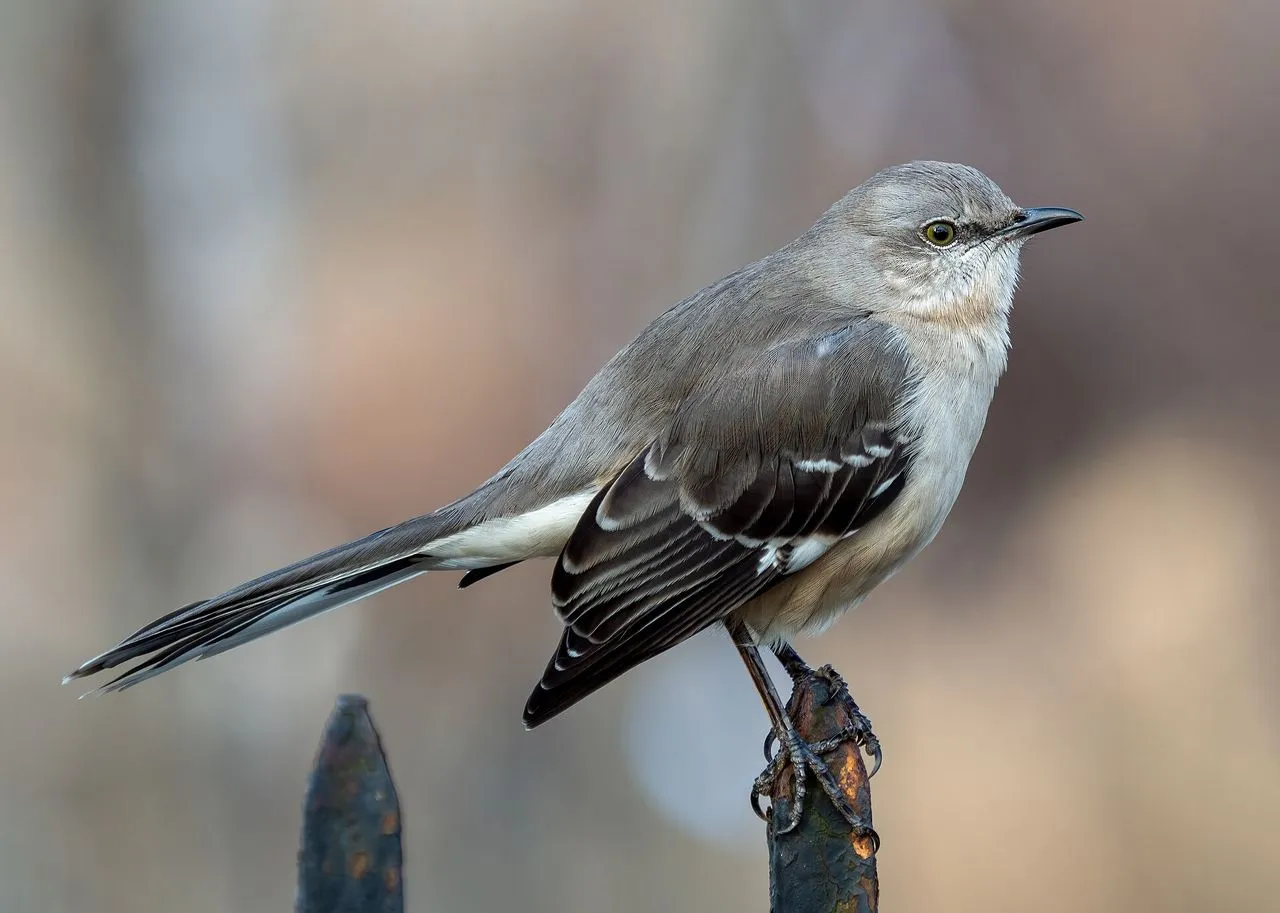
Northern Mockingbird (Mimus polyglottos) is a mimid (21-26cm), not a thrush. Grey above, white below, long tail. White wing patches flash in flight. Repertoires of 100+ song types. Aggressively territorial year-round.
Mimus polyglottos (Linnaeus, 1758), the Northern Mockingbird, is a mimid rather than a thrush and may hold repertoires exceeding 100 song types while defending fruiting shrubs, nest sites, and winter territories with conspicuous aggression.
Part of the Complete Thrushes Guide.
Identification at a glance
| Character | Northern Mockingbird (M. polyglottos) | Gray Catbird (D. carolinensis) | American Robin (T. migratorius) |
|---|---|---|---|
| Length | 21–26 cm (8.3–10.2 in) | 21–24 cm (8.3–9.4 in) | 23–28 cm (9.1–11 in) |
| Plumage | Grey above, pale below, white wing patches | Slate grey, black cap, chestnut undertail | Grey-brown above, orange-red breast |
| Tail | Long, conspicuous | Long, dark, often flicked | Shorter, white corners in flight |
| Song | Mimic phrases repeated 3–6 times | Rambling phrases, usually not repeated | Clear rolling carol |
| Behaviour | Open, aggressive, wing-flashing | Dense-cover skulker | Lawn-running thrush |
Identification
Visual
Northern Mockingbird is 21–26 cm long and usually 45–58 g, gray above, paler below, with a long tail, slender bill, and long legs. The key field mark is white in the wings and tail. When the bird flies, broad white wing patches flash boldly; when it raises its wings in display or foraging, the white patches are exposed even on the ground.
Sexes are alike. Juveniles are duller, with spotting or streaking on the breast and a shorter-looking tail, but the wing pattern soon becomes apparent. The species is slimmer, grayer, and longer-tailed than any robin or thrush likely in the same yard. It often runs across open ground, pauses upright, then raises the wings in a two-step flash.
Compared with Gray Catbird, mockingbird is paler, more open, more conspicuous, and marked by white wing patches. Compared with Loggerhead Shrike, it lacks a black mask and hooked bill. Compared with American Robin, it lacks orange underparts and has a much longer tail and more deliberate wing-flashing behaviour.
Audio
The song is a long sequence of repeated phrases. A mockingbird commonly gives one phrase three to six times, then switches to another, continuing for minutes or hours. The repertoire includes imitations of other birds, frogs, alarms, mechanical sounds, and invented phrases. Males sing from exposed perches: antennas, rooflines, tree tops, utility wires, and fence posts.
Unpaired males may sing at night, especially in spring and early summer, and urban lighting can extend this behaviour. Calls include harsh chak notes, scolds, and soft contact sounds. The repeated-phrase structure is the easiest separation from Gray Catbird, which usually changes phrases more rapidly and sings from cover.
Distribution
Northern Mockingbird is resident across the southern and eastern United States, much of Mexico, the Caribbean, and parts of Central America. In the United States its range expanded north during the 20th century, aided by suburban habitat, ornamental fruit plantings, and winter food availability. It now breeds regularly into the Mid-Atlantic, lower Midwest, and parts of New England, though abundance declines northward.
Most populations are resident or locally dispersive rather than strongly migratory. Winter survival at northern limits depends on fruit supply, shelter, and weather severity. Individual birds may hold the same winter territory for months, defending a berry source as vigorously as a nesting territory.
Habitat
The species favours open and semi-open landscapes with shrubs, scattered trees, and exposed perches: suburbs, parks, campuses, farms, roadsides, desert towns, hedgerows, coastal scrub, and residential yards. It avoids deep closed forest. A typical territory includes lawn or bare ground for foraging, dense shrubs for nesting, and high song posts.
Urban and suburban environments often suit mockingbirds because they provide exactly this mixture: ornamental hollies, pyracantha, privet, lawn, fences, rooflines, and street trees. The ecological cost is that many favoured fruits are non-native ornamentals, which may spread through bird dispersal. Native alternatives such as holly, dogwood, serviceberry, elderberry, and hackberry can support the bird without increasing invasive pressure.
Diet and Foraging
In spring and summer, Northern Mockingbird feeds on beetles, grasshoppers, ants, wasps, caterpillars, spiders, and other arthropods. It forages on lawns and bare ground, runs after prey, gleans from shrubs, and sometimes flashes the wings while walking. The wing-flash may startle insects into movement or function as a visual signal; its exact role varies with context.
From late summer through winter, fruit becomes dominant. Holly, dogwood, elderberry, hackberry, sumac, serviceberry, mulberry, blackberry, pyracantha, and cultivated fruit are all taken. Mockingbirds defend fruiting shrubs against robins, waxwings, starlings, and other mockingbirds. At feeders they may take suet, mealworms, raisins, and fruit, but they are not seed specialists.
Breeding Biology
The nest is an open cup placed in dense shrubs, small trees, vines, or thorny vegetation, usually 1–3 m above ground but sometimes higher. The male often begins several twig foundations, and the female completes the selected nest with grasses, rootlets, leaves, and finer lining. Thorny shrubs and dense ornamentals are frequently used in yards.
Clutch size is usually 3–5 eggs, greenish to bluish with brown markings. Incubation lasts 12–13 days, mostly by the female. Nestlings fledge after 11–13 days. Two or three broods are common in southern populations, and long seasons permit repeated attempts after failure.
Nest defence is conspicuous. Adults dive at cats, dogs, crows, hawks, squirrels, and people, often striking or passing within centimetres. This aggression is not theatrical excess; open-cup nests in shrubs are vulnerable, and active defence improves the odds that nestlings survive long enough to fledge.
Notes
Mockingbird repertoire size increases with age and experience. A mature male may carry dozens to more than 100 phrase types, and local repertoires can include species common in the immediate neighbourhood. The bird is not merely copying for novelty. Song functions in mate attraction, territorial advertisement, and possibly assessment of male age or condition. The yard-defending behaviour follows the same principle: a mockingbird treats acoustic space, nesting cover, and fruiting shrubs as defensible resources. The result is a bird that can dominate a suburban block without belonging to the thrush family at all.
See Also
Frequently Asked Questions
How do I identify Northern Mockingbird?
Gray upperparts, paler below, long tail. White wing patches visible in flight or when wings raised. Slender bill, long legs. No orange like robin, larger, longer-tailed.
Why do Mockingbirds raise their wings?
The white wing patches are displayed in a two-step flash, both when flying and when perched and raised. Used in territorial display and to startle prey.
How many songs can a Mockingbird know?
Can hold repertoires exceeding 100 song types. Each phrase repeated 3-6 times, then switches. Includes imitations of other birds, frogs, mechanical sounds.
Do Mockingbirds use feeders?
Occasionally take fruit on platform feeders, apples, berries. More known for defending fruiting shrubs and nest sites aggressively. Attract with fruit, not seed.