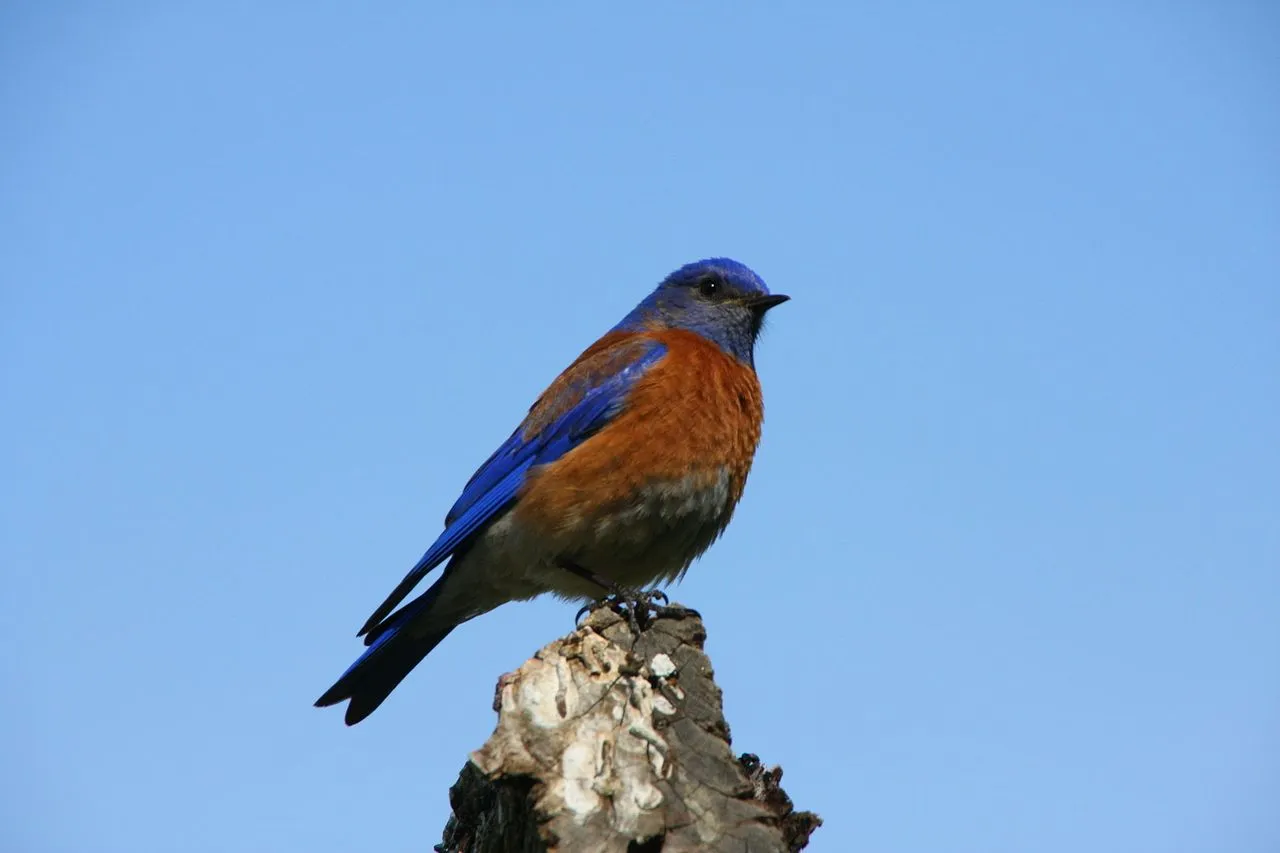
Western Bluebird (Sialia mexicana) is a cavity-nesting thrush (16-19cm). Males deep blue above with chestnut breast; females grey-brown with blue wings. Western oak/pine woodland, often uses nest boxes.
Sialia mexicana Swainson, 1832, the Western Bluebird, is a cavity-nesting thrush of western oak, pine, and open woodland whose local abundance often depends on the supply of old woodpecker holes and maintained nest boxes.
Part of the Complete Thrushes Guide.
Identification at a glance
| Character | Western Bluebird (S. mexicana) | Mountain Bluebird (S. currucoides) | Eastern Bluebird (S. sialis) |
|---|---|---|---|
| Length | 16–19 cm (6.3–7.5 in) | 16–20 cm (6.3–7.9 in) | 16–21 cm (6.3–8.3 in) |
| Male | Deep blue, chestnut breast and scapulars | Pale sky-blue, no orange | Blue above, rusty chest, white belly |
| Female | Grey-brown, blue wings, subdued orange breast | Cold grey-brown, no strong orange | Blue-grey above, pale orange chest |
| Habitat | Open oak, pine, wooded pasture | Treeless open country | Eastern open fields and pastures |
| Nest box | 38 mm (1.5 in) entrance in open woodland | 38 mm (1.5 in) entrance in open country | 38 mm (1.5 in) entrance in eastern open country |
Identification
Visual
Adult male Western Bluebird has deep blue upperparts, a blue throat, chestnut breast and scapular patch, and grayish belly. The chestnut is usually richer and more restricted than in Eastern Bluebird, and the blue throat is an important separator. Total length is 16–19 cm; weight is usually 24–31 g. The bird is compact and upright, often seen on fence lines, dead limbs, or low oak branches.
Adult female is gray-brown above with blue in the wings and tail and a subdued orange-brown breast. Many females show a faint blue wash on the back. Compared with female Mountain Bluebird, female Western is warmer, more orange below, and more often associated with trees. Juveniles are spotted below, with blue beginning in wings and tail, and can be confused with young Mountain Bluebirds only where the two overlap.
The absence or presence of chestnut is the first field question in western bluebirds. Mountain Bluebird male lacks chestnut entirely and is paler blue overall. Western male carries a definite warm breast and often chestnut on the back. Eastern Bluebird overlaps only locally in the southern plains and is usually separated by range and by the Eastern male's orange throat rather than blue throat.
Audio
Western Bluebird song is a soft, warbling series of short notes, often delivered from an exposed perch near the nest site. It is less carrying than American Robin song and can be missed in windy oak savanna. Calls include a mellow few and low chattering notes exchanged among pairs and family groups.
Family contact calls are important in the field. Western Bluebirds often remain in small groups after breeding, and soft calls from oak crowns or pines may reveal birds before any colour is visible. Around nest boxes, adults give sharper alarm calls when House Wrens, squirrels, or people approach.
Distribution
The breeding range extends from southwestern Canada through the western United States into Mexico, including the Pacific states, interior Northwest, Great Basin margins, Rocky Mountain foothills, and southwestern highlands. It is patchy where suitable open woodland and cavities are absent.
Northern and high-elevation birds move south or downslope in winter. Coastal California, the Southwest, Mexico, and lower valleys hold many wintering birds. In mild climates, pairs may remain close to breeding territories year-round, especially where berry crops and roost cavities persist.
Habitat
Western Bluebird occupies open woodland rather than treeless grassland. Oak savanna, ponderosa pine parkland, pinyon-juniper edge, orchard margins, burned forest with standing snags, and lightly wooded pasture are typical. It needs open ground for hunting and cavities for nesting, with scattered trees or posts for perching.
Closed-canopy forest is unsuitable, as is intensive urban lawn without cavity supply. Old orchards and ranchland can be excellent if dead limbs and fence posts remain. Removal of snags, replacement of wooden posts, and fire suppression that closes formerly open woodland all reduce habitat quality.
Diet and Foraging
The breeding-season diet is dominated by insects and other arthropods: beetles, grasshoppers, caterpillars, ants, flies, crickets, and spiders. Birds hunt by perch-and-drop foraging, scanning from low branches or wires and dropping to the ground. Short vegetation improves prey detection; dense grass reduces capture efficiency.
Fruit becomes important in autumn and winter. Mistletoe berries, juniper, elderberry, madrone, toyon, poison oak fruit, and various native shrubs are taken. Winter flocks may move through oak woodland and suburban edges where fruiting plants and open lawns occur together. Mealworms are accepted at feeders, particularly near nest boxes, but they should not be used as a substitute for insect-rich habitat.
Breeding Biology
Western Bluebird nests in cavities made by woodpeckers, natural rot holes, fence-post cavities, and nest boxes. A 38 mm entrance admits bluebirds and excludes European Starlings. Boxes should be mounted 1.2–1.8 m high on poles or posts, facing open ground, with predator protection where raccoons, snakes, or cats are present.
The nest is a cup of grasses, pine needles, fine stems, and feathers. Clutch size is usually 4–6 pale blue eggs, occasionally white. Incubation lasts 13–14 days and is done by the female. Nestlings fledge after about 18–22 days. Two broods are common in mild climates, and pairs may reuse the same box after old nest material is removed.
Cooperative breeding occurs in some populations. Young from a previous brood or season may help feed nestlings, especially where territories are clustered around high-quality cavities. This social structure makes local groups more persistent once a nest box trail is established, but it also means poor management of a box cluster can affect several related birds at once.
Notes
Nest box use by Western Bluebird works only when the surrounding landscape already resembles bluebird habitat. Boxes placed in dense suburbs, closed forest, or tall rank grass mostly produce House Sparrows, House Wrens, or no birds. In appropriate oak or pine parkland, however, boxes can replace cavities lost when dead limbs are removed for safety or firewood. The correct question is not whether Western Bluebirds use boxes. They do. The question is whether the box is placed in open woodland where a bluebird can hunt within 20 m of the entrance.
See Also
- Eastern Bluebird (Sialia sialis)
- Mountain Bluebird (Sialia currucoides)
- American Robin (Turdus migratorius)
- The Complete Attracting Guide
- The Complete Thrushes Guide
- Eastern vs Western Bluebird: throat and back colour side by side, with the southwestern contact-zone notes.
Frequently Asked Questions
How do I identify Western Bluebird?
Male: deep blue above, blue throat, chestnut breast and scapulars, grayish belly. Female: gray-brown above, blue in wings/tail, subdued orange-brown breast. Chestnut is key mark.
How is Western Bluebird different from Mountain Bluebird?
Western has chestnut breast and throat; Mountain has none, all blue. Western female has warm orange-brown breast; Mountain is cold grey-buff. Range differs.
Do Western Bluebirds use nest boxes?
Yes, use old woodpecker cavities and nest boxes in oak/pine woodland. Boxes need 38mm holes. Often in loose colonies where cavity density is high.
What do Western Bluebirds eat?
Insects: grasshoppers, beetles, caterpillars. Some berries. Rarely at seed feeders. Attract with proper nest boxes in appropriate habitat, open oak woodland.