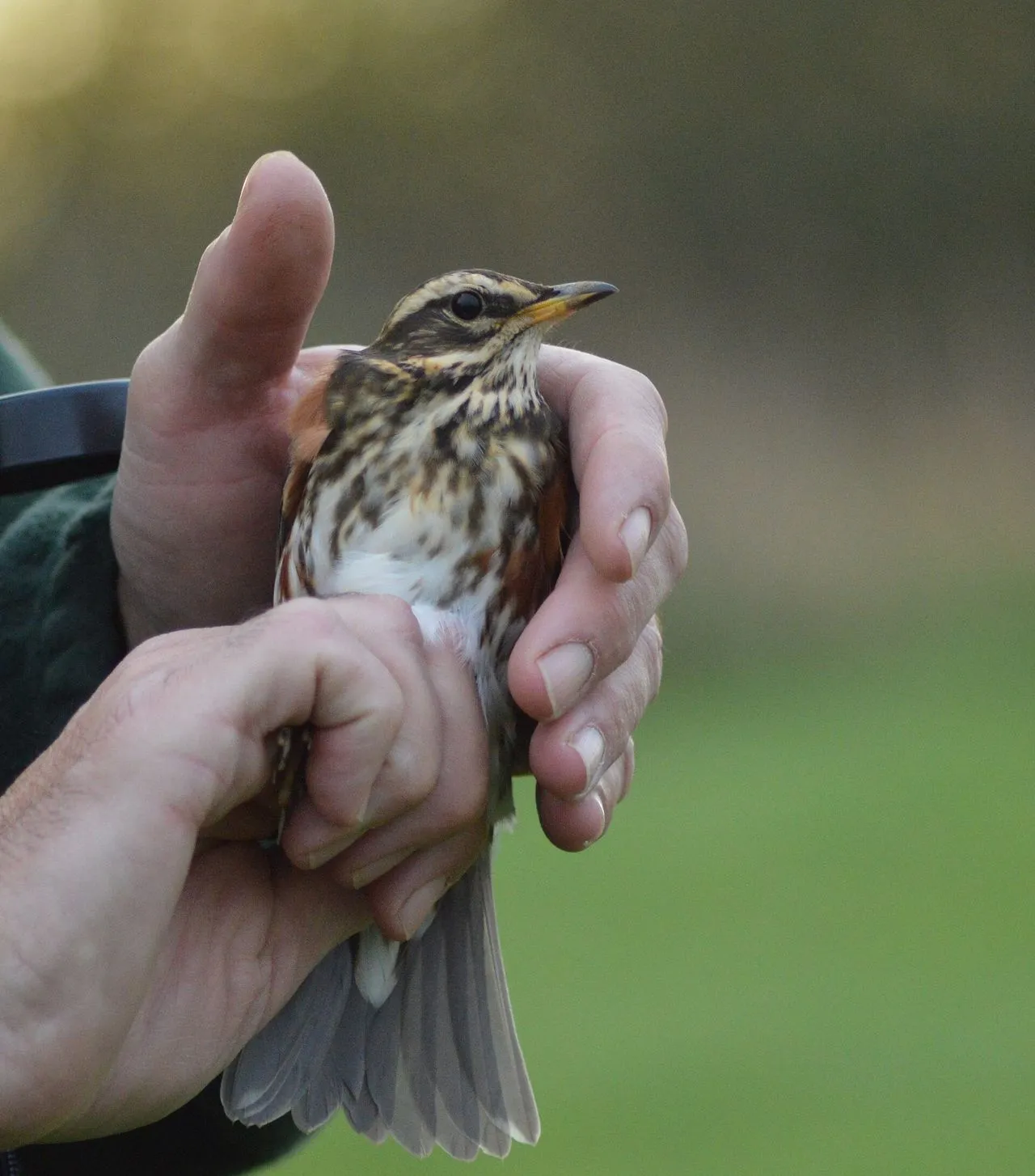
Redwing (Turdus iliacus) is Europe's smallest thrush (19-23cm). Brown above, bold cream eyebrow, rusty-red flanks. Migrates at night, thin 'seeip' call. Winters in hedgerows, often with Fieldfares.
Turdus iliacus Linnaeus, 1766, the Redwing, is the smallest regular European Turdus and reaches Britain chiefly as a nocturnal autumn migrant from Iceland, Scandinavia, and northern Russia.
Part of the Complete Thrushes Guide.
Identification at a glance
| Character | Redwing (T. iliacus) | Song Thrush (T. philomelos) | Fieldfare (T. pilaris) |
|---|---|---|---|
| Length | 19–23 cm (7.5–9.1 in) | 20–23 cm (7.9–9.1 in) | 22–27 cm (8.7–10.6 in) |
| Face | Bold creamy supercilium, dark malar | Plain face, pale eye ring | Grey head, no bold eyebrow |
| Flanks | Rusty-red patch and underwing | No red flank; buff underwing | Ochre breast, grey rump |
| Flock behaviour | Nervous, hedge-based winter groups | More solitary or loose | Larger noisy flocks |
| Call | Thin nocturnal seeip | Sharp tic or chack | Dry chattering chak-ak-ak |
Identification
Visual
Redwing is compact, 19–23 cm long and usually 50–75 g, smaller than Song Thrush and much smaller than Fieldfare. The upperparts are brown, the underparts pale and streaked, but two marks define the species: a bold creamy-white supercilium above the eye and a rusty-red patch along the flanks and underwing. The red is often hidden when the bird is perched but flashes in flight or when the wing is slightly raised.
The breast streaking is finer than Song Thrush spotting, forming dark lines and small marks rather than bold arrowheads. The face pattern is stronger than any Song Thrush, with the pale eyebrow and dark malar area giving a sharper expression. Sexes are alike. Juveniles are similar but may appear warmer and less cleanly marked in early autumn.
In winter flocks, Redwings often feed with Fieldfares. Fieldfare is larger, grayer-headed, chestnut-backed, and longer-tailed, with a clattering call. Redwing is smaller, darker, and more nervous, often rising from hedgerows in tight groups rather than striding in open fields.
Audio
The nocturnal flight call is the sound by which many people first detect Redwing migration: a thin, high seeip or tseep, given overhead on autumn nights from late September through November. On still nights during major arrivals, calls may pass over towns for hours. This call is short but highly distinctive once learned.
The breeding song, heard mainly in northern Europe, is a brief series of clear whistles followed by a softer warble. Winter calls in Britain include thin contact notes and sharper alarm calls from hedges. Daytime winter flocks are often quiet until flushed, when calls rise rapidly as birds move between fields and trees.
Distribution
Redwing breeds in Iceland, Scandinavia, the Baltic region, northern Russia, and across the boreal zone into Siberia. Icelandic birds are larger and darker on average than continental birds and form an important component of the British winter population.
Britain and Ireland receive large numbers from October onward, with arrivals shaped by weather systems over the North Sea and North Atlantic. Severe frost on the continent pushes additional birds west and south. Winter range extends through western and southern Europe, North Africa locally, and parts of the Middle East. Most birds leave Britain by March or early April.
Habitat
On breeding grounds, Redwing uses birch woodland, conifer edge, willow scrub, bog margins, and open boreal forest. It is more tolerant of low, damp northern woodland than many larger thrushes.
In Britain and western Europe during winter it uses hedgerows, hawthorn scrub, orchards, pasture, playing fields, churchyards, urban berry plantings, and damp meadows. The ideal winter landscape has fruiting hedges for food and cover, plus open grassland for earthworms when conditions thaw. In hard weather, birds move into gardens and towns where ornamental rowan, cotoneaster, pyracantha, and crabapple remain accessible.
Diet and Foraging
Autumn and winter diet is dominated by berries and ground invertebrates. Hawthorn is especially important in Britain, followed by rowan, holly, ivy, yew, rose hips, cotoneaster, and fallen apples. When soil is unfrozen, Redwings feed on earthworms and invertebrates in short grass, often in company with Fieldfares and Starlings.
Foraging is wary. Birds drop from hedges to fields, feed rapidly, then return to cover or move on if disturbed. In gardens they take soft fruit and berries rather than seed. Apples cut open on the ground may attract them during snow, but only if placed near escape cover and not dominated by larger thrushes.
Breeding Biology
The nest is a cup of twigs, grass, moss, and mud, lined with finer material, placed in low trees, shrubs, banks, or on the ground among vegetation. In northern birch and willow scrub, nests may be low and well concealed. Clutch size is usually 4–6 eggs, blue-green with reddish-brown markings.
Incubation lasts about 12–13 days, mainly by the female. Nestlings fledge after 12–15 days. Two broods may occur in favourable northern seasons. Breeding density can be high in suitable boreal and subarctic habitat, but productivity is exposed to cold rain, late snow, and predator cycles involving corvids, mustelids, and small mammals.
The species is colonial or semi-colonial in some areas, and adults mob predators vigorously. This group defence is one reason Redwings can nest in relatively open northern woodland where solitary nests would be vulnerable.
Notes
The seeip nocturnal flight call is the practical key to Redwing migration. Many birds crossing Britain at night never appear in local gardens the next day; they pass over at altitude, descend before dawn, and redistribute according to fruit and weather. A night of steady calls over a city in October indicates active migration, not a hidden daytime flock nearby. Learning that call changes the species from a winter hedge bird into a visible migrant moving through darkness above ordinary streets.
See Also
Frequently Asked Questions
How do I identify Redwing?
Small thrush with bold creamy-white eyebrow, dark malar. Rusty-red patch on flanks and underwing. Finer breast streaking than Song Thrush. Flashes red in flight.
How do I hear Redwings migrating?
Nocturnal flight call is thin, high 'seeip' or 'tseep', often heard overhead on autumn nights from September through November. Learn this and you detect migrations.
What do Redwings eat in winter?
Berries: hawthorn, rowan, berries in hedgerows. Earthworms when ground soft. Flocks with Fieldfares in fields and orchards. Attract with berry bushes.
How is Redwing different from Song Thrush?
Redwing has bold superciliary stripe and red flank patch Song Thrush lacks. Smaller than Song Thrush, more nervous in flocks, finer breast streaking.