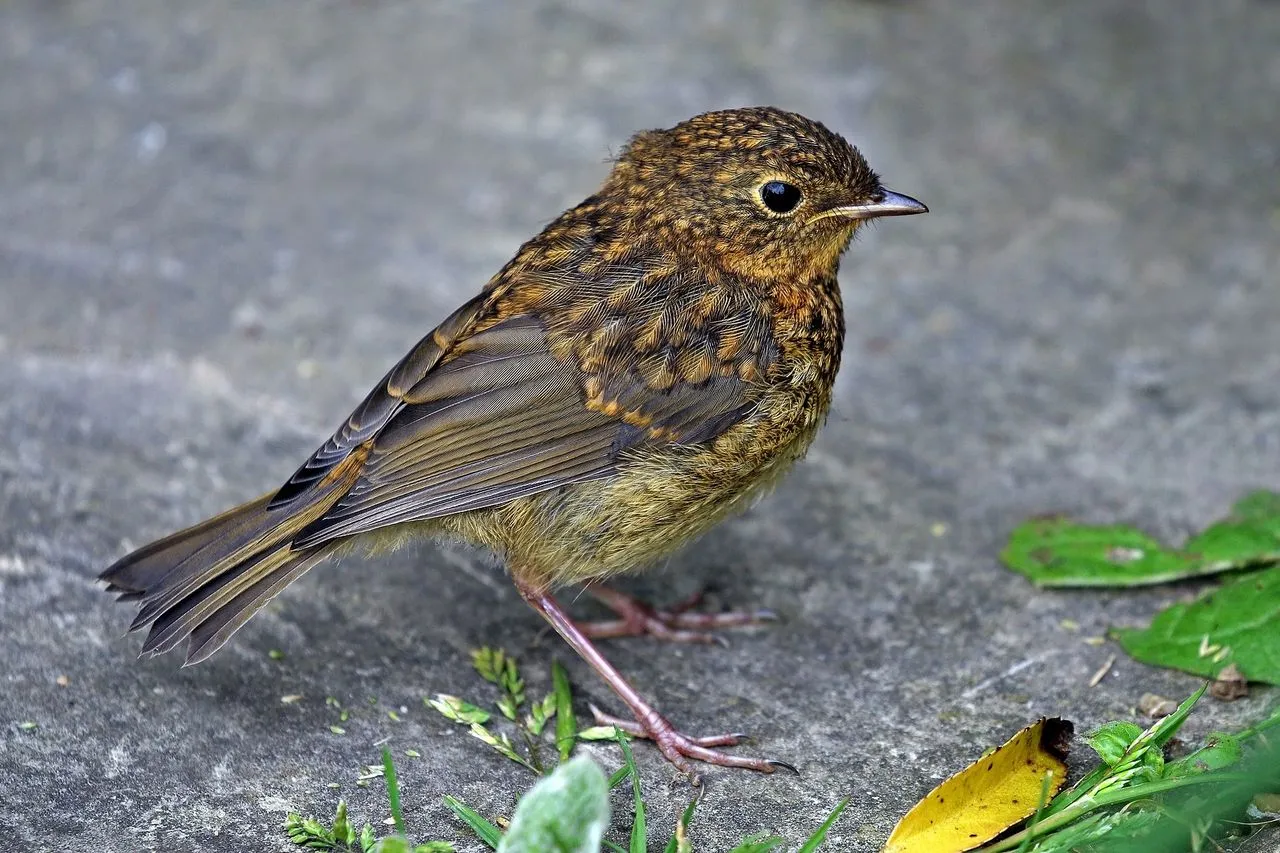
European Robin (Erithacus rubecula) is a small Old World flycatcher (12-14cm). Orange-red breast, brown upperparts, bold dark eye. Not a thrush, closer to flycatchers. Year-round territorial song, perches low in dense cover.
Erithacus rubecula (Linnaeus, 1758), the European Robin, is not a true thrush but an Old World flycatcher whose red breast caused English colonists to lend its name to the unrelated American Robin.
Part of the Complete Thrushes Guide.
Identification at a glance
| Character | European Robin (E. rubecula) | American Robin (T. migratorius) | Common Blackbird (T. merula) |
|---|---|---|---|
| Length | 12–14 cm (4.7–5.5 in) | 23–28 cm (9.1–11 in) | 23–29 cm (9.1–11.4 in) |
| Family | Old World flycatcher | True thrush | True thrush |
| Breast | Orange-red face and breast | Orange-red breast, grey-brown above | Male black; female brown |
| Song | Thin, sweet, year-round | Rolling dawn carol | Mellow fluted phrases |
| Nest site | Low, concealed cover | Open ledges and branches | Shrubs, hedges, ivy |
Identification
Visual
European Robin is small, round, and short-tailed, 12–14 cm long and usually 16–22 g, with a warm orange-red face and breast bordered by bluish gray along the sides of the neck. The upperparts are olive-brown, the belly whitish, and the eye large and dark. The bill is fine and insectivorous, not the heavier bill of a finch or sparrow.
Sexes are alike, which is important because both males and females defend territories and sing in winter. Juveniles lack the red breast entirely and are mottled brown and buff, a plumage that prevents territorial attack by adults during the post-fledging period. Young birds acquire the orange breast during the post-juvenile moult.
Compared with American Robin, European Robin is less than one-third the mass, lacks the long-legged lawn-foraging structure, and belongs to a different family. Compared with Dunnock, it is rounder, warmer-faced, and more upright. Compared with juvenile Common Blackbird, it is much smaller, with a finer bill and a more compact shape.
Audio
The song is a thin, sweet, highly variable sequence of warbled phrases, often delivered from dense cover rather than an exposed treetop. It is one of the most persistent winter songs in Britain and western Europe. Both sexes sing outside the breeding season, particularly from September through March, when territories are defended for food rather than mates.
The common call is a hard, ticking tic, easily confused with Wren or Blackcap alarm calls until the rhythm and position are learned. In autumn evenings, robins often tick from hedges and ivy before giving short song phrases in near darkness. Their large eyes and crepuscular habits make them active at light levels that silence many smaller passerines.
Distribution
European Robin breeds across most of Europe, from Iberia and the British Isles east into western Russia, and south into North Africa and parts of the Near East. Northern and eastern populations are more migratory; western European and British birds are largely resident, though winter influxes from Scandinavia and continental Europe alter local numbers.
In Britain and Ireland it is present year-round in gardens, woodland, hedgerows, parks, churchyards, and farmland edges. In Scandinavia and eastern Europe, many birds move southwest in autumn. Wintering birds reach the Mediterranean basin, North Africa, and the Middle East.
Habitat
The species requires low cover and accessible ground. Deciduous woodland, mixed woodland, hedgerows, gardens, orchards, parks, and scrub all support robins when leaf litter and invertebrate prey are available. Dense ivy, bramble, evergreen shrubs, log piles, and hedge bases are valuable because they provide both nesting cover and winter shelter.
Garden abundance is often high where soil is turned, compost is exposed, and shrubs create shaded edges. Robins follow gardeners not from affection but because digging exposes worms, beetle larvae, and other prey. The association is learned quickly and can make individual birds appear unusually tame.
Diet and Foraging
European Robin feeds on insects, spiders, worms, small molluscs, and other invertebrates throughout the year, with fruit and seeds added in autumn and winter. It forages by watching from a low perch and dropping to the ground, or by hopping through leaf litter and taking exposed prey.
In gardens it uses mealworms, suet crumbs, soaked raisins, soft fruit, and live foods on low tables or ground trays. It is not built for clinging to seed feeders. Dry, exposed feeding stations favour larger birds; robins feed more readily where food is near cover but not so buried that cats can ambush them. Native fruiting plants such as hawthorn, ivy, elder, rowan, and holly support winter diet without creating feeder dependence.
Breeding Biology
The nest is a cup of moss, leaves, grass, and hair, placed low and concealed: ivy, hedge bases, banks, wall holes, sheds, climbing plants, old pots, or open-fronted nest boxes. The flexibility of nest-site choice explains many garden records, but it also exposes nests to cats, corvids, rats, and disturbance.
Clutch size is usually 4–6 eggs, whitish with reddish-brown speckling. Incubation lasts 13–14 days and is performed by the female. Nestlings fledge after about 13–14 days, before they can fly strongly, and remain hidden in vegetation while adults feed them. Two broods are normal; three may occur in long mild seasons.
Territorial aggression is intense. Adults attack red-breasted intruders, and experimental red breast models elicit strong responses. Winter territories may be held by either sex, so the garden robin singing in December is not necessarily male.
Notes
The European Robin is included here because it is central to the robin naming problem, not because it belongs in Turdidae. Molecular work places Erithacus in Muscicapidae with the Old World flycatchers. Its garden behaviour also differs sharply from American Robin. European Robin is solitary, territorial, small, low-nesting, and insect-focused through winter. American Robin is a large true thrush that forms winter flocks and forages openly on lawns and fruiting trees. The shared English name is historical residue, not biological guidance.
See Also
- Song Thrush (Turdus philomelos)
- Common Blackbird (Turdus merula)
- The Complete Warblers Guide
- The Complete Attracting Guide
- The Complete Thrushes Guide
- American Robin vs European Robin: why both species got the same English name despite being unrelated.
Frequently Asked Questions
How do I identify European Robin?
Round, small bird with orange-red face and breast, bordered by blue-gray on neck sides. Brown above, pale below, large dark eye. No size difference between sexes.
Does European Robin sing year-round?
Yes, both males and females sing year-round, especially September through March. Delivered from dense cover, unlike most birds. One of the few winter songs in Britain.
How is European Robin different from American Robin?
Not related, European Robin is a flycatcher, not a thrush. American Robin is one-third larger. European Robin is perching, not lawn-running, and nests low in dense cover.
What do European Robins eat?
Insects, worms, spiders. In winter they take berries and seeds. Uses ground feeders in gardens, taking mealworms, chopped fruit, and seeds on trays.