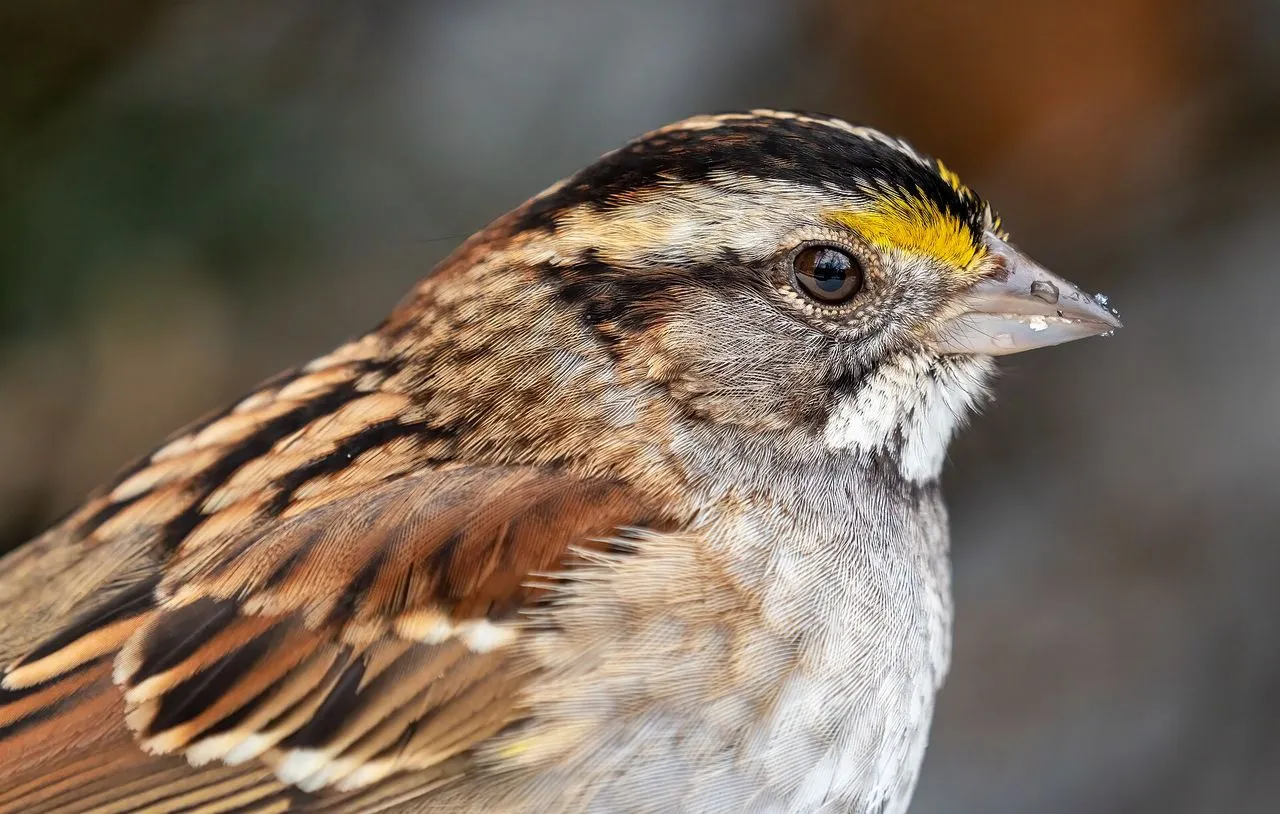
White-throated Sparrow (Zonotrichia albicollis) is a large North American sparrow (15-19cm, 22-32g) with white throat patch, yellow lores, and two colour morphs: white-striped and tan-striped. Song is a clear whistled phrase ('Old Sam Peabody'). Boreal forest breeder, winters eastern US.
Zonotrichia albicollis Gmelin, 1789, the white-throated sparrow, carries a chromosomal polymorphism that produces two colour morphs maintained by disassortative mating in most breeding populations.
Part of the Complete Finches & Sparrows Guide.
Identification
Visual
White-throated sparrow is a large, full-bodied sparrow, 15 to 19 centimetres long and usually 22 to 32 grams. The white throat patch is sharply bordered below by a dark malar line. Yellow lores sit between the eye and bill, a small but decisive mark even on dull birds. The underparts are grey, the back brown-streaked, and the bill pinkish to horn-coloured.
Two adult morphs occur. White-striped birds have bright white crown stripes, black lateral crown stripes, and a cleaner face. Tan-striped birds have buffy tan crown stripes and duller head contrast. Both morphs occur in both sexes, though white-striped individuals are generally more aggressive and more song-active. The morph is not age or seasonal wear; it reflects a stable genetic difference linked to a chromosomal inversion.
Immatures can look subdued, but the throat patch, yellow lores, and large size remain useful. White-crowned sparrow lacks yellow lores and has no white throat patch. Song sparrow is streaked below and usually smaller. House sparrow female lacks the yellow lores and strong throat border.
| Character | White-throated Sparrow (Zonotrichia albicollis) | Song Sparrow (Melospiza melodia) | White-crowned Sparrow (Zonotrichia leucophrys) |
|---|---|---|---|
| Body length | 15–19 cm (5.9–7.5 in) | 12–17 cm (4.7–6.7 in) | Similar large sparrow |
| Body mass | 22–32 g (0.8–1.1 oz) | 18–50 g (0.6–1.8 oz), regionally variable | Usually comparable in size |
| Throat | White patch with dark border | Pale throat, no sharp white patch | No isolated white throat patch |
| Lores | Yellow | Not yellow | Not yellow |
| Underparts | Grey, mostly unstreaked | Streaked with central breast spot | Grey, mostly unstreaked |
Audio
The song is a clear whistled phrase, traditionally rendered as Old Sam Peabody, Peabody, Peabody in North America or Oh sweet Canada, Canada, Canada. It consists of a pure opening whistle followed by repeated triplets or doublets. Regional song variants occur, and a two-note ending spread rapidly across parts of Canada during the early 21st century. Calls include a sharp metallic pink and a high tseet given during migration and in winter thickets.
Distribution
White-throated sparrow breeds across the boreal forest from Yukon and British Columbia east to Newfoundland, extending south through the Great Lakes region and the Appalachians at higher elevations. It winters primarily in the eastern and southern United States, from the Atlantic states through the Gulf Coast and into Texas. Migration peaks in April and May northbound and in September and October southbound.
In much of the eastern United States it is a classic winter sparrow of garden edges and woodland understory. Farther west it is less regular, though migrants and wintering birds occur in small numbers along suitable corridors.
Habitat
Breeding habitat includes young coniferous and mixed forest, regenerating burns, bog edges, alder tangles, spruce-fir openings, and shrubby cutovers. The species requires dense low cover for nesting and foraging with nearby song perches. Winter habitat broadens to woodland edges, hedges, suburban gardens, brush piles, weedy ravines, and park understory.
Leaf litter matters. White-throated sparrows feed by double-scratching, hopping backward with both feet to uncover seeds and invertebrates. A tidy garden with bare mulch and no shrub layer may provide seed but little usable foraging structure.
Diet and Feeder Behaviour
Winter diet is dominated by seeds: ragweed, smartweed, grasses, sedges, dock, millet, and fallen sunflower fragments. At feeders the species usually stays on the ground, often arriving at dawn and late afternoon. It will take white millet, cracked corn, and sunflower chips scattered under shrubs. It seldom clings to tube feeders.
During breeding, insects, spiders, and other small invertebrates become important, especially for nestlings. Adults take caterpillars, beetles, ants, flies, and larvae from leaf litter and low vegetation. Berries and small fruits are eaten in late summer and autumn.
Breeding Biology
Nesting begins from late May into June across much of the boreal range. The female builds a cup of grass, moss, bark, pine needles, and hair, usually on the ground under shrubs, in moss, or low in dense vegetation. Clutch size is 3 to 5 eggs, pale blue-green and marked with reddish brown. Incubation lasts 11 to 14 days and is mostly female. Young fledge at 7 to 12 days, still weak in flight, and remain hidden in cover.
The morph system shapes breeding behaviour. White-striped birds tend to sing more, defend territories more aggressively, and provide somewhat less parental care. Tan-striped birds tend to invest more in care and less in aggression. Pairing is strongly biased toward opposite morphs, producing a behavioural balance that has persisted over evolutionary time rather than collapsing into one strategy.
Notes
The white-throated sparrow's morph system is one of the best entry points into behavioural genetics for field observers. The difference is visible in the head stripes and audible in seasonal behaviour, yet both morphs belong to one interbreeding species. A winter feeder flock may contain the raw material of this system, but its consequences become clearest on breeding territories where song rate, aggression, and parental investment diverge.
See Also
- Dark-eyed Junco: a familiar winter ground-feeder that often shares the same shrub cover.
- Song Sparrow: a streaked, secretive sparrow with a different song structure.
- Chipping Sparrow: a smaller, cleaner-faced sparrow for seasonal comparison.
- House Sparrow: the common introduced sparrow often seen in the same gardens.
- The Complete Finches & Sparrows Guide: full family reference: identification, song, and feeder behaviour.
Frequently Asked Questions
How do I identify White-throated Sparrow?
White throat patch sharply bordered by dark malar, yellow lores between eye and bill, grey underparts, brown-streaked back. Two adult morphs: white-striped (bright white crown stripes) and tan-striped (buffy tan stripes). Both have yellow lores.
What are the two colour morphs?
White-striped birds: bright white crown stripes, black lateral stripes, cleaner face. Tan-striped: buffy tan stripes, duller. The difference reflects a stable chromosomal inversion, maintained by disassortative mating (opposite morphs pair together).
What does White-throated Sparrow song sound like?
A clear whistled phrase: pure opening whistle followed by repeated triplets. Traditionally rendered 'Old Sam Peabody, Peabody, Peabody' in North America or 'Oh sweet Canada, Canada, Canada'. Regional variants exist.
How do White-throated Sparrows forage?
Double-scratching, hop backward with both feet to uncover seeds and invertebrates in leaf litter. Prefer ground under shrubs and dense cover. At feeders: ground scatter for millet, cracked corn, sunflower chips. Rarely use elevated feeders.