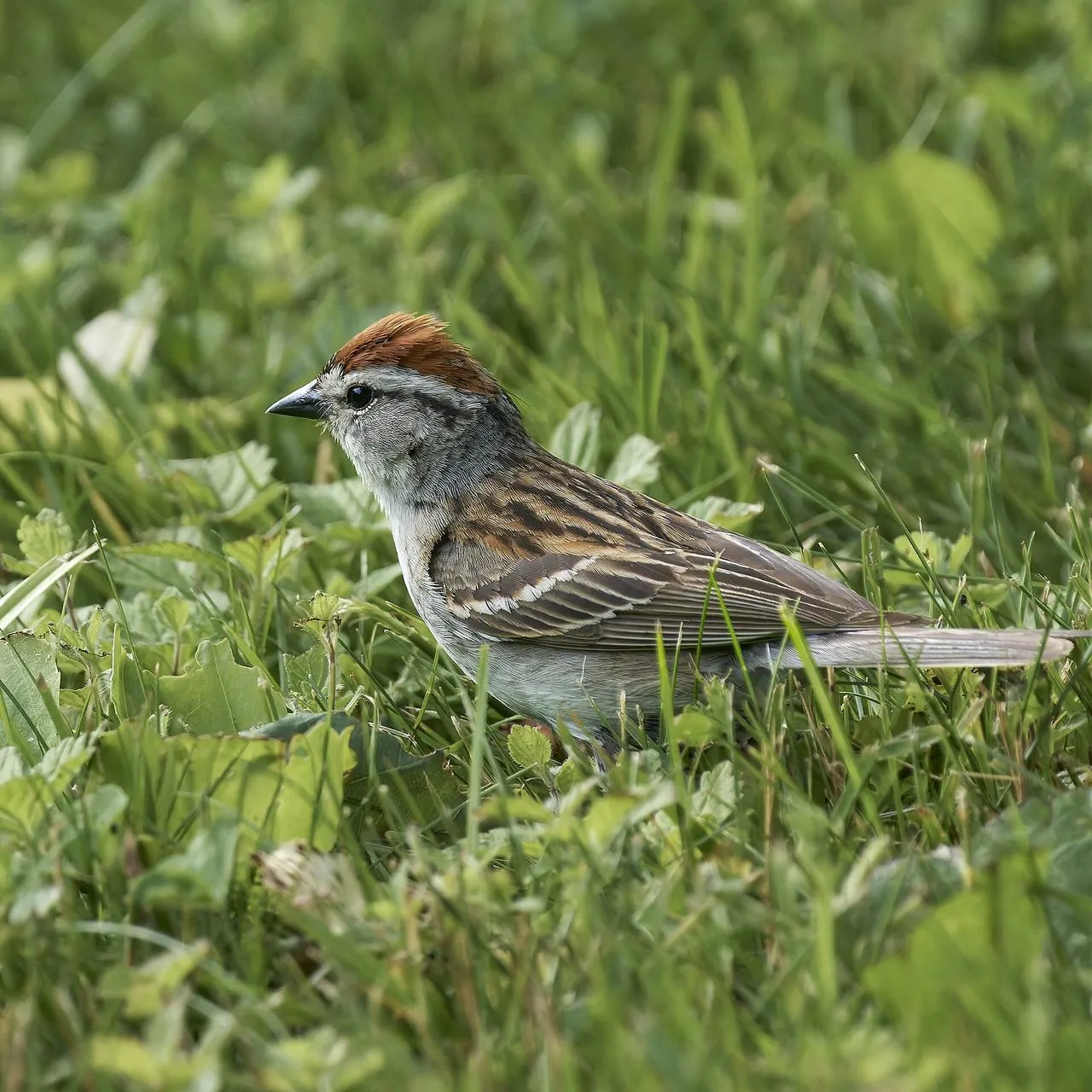
Chipping Sparrow (Spizella passerina) is a small North American sparrow (12-15cm, 11-16g) with bright rufous cap, black eye-line, and white supercilium. Males develop a crisp breeding face by spring. Song is a long dry trill. Migrates between Canada/US and Mexico.
Spizella passerina Bechstein, 1798, the chipping sparrow, is a 11 to 16 gram Passerellid whose dry mechanical trill can exceed 50 notes in a single two-second song.
Part of the Complete Finches & Sparrows Guide.
Identification
Visual
Breeding adult chipping sparrow is neat and lightly built, 12 to 15 centimetres long, with a bright rufous cap, black eye-line, white supercilium, plain grey breast, and small pinkish bill. The back is brown with dark streaks, but the underparts are clean. The combination of rufous cap and unstreaked underparts separates it from song sparrow, juvenile white-throated sparrow, and most house sparrow females.
Non-breeding birds lose some facial sharpness. The cap becomes duller brown, the supercilium buffier, and the face less crisp. Juveniles are streaked below and can cause confusion in late summer. They remain slimmer and finer-billed than song sparrows, with a longer-tailed, lighter frame and less emphatic central breast spot.
At feeders, chipping sparrow looks delicate beside house sparrow. It has a finer bill, cleaner posture, and a quick ground-feeding style. House sparrow female is heavier, broader-billed, and lacks the narrow black eye-line of a breeding chipping sparrow.
| Character | Chipping Sparrow (Spizella passerina) | Field/Tree-type confusion sparrows | House Sparrow (Passer domesticus) |
|---|---|---|---|
| Body length | 12–15 cm (4.7–5.9 in) | Usually small to medium | 14–18 cm (5.5–7.1 in) |
| Crown | Bright rufous in breeding plumage | Often rufous or brown, less cleanly framed | Grey or brown, not bright rufous |
| Face | Black eye-line and white supercilium | Variable; check eye-ring and bill | Plain female face; male with bib |
| Underparts | Plain grey in adults | Often buffier or lightly marked | Plain buff-grey, heavier body |
| Bill | Small, pinkish, fine | Fine to medium | Broad and blunt |
Audio
Song is a long, dry trill on one pitch, delivered from trees, wires, and shrubs. It resembles the song of dark-eyed junco and pine warbler, but chipping sparrow is often drier and more insect-like. Individuals vary in speed and pitch; some trills run so rapidly that separate notes blur. Calls include a sharp chip, the source of the common name, and thin contact notes within feeding groups.
Distribution
Chipping sparrow breeds across most of Canada and the United States, absent only from the highest Arctic, some desert interiors, and treeless regions. Northern populations migrate to the southern United States, Mexico, and Central America. In the southern United States some birds remain year-round, especially where open pine or suburban habitat persists. Spring arrival in the northern states occurs mainly from March through May; southbound movement peaks from September into October.
The species benefited historically from forest clearing and settlement because lawns, orchards, cemeteries, and open woodland mimic its preferred edge structure. It remains common, though local declines occur where shrub and low-tree nesting sites are removed.
Habitat
Chipping sparrow uses open woodland, pine edges, orchards, parks, gardens, cemeteries, campuses, and farm shelterbelts. It avoids dense forest interiors and treeless open fields. Scattered trees above short grass are ideal: the trees provide song posts and nest sites, while the ground supplies seed and small arthropods.
In western mountains it occupies open conifer stands and dry forest edges. In eastern suburbs it often nests in ornamental conifers, hedges, and small deciduous trees. The species tolerates human presence well but needs vegetation dense enough to conceal a small cup nest.
Diet and Feeder Behaviour
Diet consists of small seeds and insects. Grass seed, crabgrass, chickweed, ragweed, and small weed seeds are taken through much of the year. In breeding season adults collect caterpillars, beetles, leafhoppers, flies, and spiders for nestlings. The bill is too fine for efficient cracking of large sunflower shells, so feeder use centres on millet, fine cracked corn, and sunflower chips.
Chipping sparrows usually feed on the ground below feeders or on low trays. They arrive in small groups during migration and in pairs or family parties during summer. They rarely displace other species but can be persistent where millet is available. Clean ground matters because spilled seed mixed with wet hulls increases disease risk for all ground-feeding sparrows.
Breeding Biology
Breeding begins soon after spring arrival. The female builds a small, loose cup of grass, rootlets, and fine stems, lined with hair or fine fibres. Nests are placed in shrubs, conifers, vines, or small trees, typically 1 to 3 metres above ground but sometimes higher. Ornamental cedars and dense garden conifers are frequent nest sites in suburbs.
Clutch size is usually 3 to 4 pale blue eggs with dark markings. Incubation lasts about 11 to 14 days, mainly by the female. Young fledge after 9 to 12 days. Two broods are common in much of the range, and replacement nests follow failure quickly. Brown-headed cowbird parasitism occurs, especially in fragmented landscapes, but chipping sparrows sometimes abandon parasitised nests.
Notes
The chipping sparrow's song is simple but not careless. Males maintain territories with a narrow acoustic signal that carries well through open woodland without the elaborate phrase structure of song sparrow. Because several species produce similar trills, visual confirmation matters in mixed habitats. A dry trill from a lawn-edge pine in April is often chipping sparrow; the same sound from a dark conifer slope in June may be junco.
See Also
- Song Sparrow: the heavier, more streaked sparrow whose complex song and tail shape often anchor comparisons.
- Dark-eyed Junco: another dry-trill singer, but with a white belly and flashing tail feathers.
- White-throated Sparrow: a larger, more boldly marked sparrow for feeder-side comparison.
- House Sparrow: the common commensal sparrow most likely to be confused at bird tables.
- The Complete Finches & Sparrows Guide: full family reference: identification, song, and nesting behaviour.
Frequently Asked Questions
How do I identify Chipping Sparrow?
Bright rufous cap, black eye-line through the eye, white supercilium, plain grey breast, small pinkish bill. Breeding birds are neat and clean-faced. Juveniles are streaked below. More slender than House Sparrow.
What does Chipping Sparrow song sound like?
A long, dry mechanical trill on one pitch, can exceed 50 notes in two seconds. Resembles Dark-eyed Junco and Pine Warbler songs but is often more insect-like and drier. The 'chip' call gives the bird its name.
Where does Chipping Sparrow nest?
Shrubs, conifers, hedges, ornamental trees, typically 1-3m above ground. The nest is a small cup of grass lined with hair. Commonly nests in suburban ornamental conifers, cemeteries, and orchard edges.
Do Chipping Sparrows use feeders?
Yes but briefly, they feed mainly on the ground eating fallen seed. Prefers millet, cracked corn, and sunflower chips. Clean ground matters; wet hulls increase disease risk for ground-feeding sparrows.