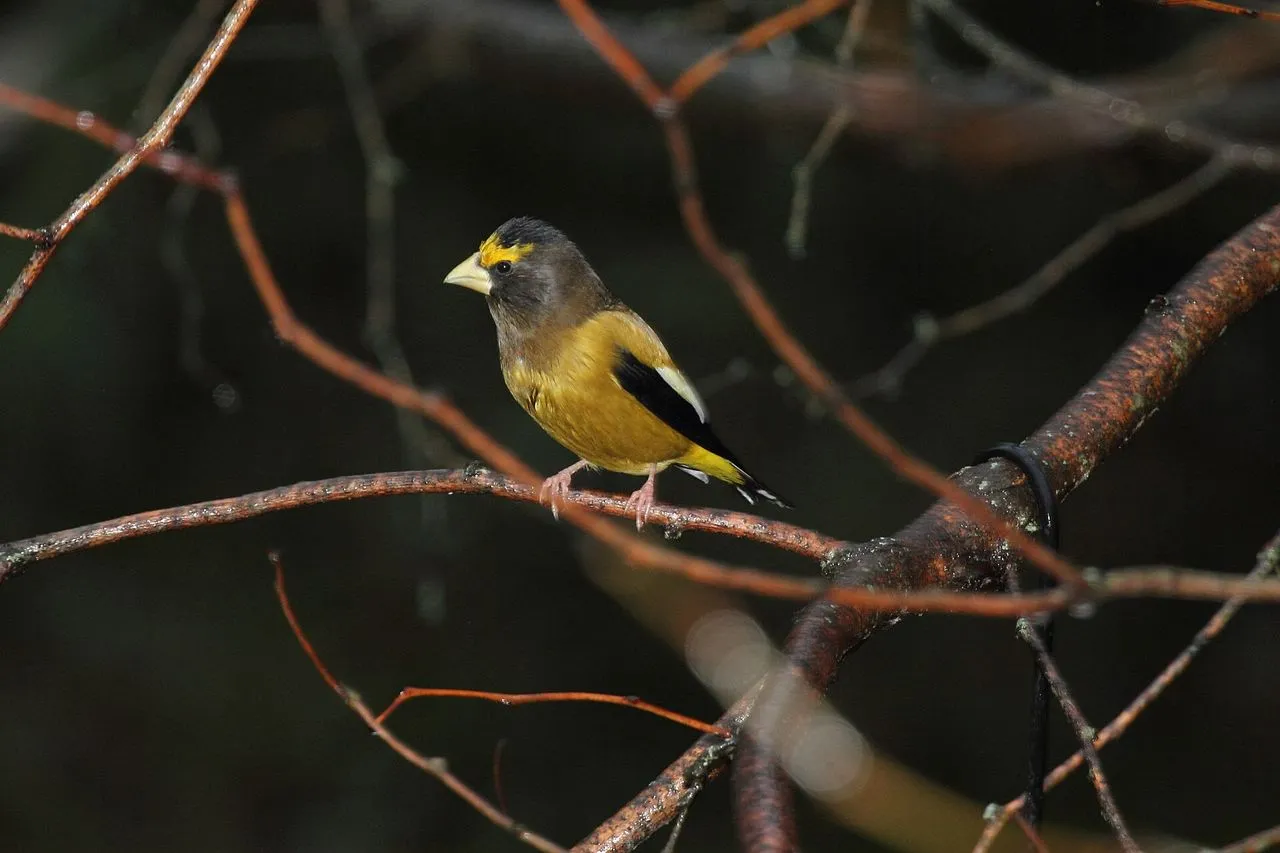
First step: Check the female face pattern first if both sexes are present at the feeder.
Avoid: Do not use red intensity alone; diet and light can make House Finches look deceptively bright.
House Finch and Purple Finch share a genus, a taste for black-oil sunflower, and enough surface similarity to generate more feeder-count misidentifications than almost any other pair of North American birds. Both females are streaky brown finches with no obvious field mark at first glance; both males show reddish colouration. The confusion is not a beginner's mistake: experienced birders misreport one species for the other at Christmas Bird Counts every winter.
SEO refresh: search intent notes
Quick answer
House Finches look warmer and streakier, with red mostly on the head, throat, and chest. Purple Finches look washed in raspberry red, with color spreading across the head, back, and breast. If the bird has heavy brown streaks on the sides and a longer, curved-looking bill, it is probably a House Finch.
What is the fastest field mark?
Start with the sides. Female and immature House Finches usually show blurry brown streaks on the belly and flanks. Female and immature Purple Finches look cleaner underneath, with a stronger face pattern and a pale eyebrow. On males, Purple Finch red looks more like a stain over the body rather than a red patch on the front.
Does range help?
Range helps, but it should not be your only clue. House Finches are widespread around towns, feeders, farms, and dry open habitats. Purple Finches are more tied to coniferous or mixed woods and are less expected in many urban yards, though winter movement can blur the map.
FAQ
Are female House Finches and Purple Finches harder to separate? Yes. Females lack the obvious red, so use streaking, face pattern, bill shape, and habitat together. Can both species visit the same feeder? Yes. Black oil sunflower seed can attract both, so feeder location and season matter when judging an ID.
Both species are covered in depth in the Complete Finches Guide, and each has its own species account: House Finch and Purple Finch. This guide focuses on the comparative identification, working through each mark in the order most useful at a feeder.
Quick answer: Adult males: House Finch has red on the forehead, throat, breast, and rump with brown-streaked flanks remaining at all colour intensities; Purple Finch has a raspberry wash across the entire head, breast, back, and rump with only faint flank washing.
Best first step: Look at the flanks. Brown-streaked flanks on a red finch mean House Finch, almost regardless of how bright the head looks. Clean or faintly washed flanks shift probability strongly toward Purple Finch.
Avoid: Judging by colour intensity alone. House Finch males on a carotenoid-poor diet can look pale orange and washed-out, similar to a dull Purple Finch. Structure and the extent of the colour field are more stable than saturation.
The Big Comparison Table
| Character | House Finch (Haemorhous mexicanus) | Purple Finch (Haemorhous purpureus) |
|---|---|---|
| Adult male: colour tone | Bright red to orange-red; diet-dependent | Raspberry-red, soft and diffuse |
| Adult male: colour extent | Forehead, throat, breast, and rump only | Head, breast, back, and rump; whole-body saturation |
| Adult male: flanks | Brown-streaked throughout, even in bright birds | Faintly washed or clean; streaking weak or absent |
| Female face | Plain grey-brown, blank, no distinct eyebrow | Bold whitish eyebrow, dark cheek border, strong malar stripe |
| Female underparts | Fine, even streaking | Coarse, heavy, triangular-blotched streaking |
| Body length | 12.5-15 cm (4.9-5.9 in) | 12-16 cm (4.7-6.3 in) |
| Body mass | 16-27 g (0.6-1.0 oz) | 18-32 g (0.6-1.1 oz) |
| Overall structure | Slim, longer-tailed, flat-headed | Compact, front-heavy, broader-chested |
| Bill | Short, blunt conical | Deeper; upper mandible slightly curved |
| Tail | Squared, longer relative to body | Notched, shorter relative to body |
| Habitat | Suburbs, farms, parks, desert towns, edges | Conifer and mixed woodland, forest edges |
| Song | Short hurried warble, 2-4 sec, ends in a buzzy rising note | Rich rolling warble, 6-15 sec, fuller and more musical |
| Feeder occurrence | Year-round resident across most of range | Irregular winter visitor; numbers vary with northern seed crops |
| Disease risk | High: Mycoplasmal conjunctivitis widespread in eastern population | Lower: not a primary host for this pathogen |
Female ID: The Hard Part
Most feeder errors involve females, not males. A red male draws attention; a brown female is just another streaky finch until you study the face.
The single most reliable mark on a female Purple Finch is the bold whitish supercilium: a clean, strongly contrasting eyebrow stripe that begins above the bill and sweeps back behind the ear coverts. It is not subtle. Paired with it is a dark, defined cheek patch that borders the pale eyebrow and pale throat below, framing the face in a way that registers as purposeful and patterned even at distance. A strong malar stripe runs from each side of the bill base down along the throat.
Female House Finch has none of this crispness. Its face is plain and grey-brown, with a slight paler area above the eye that does not resolve into a distinct stripe at normal feeder distances. The overall effect is blank. Where Purple Finch female looks alert and defined, House Finch female looks plain and unstructured.
Supporting marks confirm the ID. Purple Finch female has heavier, coarser streaking below, with triangular or blotchy marks rather than fine even lines. Her bill is deeper and the upper mandible has a subtle downward curve. Her tail is notched and her body compact, with the front-heavy, large-headed silhouette typical of the species. House Finch female is slimmer, longer-tailed, and more evenly streaked throughout.
A practical rule: if you see a brown finch and the face makes you look twice because something is there, check it carefully for Purple Finch. If the face makes no impression at all, it is almost certainly a House Finch.
Range and Habitat
House Finch is a year-round resident across most of the contiguous United States, southern Canada, and Mexico. The eastern population descended from cage birds released on Long Island around 1940, expanding at up to 60 kilometres per year until it met the native western population across the Great Plains by the 1990s. This species thrives wherever human structures create edges: suburbs, farms, orchards, campus grounds, parks, and desert towns. It is scarce in closed mature forest and extensive boreal habitat.
Purple Finch breeds across the boreal and mixed forests of Canada, the northeastern United States, the Great Lakes region, and Pacific coastal forests. It is not a suburban resident in the way House Finch is. In winter it moves south into the eastern United States irregularly, most strongly during years when northern seed crops of birch, ash, and conifers are poor. During irruption winters it often appears in mixed flocks alongside American Goldfinch and Pine Siskin, both of which share a preference for black-oil sunflower and nyjer at well-stocked feeders.
In practice: a streaky red finch at a suburban feeder anywhere in eastern North America in January is most likely a House Finch. A woodland-edge garden in New England or the Great Lakes during a finch irruption year is where Purple Finch becomes a real candidate. See choosing the right feeder for guidance on seed types that attract both species, and the complete attracting guide for seasonal placement strategies.
Both species come readily to black-oil sunflower, which is the best single seed for pulling finches close enough to check flank streaking and face pattern. A bulk bag such as Wagner's black oil sunflower seed keeps a tube or hopper feeder stocked through the winter months when Purple Finches are most likely to turn up at eastern feeders.
As an Amazon Associate, we earn from qualifying purchases, at no extra cost to you.
The Raspberry vs Red Mnemonic
Roger Tory Peterson described the male Purple Finch as looking like "a sparrow dipped in raspberry juice." That image endures because it captures something real about the quality of the colour, not just its hue. The raspberry wash on a Purple Finch is diffuse and saturating, as if pigment has soaked through the feathers from within. It extends uniformly across the head, breast, back, and rump with no sharp margins.
House Finch red, by contrast, is brighter and more confined. It sits on the forehead and chest like paint applied to a surface, with clean borders where it meets the brown of the back and wings. Even the reddest House Finch retains those brown-streaked flanks as a visual anchor. The back stays brown. The colour does not soak through.
When both species appear at the same feeder, the Purple Finch looks richer and more saturated throughout; the House Finch looks brighter but patchier, with more clear-cut colour boundaries. That difference in colour quality is as useful as any single structural mark once you have seen both species side by side.
Structure and Silhouette
Both species are medium-small finches, close enough in size that body length and mass alone do not separate them reliably. Structure and proportion, however, are consistent at normal feeder distances and work equally well on males, females, and immatures.
Purple Finch is compact and front-heavy. The head looks large for the body, the chest broad, and the bill noticeably deeper than House Finch's, with a slight downward curve to the upper mandible. The tail is short and notched at the tip. A perched Purple Finch appears stocky, with its mass concentrated toward the head and chest, giving it a shorter, broader profile than House Finch.
House Finch is slimmer and longer-tailed. The head is flatter, the bill more uniformly blunt and conical. The tail tip is squared rather than notched and proportionally longer, giving perched birds an elongated rear profile. In flight, the flatter head and longer tail produce a less chunky silhouette than Purple Finch. This structural difference is visible even when colour is ambiguous under poor light.
Song
Song is the most definitive character when the bird is vocalising, and the two species sound distinctly different even to a new listener.
House Finch delivers a rapid, jumbled warble of two to four seconds, typically ending in a rising buzzy note often rendered as wheer. The song is musical but hurried, and the terminal upswing is the most distinctive element. Males sing persistently from exposed perches on wires, roof lines, and tree crowns from late winter into summer.
Purple Finch sings a richer, more continuous rolling warble lasting six to fifteen seconds. It incorporates slurred phrases and fragments with an improvised quality, delivered from conifer tops or deciduous canopy edges. The overall impression is of greater depth and melodic variety than House Finch, without a characteristic buzzy terminal note. At comparable distances, Purple Finch song sounds fuller and less mechanical.
If the bird sings even once, treat song as the primary identification character and use plumage and structure marks to confirm.
A Note on Cassin's Finch
Birders in the interior West face a three-way identification problem. Cassin's Finch (Haemorhous cassinii) replaces Purple Finch across the mountains of the Great Basin, Sierra Nevada, and northern Rockies. Male Cassin's tends to have a more sharply defined rosy cap contrasting with a paler nape, and the female has finer, crisper streaking than female Purple Finch. If you are in the interior West and the red finch at your feeder does not sit comfortably in either the House or Purple category, Cassin's is the species to consider next.
See Also
- House Finch: full species account covering range expansion, diet, disease risk, and feeder behaviour.
- Purple Finch: full species account covering boreal movements, song, and habitat separation from House Finch.
- American Goldfinch: another common feeder finch that shares winter seed sources and often flocks with Purple Finch during irruptions.
- Pine Siskin: a smaller irruptive finch that frequently joins Purple Finch in winter feeder flocks.
- The Complete Finches Guide: full family reference for all finch and sparrow species on this site.
Quick answer: use face pattern before color
Color is the trap. Bright House Finches can look surprisingly red, and dull Purple Finches can look underwhelming. On females and immature birds, the cleaner clue is the face: Purple Finch shows a stronger eyebrow and cheek pattern, while House Finch looks more evenly brown and streaked.
What to check at the feeder
Watch the bird from the side and compare face, bill, flank streaks, and tail shape before writing it down. A compact guide such as the National Geographic Field Guide to the Birds of North America helps because the similar finches sit on facing pages instead of relying on one memory of a red bird.
As an Amazon Associate, we earn from qualifying purchases, at no extra cost to you.
Can a bright red House Finch look like a Purple Finch?
Yes. Male House Finch color changes with diet, age, and light, so some birds look very red. Use the whole pattern: Purple Finch usually looks more raspberry washed across the head, back, and breast, while House Finch keeps more brown on the back and stronger streaking on the sides.
Quick answer: female House Finch vs female Purple Finch
Start with the face. Female Purple Finch usually shows a clear pale eyebrow and a stronger cheek pattern, almost like the face has been drawn in. Female House Finch is plainer, with a softer brown face and finer streaks below. If the bird looks blank-faced, House Finch is the safer call.
As an Amazon Associate, we earn from qualifying purchases, at no extra cost to you. A printed guide helps with this pair because you can compare females side by side; this Amazon search for National Geographic Field Guide to the Birds of North America keeps the search focused on a useful North American field guide.
Mistakes that cause most feeder misidentifications
- Calling every bright red male a Purple Finch. Some House Finches are vivid red, but they still keep brown streaked sides.
- Ignoring location. In many suburban yards, House Finch is the everyday bird and Purple Finch is more seasonal or irruptive.
- Checking only one mark. Use face, flanks, bill depth, and tail shape together before reporting a Purple Finch.
FAQ: is Purple Finch actually purple?
Not really. Adult males look more raspberry red than purple. The name is old and a little misleading, which is why color alone causes so many wrong calls.
Frequently Asked Questions
What is the most reliable single field mark to separate these species?
For males, check the flanks: House Finch retains obvious brown streaks down the sides even when very red; Purple Finch flanks are clean or faintly washed. For females, the bold whitish eyebrow is the key mark. A crisp, contrasting supercilium with a dark cheek border is Purple Finch; a blank, plain face is House Finch.
How do I tell female House Finch from female Purple Finch?
Female Purple Finch has a bold whitish eyebrow stripe, a defined dark cheek patch, and a strong malar stripe, giving the face a crisp, patterned look. Female House Finch is plain grey-brown with a featureless face and no distinct eyebrow. Purple Finch is also more compact, with a notched tail and a deeper, slightly curved bill.
Can colour alone identify the male?
Not reliably. House Finch males vary from yellow-orange to bright red depending on diet, and pale individuals can overlap with dull Purple Finches in apparent saturation. Extent matters more than brightness: Purple Finch has raspberry colour covering the entire head, back, and rump; House Finch keeps red off the back and retains brown-streaked flanks at all colour intensities.
Which is more likely at my feeder?
In most suburban gardens across North America, House Finch is more likely year-round. Purple Finch is a winter visitor that arrives irregularly depending on northern seed crops. During irruption winters in New England or the Great Lakes, Purple Finch can be common at woodland-edge feeders; in a typical suburban garden further south, House Finch is almost certain and Purple Finch is a good find.
How do I identify a female Purple Finch?
Look for the bold whitish eyebrow (supercilium) and dark cheek patch. A female Purple Finch has a crisply patterned face; a female House Finch has a plain grey-brown face with no strong markings. The eyebrow is the single most reliable mark.
Are Purple Finches actually purple?
No. The male is raspberry or wine-red, washed over the head, breast, back, and rump. Peterson's line about a sparrow dipped in raspberry juice fits far better than the word purple does.
Sources & References
- Badyaev, A. V., V. Belloni, and G. E. Hill (2020). House Finch (Haemorhous mexicanus), version 1.0. In Birds of the World (A. F. Poole, Editor). Cornell Lab of Ornithology, Ithaca, NY, USA. https://doi.org/10.2173/bow.houfin.01
- Wootton, J. T. (2020). Purple Finch (Haemorhous purpureus), version 1.0. In Birds of the World (A. F. Poole and F. B. Gill, Editors). Cornell Lab of Ornithology, Ithaca, NY, USA. https://doi.org/10.2173/bow.purfin.01
- Sibley, D. A. (2014). The Sibley Guide to Birds (2nd ed.). Knopf.
- Pyle, P. (1997). Identification Guide to North American Birds, Part I. Slate Creek Press, Bolinas, California.
- Dhondt, A. A., D. L. Tessaglia, and R. L. Slothower (1998). Epidemic mycoplasmal conjunctivitis in House Finches from eastern North America. Journal of Wildlife Diseases 34(2): 265-280.