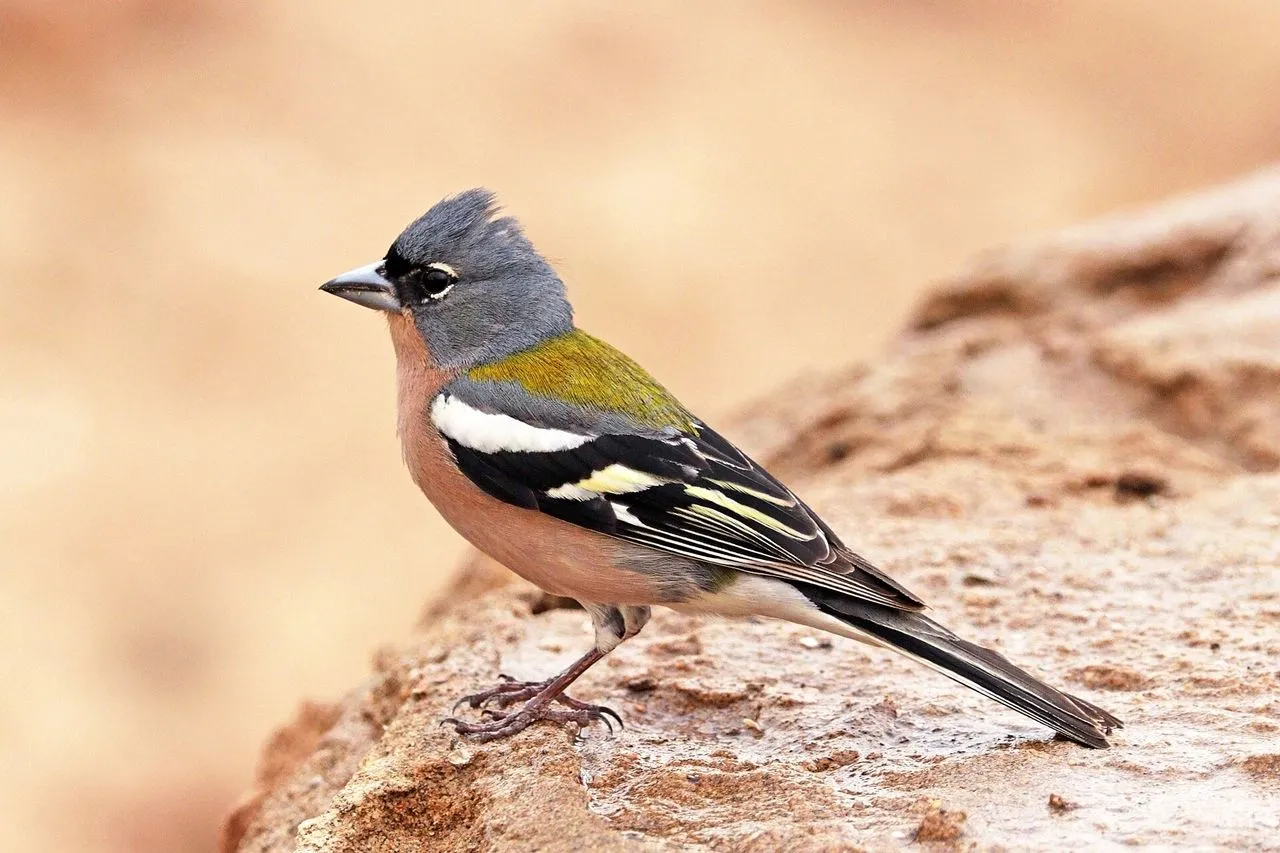
Chaffinch (Fringilla coelebs) is a common European finch (14-16cm, 18-29g) with two bold white wing bars and white tail edges. Males have blue-grey crown, pinkish breast, and chestnut back. Song is a descending accelerating cascade. Resident across most of Europe.
Fringilla coelebs Linnaeus, 1758, the common chaffinch, is a 18 to 29 gram finch whose males produce highly stereotyped songs with local dialects detectable over only a few kilometres.
Part of the Complete Finches & Sparrows Guide.
Identification
Visual
Chaffinch is a medium finch, 14 to 16 centimetres long, with two bold white wing bars, white outer tail feathers, and a relatively long tail. Adult males in breeding plumage have a blue-grey crown and nape, pinkish breast and face, chestnut back, greenish rump, and black-and-white wings. Females are olive-brown and grey-buff but retain the same white wing bars and tail flashes.
The bill is conical and changes colour seasonally in males, becoming bluish in breeding condition and paler in winter. In flight, the white wing bars and white tail edges are conspicuous. Brambling is the main winter confusion species. Brambling shows orange breast and shoulders, a white rump, and in winter a scaly head pattern; chaffinch has a greenish rump and cleaner wing-bar pattern.
At garden feeders, chaffinch often feeds on the ground below hanging ports rather than clinging for long. Its posture is lighter and more athletic than house sparrow, and the white wing flashes are visible even in dull female plumage.
| Character | Chaffinch (Fringilla coelebs) | Brambling (Fringilla montifringilla) |
|---|---|---|
| Body length | 14–16 cm (5.5–6.3 in) | 14–16 cm (5.5–6.3 in) |
| Body mass | 18–29 g (0.6–1.0 oz) | 19–29 g (0.7–1.0 oz) |
| Rump | Greenish | White, conspicuous in flight |
| Breast | Male pinkish; female grey-buff | Orange-toned in both sexes |
| Usual garden status | Common resident in Britain | Irregular winter visitor |
Audio
Song is a descending accelerating cascade ending in a flourish, usually lasting two to three seconds. British field tradition renders the rhythm as a bowler running up and delivering the ball. Males repeat the same song type many times from exposed perches. Local dialects arise because young males learn song from nearby adults, and small copying differences persist within neighbourhoods.
Calls include a sharp pink and a thin seep. The rain call, a drawn, slightly nasal note, is commonly heard but not actually a weather forecast. Song begins in late winter and becomes persistent through spring.
Distribution
Chaffinch breeds across Europe, North Africa, and western Asia, extending into Siberia. It is one of the most widespread European passerines. In Britain it is common in most wooded and suburban landscapes, though affected locally by disease and broader habitat changes. Northern and eastern populations are migratory; many British birds are resident, joined in winter by continental migrants.
Sex-biased migration is strong in parts of the range. Linnaeus's species name coelebs, meaning bachelor, refers to observations that females left Sweden in winter while many males remained. Winter flocks may therefore show skewed sex ratios depending on region.
Habitat
Chaffinch uses deciduous woodland, mixed forest, hedgerows, orchards, parks, gardens, churchyards, and farmland with trees. It needs trees for nesting and song posts but feeds extensively on the ground. Dense conifer plantations support fewer birds than mixed woods with open edges and seed-rich margins.
Garden suitability depends less on exotic planting than on structure: trees, shrubs, leaf litter, and safe ground feeding areas. A chaffinch will visit a feeder station in open lawn, but it spends more time where cover lies within a short flight.
Diet and Feeder Behaviour
Adults eat seeds, buds, berries, and invertebrates. Beech mast, weed seed, cereals, and tree seeds are important outside the breeding season. At feeders chaffinches take sunflower hearts, mixed seed, millet, and fragments dropped by tits and greenfinches. They often feed beneath feeders because the bill handles loose fragments efficiently but the feet are less specialised for clinging than those of goldfinch.
Nestlings receive insects and spiders, especially caterpillars. The breeding-season shift to animal food is more pronounced than in goldfinch. Disease has become a practical concern: chaffinches suffer from trichomonosis and from papillomavirus-related foot lesions. Birds with swollen, crusted feet may remain alive for long periods but are less efficient foragers.
Breeding Biology
Breeding starts from April in Britain and later farther north. The female builds one of the neater nests among common garden birds: a deep cup of moss, grass, bark strips, and spider silk, camouflaged externally with lichen and lined with hair and feathers. It is usually placed in a tree fork, hedge, or shrub 2 to 10 metres above ground.
Clutch size is 4 to 5 eggs, bluish or reddish with dark blotches. Incubation lasts 11 to 13 days and is by the female. The male feeds her and later helps feed young. Nestlings fledge after 13 to 14 days. One brood is usual in northern regions; two may occur in favourable southern seasons.
Notes
Chaffinch song dialect is not ornamental trivia. It reveals cultural transmission in a bird many observers treat as ordinary. A male does not simply emit a species template; he reproduces a local version learned during development. Because song neighbourhoods can shift over time, long-term listening from the same garden can detect cultural change as surely as a ringing scheme detects movement.
See Also
- Brambling: the winter counterpart with orange shoulders, white rump, and overlapping range in Britain.
- European Goldfinch: Britain's other common garden finch, with a twittering song and nyjer feeder presence.
- Greenfinch: the heavy-billed garden finch sharing hedgerow habitat and disease risks with chaffinch.
- House Sparrow: the commensal sparrow whose population trajectory provides a comparison for chaffinch decline patterns.
- The Complete Finches & Sparrows Guide: full family reference: identification, song dialects, and feeder behaviour.
Frequently Asked Questions
How do I identify Chaffinch?
Two bold white wing bars, white outer tail feathers, blue-grey crown (male), pinkish breast. Females are olive-brown but retain white wing bars. The bill turns bluish in breeding season. Smaller than Blackbird.
What does Chaffinch song sound like?
A descending accelerating cascade ending in a flourish, often compared to a bowler running up and delivering the ball. Lasts 2-3 seconds, repeated from exposed perches. Local dialects exist.
Why is the species name 'coelebs'?
Linnaeus named it coelebs (bachelor) because in Sweden he observed females migrating south in winter while many males remained resident. Sex-biased migration is still documented in parts of the range.
What do Chaffinches eat?
Seeds, buds, berries, insects. At feeders: sunflower hearts, mixed seed, millet. Often feeds on ground under feeders. Nests need insects, caterpillars and spiders fed to chicks.