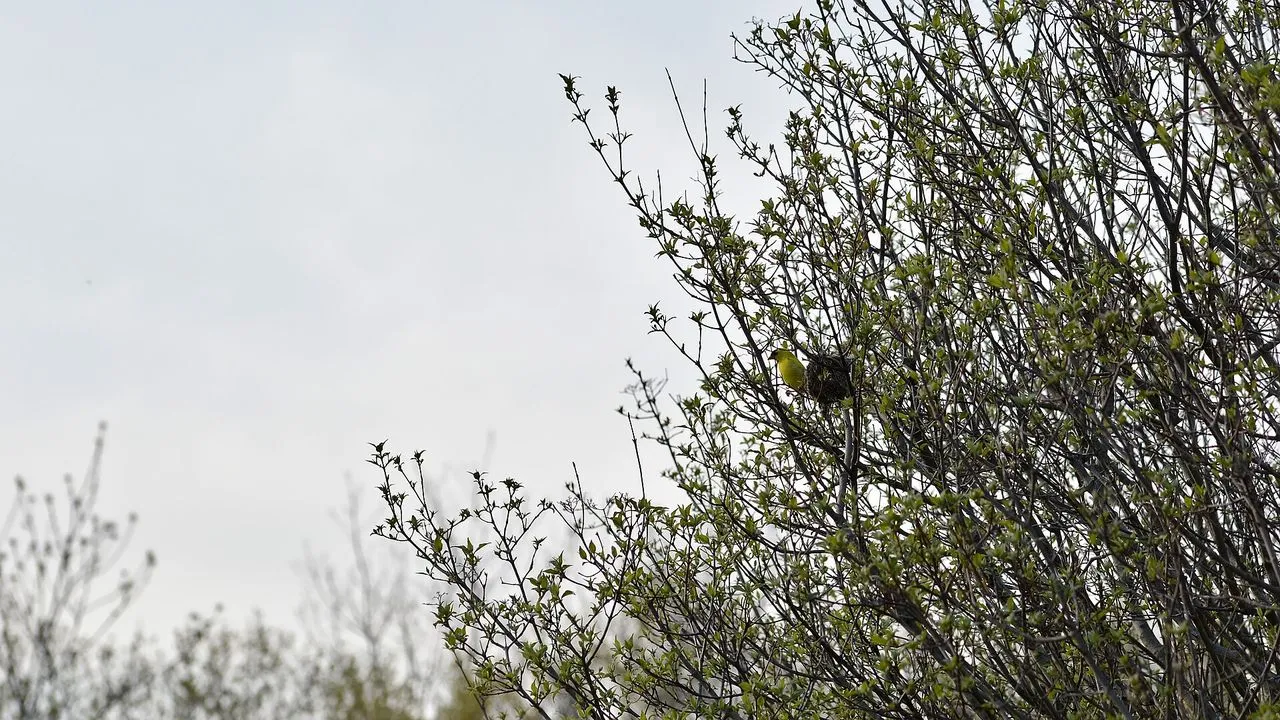
Spinus tristis Vieillot, 1809, the American goldfinch, is the most frequently recorded Fringillid at backyard feeding stations across North America, documented at over 90% of Project FeederWatch sites east of the Rockies in a typical winter.
Part of the Complete Finches & Sparrows Guide.
Identification
Visual
The male in breeding plumage (May through August) is unmistakable: lemon-yellow body, black cap, black wings with two bold white wing bars, black tail with white patches, and a white rump. The bill is short, conical, and pale orange-pink. That bill colour in combination with the black cap is useful at distance for ruling out confusion species before the full plumage registers.
In non-breeding plumage (October through March) the male loses the black cap entirely and becomes olive-yellow above, yellowish-buff below. The wing bars fade to off-white. At this stage the male closely resembles the female, which is dull olive-yellow throughout the year and carries no black cap in any plumage.
The wing pattern is the most reliable all-season mark: bold white wing bars against black wings create clear contrast at feeder distance. Pine siskin (Spinus pinus), the most frequently confused species, is streaked on the breast and flanks in all plumages and shows only a narrow yellow wing edge rather than the broad white bar of goldfinch. In winter plumage, goldfinch fades considerably, but the white rump and white wing bars remain visible in flight.
| Character | American Goldfinch (Spinus tristis) | Pine Siskin (Spinus pinus) |
|---|---|---|
| Body length | 11–14 cm (4.3–5.5 in) | 11–14 cm (4.3–5.5 in) |
| Underparts | Unstreaked in breeding plumage; duller in winter | Heavily streaked in all plumages |
| Wing pattern | Broad white wing bars on black wings | Narrow yellow flashes in wing and tail |
| Bill | Short, conical, pale in breeding plumage | Thin, pointed, suited to small seeds |
| Feeder clue | Often steady at nyjer ports | Restless, quarrelsome flocks in irruption years |
Audio
The flight call is a rising, lilting four-note phrase widely rendered as po-ta-to-chip or per-chick-o-ree, delivered consistently in the species' characteristically undulating flight. Song is a prolonged series of twitters and trills, canary-like in quality, given from a perch or in display flight. Contact calls within feeding flocks include a soft tee-yee. The flight call alone is sufficient for confident identification under most field conditions.
Distribution
Year-round resident across most of the contiguous United States; migratory at the northern edge of the range, with Canadian breeding populations moving south from October. The southern winter boundary reaches the Gulf states and northern Mexico. The species is largely absent from the arid southwest. A northward range expansion in Canada has been documented over recent decades, consistent with a pattern seen across several Fringillid species.
Habitat
Open and semi-open country with access to seed-producing plants: weedy fields, roadsides, riparian margins, gardens, and suburban parks. Avoids closed-canopy forest. Shows a clear preference for sites with thistles, sunflowers, and composite seed heads for natural foraging, and visits feeders most reliably when those resources are limited by weather or season.
Diet and Feeder Behaviour
Spinus tristis specialises on small, oil-rich seeds. Nyjer (thistle seed, Guizotia abyssinica) is the most effective feeder attractant; the bill's length and slight curvature are well-matched to the narrow ports of nyjer tube feeders. Fine-chip sunflower hearts are also taken readily. The species will attempt shelled black-oil sunflower but tends to lose competitive access to house finches and house sparrows when those species are present at the same station.
At feeders, goldfinch feeds in flocks ranging from a handful of birds to 40 or 50 in winter. Dominance hierarchies operate within the flock but are fluid and not strongly expressed compared to species such as greenfinch. Both sexes hang inverted from nyjer socks; the toe flexor strength that allows this is characteristic of Spinus as a genus. Natural diet in summer is almost entirely seed, supplemented with aphids and small invertebrates fed to nestlings. Unlike many Fringillids, goldfinch does not make a wholesale shift to invertebrate foraging during breeding.
Breeding Biology
Spinus tristis breeds later than most North American songbirds. Nest construction typically begins in late June or early July, with eggs laid from mid-July through August. This timing is tied to peak thistle seed availability rather than the invertebrate flush that triggers breeding in most passerines. Goldfinch broods are often still in the nest in September, when many other species have already completed their breeding cycle.
The nest is a compact cup of plant fibres bound with spider silk, placed in a shrub or small tree fork 1 to 10 metres from the ground. The weave is tight enough to hold water if the cup fills during rain, and nest failure from flooding has been recorded. Clutch size is 4 to 6 pale blue-white eggs. Incubation runs 12 to 14 days and is carried out largely by the female; the male feeds her on the nest throughout. Nestlings are fed regurgitated seed rather than fresh invertebrates, consistent with the species' seed specialism. One or two broods per season.
Notes
The male's breeding plumage is achieved by feather-tip abrasion rather than new feather growth. The autumn moult produces olive-tipped yellow feathers; the yellow is progressively revealed as the tips wear through winter. The rate of abrasion is partly temperature-dependent, so spring appearance varies slightly with winter severity and geography. A male that has spent winter in a mild area may still look comparatively dull in April while a bird from a colder region has already abraded to full yellow.
Spinus tristis is one of the few passerines that regularly removes brown-headed cowbird eggs from the nest or abandons parasitised clutches entirely. The species' regurgitated-seed diet is nutritionally inadequate for cowbird chicks, which require the protein content of fresh invertebrates in early life. This dietary mismatch provides a partial ecological buffer against brood parasitism that is relatively unusual among small songbirds and makes goldfinch a less frequent cowbird host than its abundance would predict.
See Also
- House Sparrow: the commensal sparrow that shares feeder sites and competes with goldfinch for perch space.
- Pine Siskin: the closely related Spinus that is streaked throughout and irregularly irruptive in winter.
- European Goldfinch: the Old World relative for comparison of bill morphology and seed specialisation across continents.
- Song Sparrow: the native Passerellid that shares garden feeder habitat in North America without Passeridae confusion.
- The Complete Finches Guide: full family reference: taxonomy, identification, and feeder behaviour.
- American vs European Goldfinch: geographic separation, plumage side-by-side, and why most US sightings of European are escaped cage birds.
Quick answer: how do you attract American goldfinches?
Plant seed-bearing flowers, leave some dried seed heads standing, and keep feeders clean. If you use a feeder, a targeted search for nyjer seed feeders for goldfinches is a sensible starting point because goldfinches feed best from small ports that keep seed dry. As an Amazon Associate, we earn from qualifying purchases, at no extra cost to you.
Field marks that change by season
Do not expect every American goldfinch to look like a bright yellow male. Winter birds can be plain olive or tan with dark wings and pale wing bars. Watch the bouncy flight and listen for the rising-and-falling call if the color is confusing.
Feeder mistakes that keep goldfinches away
Wet nyjer spoils quickly. If birds stop visiting, empty the tube, wash it, let it dry, and refill with fresh seed. A half-full clean feeder beats a full one that has been damp for two weeks.
Frequently Asked Questions
What do American goldfinches eat?
They eat mostly seeds, including thistle, sunflower, aster, coneflower, and grass seeds. During nesting season they still rely heavily on plant material.
Why are my goldfinches not bright yellow?
Males are brightest during breeding season. Females, young birds, and winter males are duller olive, brown, or yellow-green.
How do I attract American goldfinches?
Leave seed heads on native flowers, keep feeders clean, and offer nyjer or sunflower chips in a feeder that stays dry.