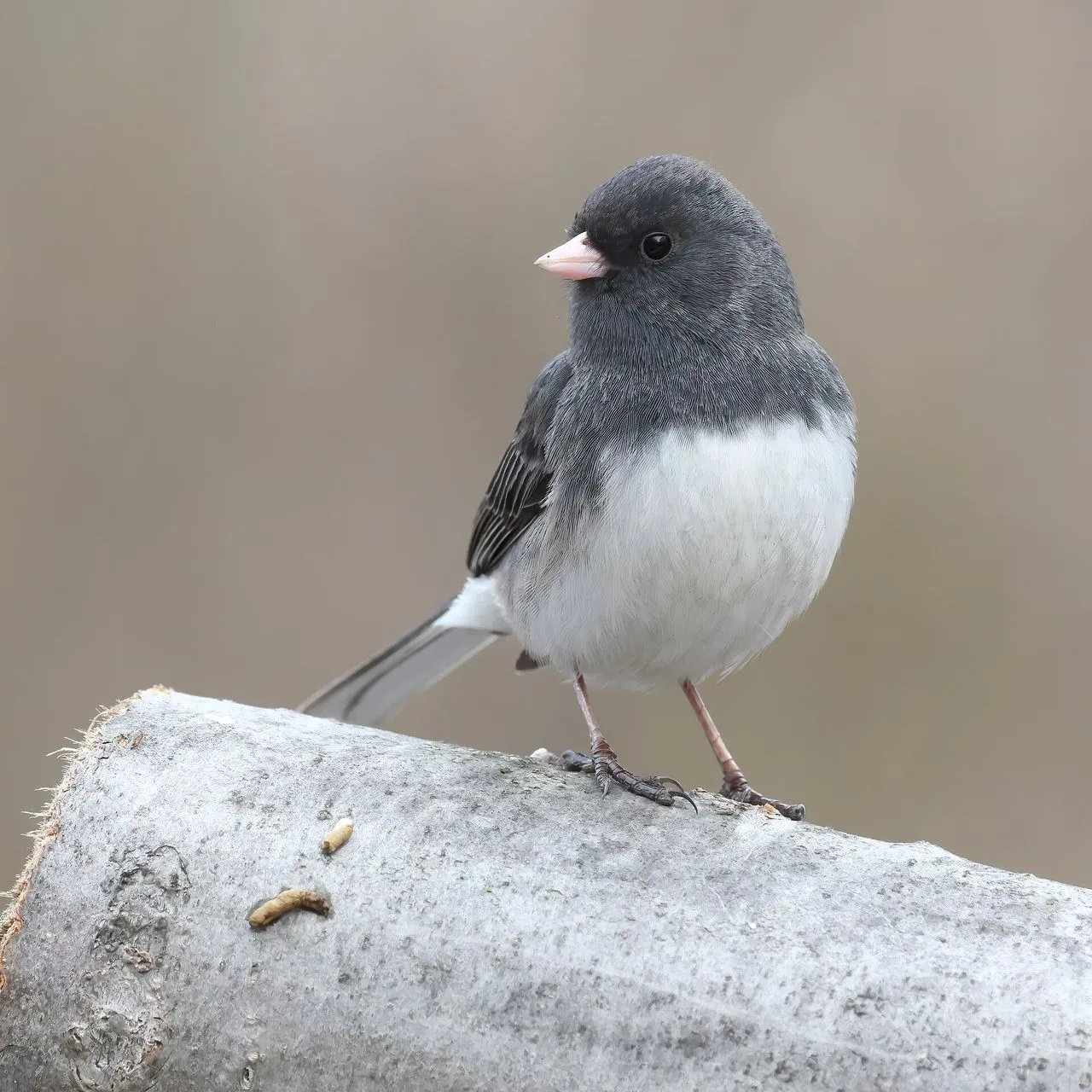
Dark-eyed Junco (Junco hyemalis) is a common winter sparrow (18–30g). Pink bill, dark hood, white outer tail feathers. Several regional forms, 'Oregon', 'Slate-colored', 'White-winged'. Forages on ground under feeders.
Junco hyemalis Linnaeus, 1758, the dark-eyed junco, is a 18 to 30 gram Passerellid whose wintering numbers can exceed 600 million individuals across North America.
Part of the Complete Finches & Sparrows Guide.
Identification
Visual
Dark-eyed junco is a compact sparrow, 14 to 16 centimetres long, with a short pinkish bill, rounded head, dark eye, and conspicuous white outer tail feathers. Those tail feathers flash during short flights and are often the first mark seen when a bird leaves a path edge or feeder base.
The eastern "slate-coloured" form is dark grey above and pale below, with a clean white belly. Females and immatures are browner, especially on the back and flanks. Western forms complicate the species. "Oregon" juncos have a blackish hood, brown back, and pinkish flanks. "Pink-sided" birds show a grey head, brown back, and broad rosy flanks. "White-winged" juncos of the Black Hills are larger and show obvious white wing bars. "Grey-headed" birds carry a grey body, reddish-brown back, and pale bill. These forms intergrade where ranges meet, and many winter birds do not fit a field-guide plate cleanly.
The species differs from chipping sparrow and song sparrow by its plain face, white belly, and tail flash. It does not show the streaked breast of song sparrow or the rufous cap and black eye-line of breeding chipping sparrow.
| Character | Dark-eyed Junco (Junco hyemalis) | Chipping Sparrow (Spizella passerina) | Song Sparrow (Melospiza melodia) |
|---|---|---|---|
| Body length | 14–16 cm (5.5–6.3 in) | 12–15 cm (4.7–5.9 in) | 12–17 cm (4.7–6.7 in) |
| Tail mark | White outer feathers flash in flight | No strong white tail flash | Rounded, often pumped in cover |
| Face | Plain, dark-eyed, pink bill | Rufous cap, black eye-line | Patterned face with malar stripe |
| Underparts | White belly, usually unstreaked | Plain grey in adults | Streaked with central breast spot |
| Feeder position | Ground below feeders | Ground or low tray | Ground near dense cover |
Audio
Song is a simple, even trill, usually one pitch repeated for one to two seconds. It resembles chipping sparrow song but is often more musical and less dry. The common call is a sharp tick, given from cover or in flight. Winter flocks produce low contact notes while feeding under shrubs. In spring, males sing from conifer branches, fence lines, and exposed understory perches soon after arrival on breeding territory.
Distribution
Dark-eyed junco breeds across boreal Canada, Alaska, the northern United States, the Appalachians, the Rockies, and western mountain systems south into Mexico. It winters across most of the United States and southern Canada, becoming one of the most familiar cold-season birds at ground feeders. Migration occurs mainly from September through November and March through May, with timing governed by latitude and snow cover.
Many populations are short- to medium-distance migrants. Mountain breeders often descend to lower elevations rather than leaving the region entirely. The slate-coloured form dominates eastern winter flocks, while western gardens may hold mixtures of Oregon, pink-sided, grey-headed, and intergrade birds.
Habitat
Breeding habitat is usually coniferous or mixed woodland with a cool understory: spruce-fir forest, pine woods, hemlock ravines, boreal edges, and high-elevation thickets. In winter the species broadens into woodland edges, hedgerows, brush piles, suburban gardens, weedy fields, and parks. It prefers cover close to feeding ground. A feeder placed beside dense shrubs will hold more juncos than one isolated on open lawn.
Snow changes microhabitat use. Birds concentrate along ploughed edges, under conifers where ground remains exposed, and beneath feeders where falling seed accumulates. They rarely cling to tube feeders for long; the species is built for ground foraging.
Diet and Feeder Behaviour
Seeds dominate the winter diet. Juncos take millet, cracked corn, sunflower fragments, grass seed, ragweed, amaranth, and sedge seed. At feeders they work the ground below hanging ports, picking up what larger birds drop. White millet scattered thinly near cover attracts them reliably, but heavy piles can draw house sparrows and rodents.
During breeding, adults add insects and spiders, especially for nestlings. Caterpillars, beetles, flies, and small arthropods provide the protein required for growth. In autumn and winter, flock hierarchy influences access to the safest feeding positions. Older males often occupy central spots near cover; younger birds and females feed farther out and flush sooner.
Breeding Biology
Breeding begins from April in southern mountains to June across the boreal north. The nest is usually on or near the ground, tucked into a bank, grass clump, root mass, mossy hollow, or low shrub. The female builds a cup of grasses, moss, bark strips, and hair. Ground placement makes nests vulnerable to snakes, chipmunks, squirrels, and heavy rain.
Clutch size is 3 to 5 eggs, whitish to pale greenish and marked with brown. Incubation lasts 11 to 13 days and is mainly by the female. Nestlings fledge after 9 to 13 days, often before they can fly strongly, and remain concealed in vegetation while parents feed them. Two broods are possible in southern or low-elevation parts of the breeding range.
Notes
Dark-eyed junco is one of the clearest examples of recent, incomplete passerine diversification in North America. The named forms were once treated as separate species; genetic and contact-zone evidence now places them within a single, variable species. The winter flock under a feeder may therefore contain visible evidence of postglacial range shifts, mountain isolation, and secondary contact. Treat every odd-looking junco as data rather than as a nuisance plumage problem.
See Also
- Song Sparrow: a streaked, cover-loving sparrow with a very different song structure.
- White-throated Sparrow: another northern sparrow that winters widely and feeds low to the ground.
- Chipping Sparrow: the dry-trill sparrow most often confused with junco in spring and autumn.
- American Goldfinch: a common feeder finch for comparing winter flocking and seed use.
- The Complete Finches & Sparrows Guide: full family reference: identification, song, and feeder behaviour.
Frequently Asked Questions
What are the different junco forms?
'Slate-colored' (eastern): grey body, dark hood. 'Oregon' (west): brown with black hood. 'White-winged' (central): grey with white wing bars. 'Pink-sided' (southwest): grey with pink flanks. Each form occupies different regions.
Where does Dark-eyed Junco nest?
Coniferous and mixed forests across Canada and the western mountains. Nests on ground, well-concealed in vegetation. One of the most widespread North American breeding birds.
Do juncos use feeders?
Yes, they feed on the ground under seed feeders, eating fallen seed. Prefer platform feeders or ground feeding. Very common winter visitor to backyards across North America.
What do juncos eat?
Seeds, especially on the ground. They also eat insects in summer. In winter, they rely heavily on fallen seed beneath feeders.