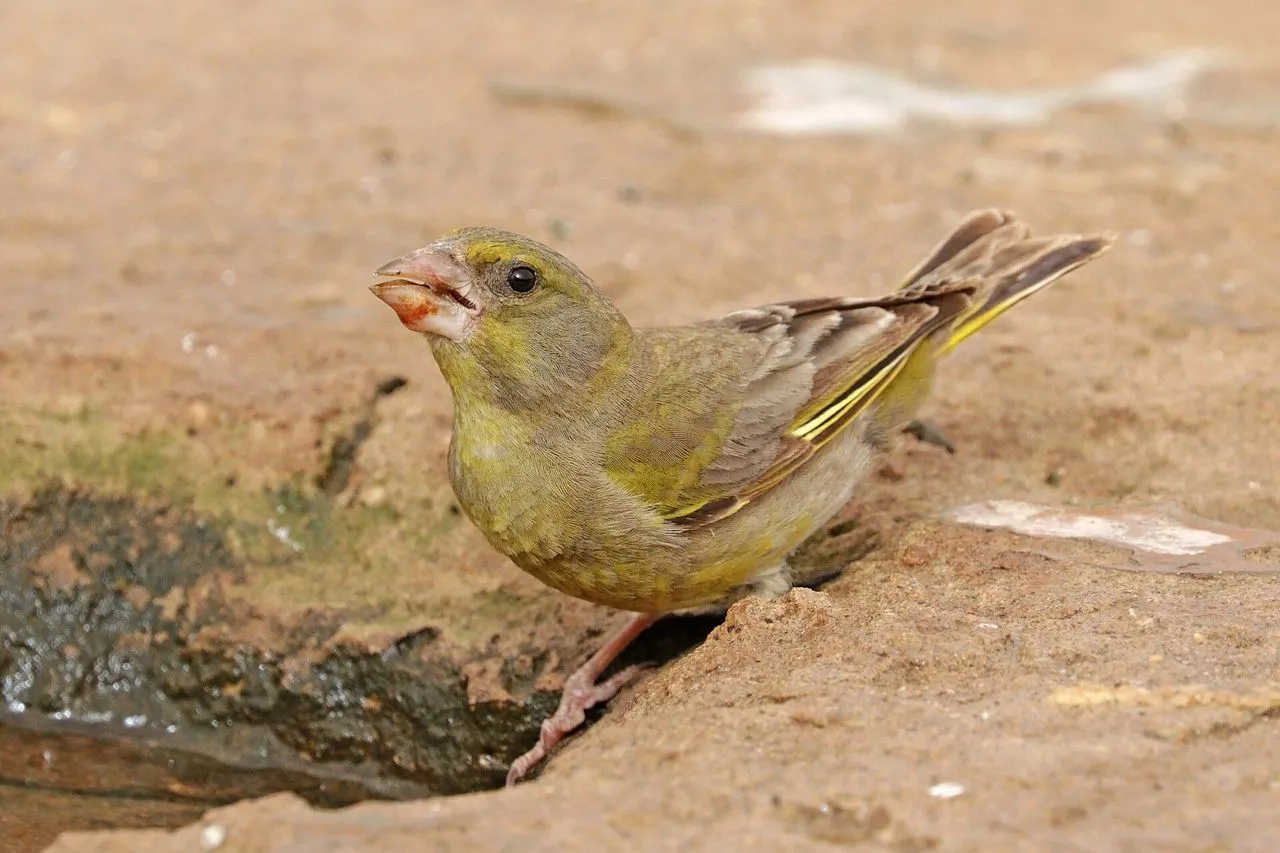
European Greenfinch (Chloris chloris) is a stocky finch (14-16cm, 25-34g) with heavy pale bill, olive-green plumage, and yellow flashes in wing and tail. Males are brighter. Declined 60%+ in Britain after finch trichomonosis emerged in 2005. Wheezing song is distinctive.
Chloris chloris Linnaeus, 1758, the European greenfinch, declined by more than 60% in Britain after trichomonosis emerged in garden birds in 2005.
Part of the Complete Finches & Sparrows Guide.
Identification
Visual
Greenfinch is a stocky, heavy-billed finch, 14 to 16 centimetres long and usually 25 to 34 grams. Adult males are olive-green with yellow in the wing and tail, greyish cheeks, and a thick pale bill. Females are duller grey-green with more subdued yellow but retain the broad bill and yellow wing edges. Juveniles are streaked and browner, yet their size and bill distinguish them from siskins and goldfinches.
The flight pattern is bounding, with bright yellow flashes along the primaries and outer tail. At rest the bird can look bulky and blunt-headed. Goldfinch is smaller, finer-billed, and marked by the red face. Chaffinch has white wing bars and a slimmer bill. House sparrow is structurally different, with a shorter blunt bill and no yellow wing panel.
Sick greenfinches are unfortunately familiar at feeders. Birds with fluffed plumage, wet-looking face feathers, difficulty swallowing, or prolonged sitting near food may be suffering from trichomonosis. Such signs should be treated as disease evidence, not as tame behaviour.
| Character | Greenfinch (Chloris chloris) | European Goldfinch (Carduelis carduelis) | Chaffinch (Fringilla coelebs) |
|---|---|---|---|
| Body length | 14–16 cm (5.5–6.3 in) | 12–13.5 cm (4.7–5.3 in) | 14–16 cm (5.5–6.3 in) |
| Body mass | 25–34 g (0.9–1.2 oz) | 14–19 g (0.5–0.7 oz) | 18–29 g (0.6–1.0 oz) |
| Bill | Heavy, pale, conical | Long, fine, pointed | Medium conical |
| Wing mark | Yellow flashes in wing and tail | Broad yellow wing bar | Two white wing bars |
| Head pattern | Olive-green, no red face | Red face bordered black and white | Male blue-grey crown; female plainer |
Audio
The characteristic song combines twittering phrases with a drawn-out nasal wheeze, often rendered dzhweee. Males deliver this from treetops, hedges, or in a slow butterfly-like display flight with exaggerated wingbeats. Calls include a hard dzup and softer flock notes. The long wheeze is one of the most recognisable sounds of spring gardens where the species remains common.
Distribution
Greenfinch is widespread across Europe, North Africa, and western Asia, and has been introduced to New Zealand, Australia, and parts of South America. In Britain and Ireland it remains widespread but much reduced from late 20th-century levels. Most populations are resident or partially migratory, with northern and eastern birds moving south or west in winter.
The British decline began abruptly after finch trichomonosis appeared in 2005. The parasite Trichomonas gallinae infects the upper digestive tract and can prevent swallowing. Greenfinches and chaffinches were hit particularly hard, probably because their feeder behaviour brings repeated contact with contaminated surfaces and saliva-contaminated food.
Habitat
Greenfinch uses hedgerows, gardens, orchards, farmland edges, scrub, parks, cemeteries, and young plantations. It needs dense shrubs or conifers for nesting and open feeding areas with seeds. Traditional mixed farmland once supplied abundant weed seed and hedgerow nesting cover; intensification reduced both.
Suburban gardens can support breeding pairs where dense evergreen shrubs, hawthorn, ivy, or conifers remain. Over-tidying removes nest cover. Disease risk rises where many birds share poorly cleaned feeders, especially in warm wet conditions that keep food moist.
Diet and Feeder Behaviour
Diet consists of seeds, buds, berries, and some insects. The heavy bill cracks larger seeds than goldfinch can manage: sunflower, hemp, cereal grains, rosehip seeds, and tree seeds. At feeders greenfinches favour black sunflower, sunflower hearts, and mixed seed. They use tubes, trays, and hanging feeders but often dominate ports through size and persistence.
Feeder hygiene is not optional for this species. Trichomonosis spreads when infected birds contaminate food or water with saliva. If sick birds appear, feeding should stop temporarily, food should be discarded, and feeders and bird baths should be cleaned and dried thoroughly. Continuing to supply seed to a diseased aggregation can increase mortality.
Breeding Biology
Breeding begins from March or April. The female builds a bulky cup of twigs, grass, moss, and roots, lined with hair and fine fibres, usually in dense evergreen shrubs, hedges, ivy, or conifers. Nests are commonly 1.5 to 4 metres above ground but may be higher in trees.
Clutch size is usually 4 to 6 eggs, pale blue-white with reddish markings. Incubation lasts 12 to 14 days and is performed by the female while the male feeds her. Young fledge after 13 to 16 days. Two or three broods are possible in good seasons. Nestlings receive regurgitated seeds and some insects, with plant material becoming dominant as they grow.
Notes
Greenfinch shows how quickly a common garden bird can become a conservation concern. The species did not decline because observers stopped noticing it or because it shifted invisibly into other habitats. It suffered a measurable disease-driven collapse layered on top of agricultural change. A greenfinch at a feeder is therefore not merely a pleasant spring bird; it is also a reminder that garden feeding creates epidemiological conditions as well as observational opportunities.
See Also
- European Goldfinch: the smaller, finer-billed finch that shares garden feeding stations but avoids direct competition through agility.
- Chaffinch: the widespread Fringillid that shares hedgerow habitat and was similarly affected by trichomonosis.
- House Sparrow: the commensal Passerid that shares British garden habitat and competing feeder behaviour.
- Common Redpoll: the boreal Fringillid for disease and feeding competition comparison in garden context.
- The Complete Finches Guide: full family reference: taxonomy, identification, and feeder behaviour.
- Preventing Trichomonosis at Finch Feeders: the disease responsible for the Greenfinch population crash since 2005; protocol for protecting the remaining birds.
Frequently Asked Questions
How do I identify Greenfinch?
Stocky, heavy-billed finch. Males: olive-green with yellow wing and tail flashes, greyish cheeks. Females: duller grey-green with subdued yellow. The heavy bill and yellow wing edges separate it from all other garden finches.
Why did Greenfinches decline so sharply?
Finch trichomonosis (caused by Trichomonas gallinae) emerged in British garden birds in 2005. Greenfinches and Chaffinches were hit hardest, feeder behaviour brings repeated contact with contaminated surfaces. Declines exceeded 60% in Britain.
What does Greenfinch song sound like?
Twittering phrases mixed with a drawn-out nasal wheeze, often rendered dzhweee. Males deliver from treetops, hedges, or in a butterfly-like display flight with exaggerated wingbeats. The long wheeze is one of the most recognisable garden sounds.
How can I help prevent disease at feeders?
Clean feeders regularly, trichomonosis spreads through saliva-contaminated food and water. If sick birds appear (fluffed, wet face, difficulty swallowing), pause feeding, discard food, clean and dry feeders thoroughly before resuming.