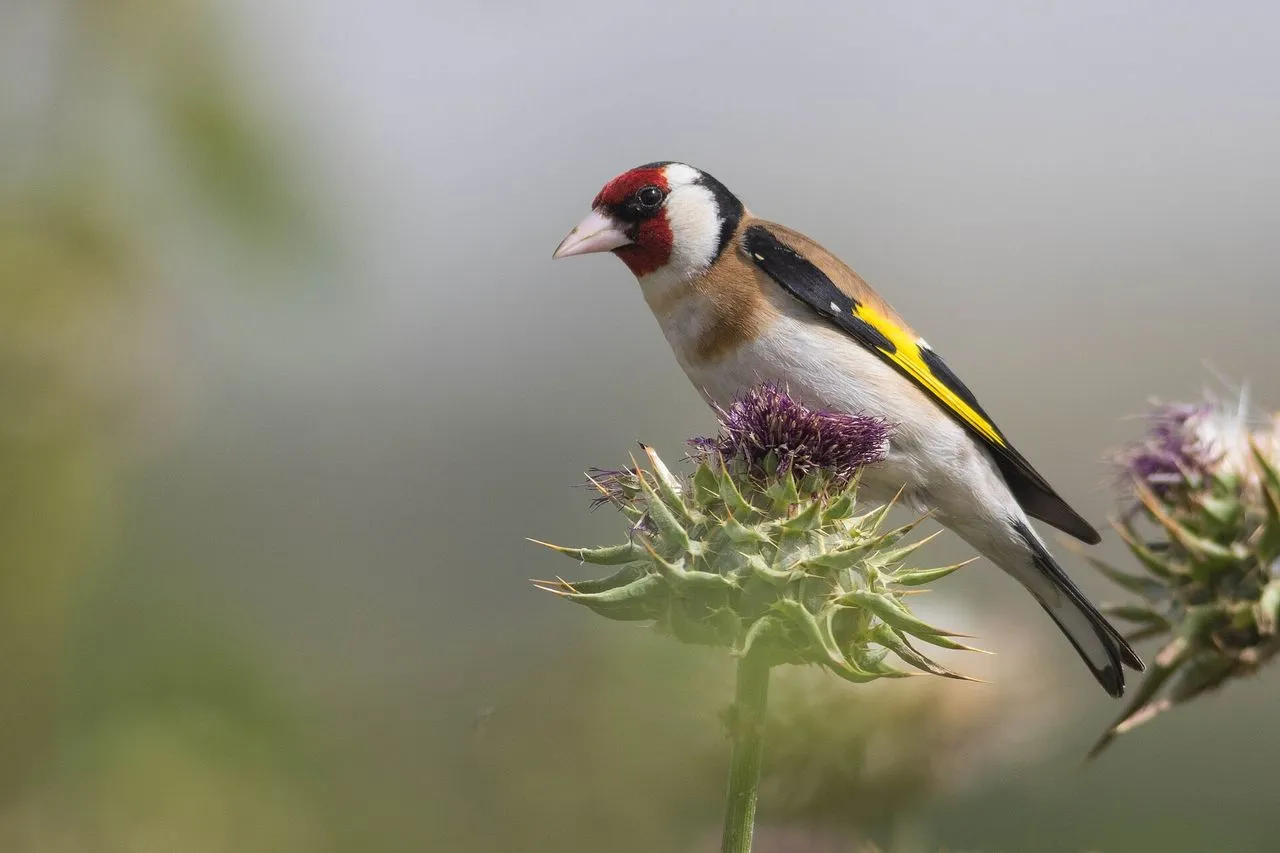
European Goldfinch (Carduelis carduelis) is a distinctive finch (12-13.5cm, 14-19g) with red face mask bordered by black and white, warm brown mantle, and black wings with broad yellow bar. Long pale bill for extracting thistle seeds. Widespread across Europe and increasingly common at nyjer feeders.
Carduelis carduelis Linnaeus, 1758, the European goldfinch, weighs about 14 to 19 grams and uses a bill narrow enough to extract teasel and thistle seeds beyond the reach of heavier finches.
Part of the Complete Finches & Sparrows Guide.
Identification
Visual
European goldfinch is one of the most distinctive western Palearctic finches. Adults show a red face mask bordered by black and white, warm brown mantle, whitish underparts, black wings with a broad yellow bar, and a white rump visible in flight. Length is 12 to 13.5 centimetres, with a wingspan of 21 to 25 centimetres. The bill is long, pale, and sharply pointed for a finch.
Sexes are similar. Males often have a red mask extending just behind the eye; in females it may stop at or before the eye, but overlap is broad and this is not a safe mark on its own. Juveniles lack the red face and have a streaked head and body, but the yellow wing bar is already prominent. In flight, the wing bar flashes as a continuous yellow panel rather than the small yellow edging of siskin.
Confusion with greenfinch is unlikely at close range: greenfinch is larger, olive-green, heavy-billed, and lacks the red face. Siskin is smaller, streaked, and shows a yellow rump. American goldfinch, where both occur through introductions or escapes, lacks the red-white-black head pattern.
| Character | European Goldfinch (Carduelis carduelis) | Greenfinch (Chloris chloris) | Siskin (Spinus spinus) |
|---|---|---|---|
| Body length | 12–13.5 cm (4.7–5.3 in) | 14–16 cm (5.5–6.3 in) | Usually smaller and slimmer |
| Body mass | 14–19 g (0.5–0.7 oz) | 25–34 g (0.9–1.2 oz) | Usually lighter than greenfinch |
| Head pattern | Red face bordered black and white | Olive-green, no red face | Streaked, no red face |
| Wing mark | Broad yellow wing bar | Yellow wing and tail flashes | Yellow wing bar and rump |
| Bill | Long, pale, pointed | Heavy, pale, conical | Fine, pointed |
Audio
Calls are liquid and bright, often rendered as tickelitt or tswit-wit-wit. Flocks announce themselves with constant tinkling contact notes. Song is a rapid, twittering mixture of trills, nasal notes, and call phrases, delivered from tree tops, aerial display, or exposed perches. The song is less forceful than chaffinch but more varied than greenfinch's wheeze-dominated performance.
Distribution
European goldfinch occupies most of Europe, North Africa, the Middle East, and western to central Asia. It has been introduced to Australia, New Zealand, parts of South America, and scattered localities elsewhere. In Britain it is widespread and has increased substantially in gardens since the late 20th century, aided by nyjer feeders and winter seed provision.
Most populations are resident or partially migratory. Northern and eastern birds move south and west in winter, while British birds show a mixture of residency and short-distance movement. Winter flocks often form around alder, birch, teasel, and garden feeders.
Habitat
The species favours open country with trees and seed-rich herbaceous plants: orchards, gardens, hedgerows, rough grassland, churchyards, farmland edges, parks, and brownfield sites. It avoids dense closed forest and intensively managed land stripped of weeds. Thistles, teasels, knapweed, dandelion, and alder provide important natural food.
Urban and suburban gardens have become important habitat where planting and feeders supply small seeds. A garden with sterile lawn and clipped evergreen alone is poor goldfinch habitat; one with seed-bearing perennials and nearby trees can hold flocks through winter.
Diet and Feeder Behaviour
Small seeds dominate the diet. Goldfinches specialise on composite seed heads, especially thistle and teasel, using the long bill to reach seeds without taking the head apart. Alder and birch seeds are important in winter. Insects are taken during breeding, but nestlings receive a high proportion of regurgitated seeds compared with many passerines.
At feeders, nyjer and sunflower hearts are the principal foods. Goldfinches cling comfortably to narrow ports and mesh feeders. Flocks can be large, and disputes at feeding ports involve bill-pointing, wing-flicking, and short chases. They usually lose direct physical contests with greenfinches but compensate by agility and numbers.
Breeding Biology
Breeding begins relatively late, often from late April or May, with timing linked to seed availability. The female builds a compact, neat cup of moss, grass, lichen, wool, and spider silk, usually near the outer branches of a deciduous tree or tall shrub. Fruit trees, birch, sycamore, and ornamental trees are frequently used.
Clutch size is commonly 4 to 6 pale bluish eggs with fine reddish markings. Incubation lasts 11 to 13 days, mainly by the female. The male feeds her during incubation. Young fledge after about 13 to 18 days. Two broods are common in favourable seasons, and late summer family parties join moulting flocks.
Notes
European goldfinch abundance in British gardens is partly a story of feeder technology. Nyjer seed and fine-port feeders gave a small-billed finch access to a dependable winter resource without handing the same advantage to larger sparrows. The increase should not be read as proof that wider farmland seed resources are healthy; it shows that this species can exploit a narrow artificial substitute exceptionally well.
See Also
- Greenfinch: the larger, heavier-billed garden finch that shares European distribution and competes at nyjer feeders.
- Siskin: the smaller streaked Fringillid for bill comparison and range overlap in Britain and Europe.
- American Goldfinch: the North American Spinus for cross-continental comparison of thistle-feeding specialisation.
- House Sparrow: the British garden sparrow that competes for seed but lacks Fringillid bill structure.
- The Complete Finches Guide: full family reference: taxonomy, identification, and feeder behaviour.
- American vs European Goldfinch: geographic and plumage side-by-side; naturalised vs vagrant status in North America.
Frequently Asked Questions
How do I identify European Goldfinch?
Red face mask bordered by black and white, warm brown mantle, whitish underparts, black wings with broad yellow wing bar, white rump in flight. Juveniles lack red face but show the yellow wing bar. Bill is long, pale, sharply pointed.
What do European Goldfinches eat?
Specialises on composite seed heads, thistle, teasel, knapweed, dandelion. The long bill reaches seeds other finches cannot. At feeders, nyjer and sunflower hearts are preferred. Clings to seed heads and narrow ports easily.
Why are European Goldfinches increasing in gardens?
Nyjer feeders gave small-billed finches access to a dependable winter resource. The increase reflects feeder technology as much as habitat health, the species exploits this narrow artificial substitute exceptionally well.
How do they breed?
Late breeding linked to seed availability (from April/May). Nest is compact cup in outer branches of deciduous trees, fruit trees, birch, sycamore. Clutch 4-6 blueish eggs. Two broods common. Family parties join winter flocks.