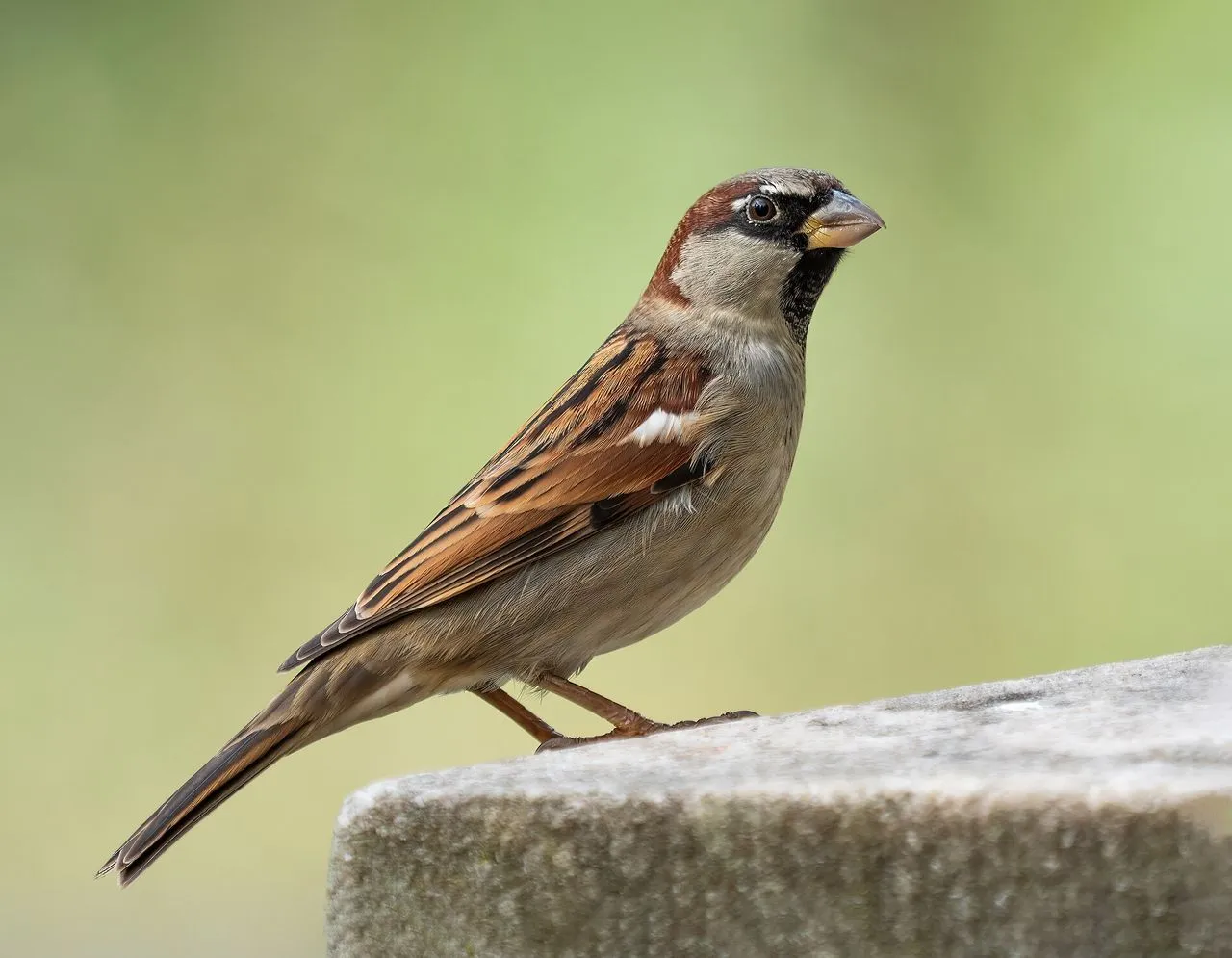
House Sparrow (Passer domesticus) is a heavily built sparrow (14-18cm) with a grey crown, chestnut nape, and black bib in males. Female is brown with pale supercilium. British populations declined 71% since 1977, now on UK Red List. Commensal with human settlement, requires colonies.
Passer domesticus Linnaeus, 1758, the house sparrow, was once the most abundant bird across British towns and much of urban North America. It now appears on the UK Birds of Conservation Concern Red List, with breeding populations in Britain estimated to have declined by 71% between 1977 and 2023.
Part of the Complete Finches & Sparrows Guide.
Identification
Visual
The male is a heavily built, bull-headed passerine with a distinctive head pattern: grey crown, broad chestnut nape, pale grey cheek patch, and a black bib. Bib size increases with age; older dominant males carry larger bibs that function as a status badge within colonies, conveying dominance without requiring direct physical contest. The back is streaked chestnut and black; the underparts are pale grey-buff and unstreaked. In fresh autumn plumage the feather tips obscure much of the chestnut and black, giving a somewhat washed-out appearance that sharpens by spring as tips abrade, though house sparrow has no pre-breeding partial moult and the change is modest compared to Fringillids.
The female and juvenile are considerably plainer: brown above with dark streaking, a pale buff supercilium, and plain buff-brown underparts. Separation from native North American Passerellid sparrows rests on the face pattern. House sparrow female lacks the clean white supercilium, rufous cap, or distinct malar stripe that characterise most Passerellids. The broad, blunt bill and heavy-chested build are also helpful at range.
| Character | House Sparrow (Passer domesticus) | Eurasian Tree Sparrow (Passer montanus) | Native Passerellid sparrows |
|---|---|---|---|
| Body length | 14–18 cm (5.5–7.1 in) | 12.5–14 cm (4.9–5.5 in) | Usually small to medium |
| Male head | Grey crown, chestnut nape, black bib | Chestnut crown, white cheek, black cheek spot | No Old World sparrow bib pattern |
| Female | Plain brown, pale buff supercilium | Sexes alike; black cheek spot present | Often stronger face stripes or streaking |
| Bill | Broad, blunt, seed-crushing | Stout but smaller | Usually finer and more pointed |
| Feeder behaviour | Bold, social, often dominant | Social but more localised | Ground or cover-oriented, less dominant |
Audio
House sparrow does not produce song in the Fringillid sense. Vocalisations are a series of cheep, chirp, and chirrup notes functioning as social signals: alarm, contact maintenance, flock cohesion, and male status advertisement. Male aggregations at nest sites generate a persistent chirruping chorus through the breeding season that, at a large colony, becomes a continuous background hiss from some distance away. There is no territorial song. Once you know the chirrup (a single, slightly two-syllabled note with a mild upward inflection), confusion with song sparrow or chipping sparrow becomes unlikely; both carry far more melodic and patterned vocalisations.
Distribution
Passer domesticus is the most widely distributed wild bird on earth, present on every inhabited continent following deliberate and accidental introductions. Native range covers the Palearctic from the British Isles east through Central Asia. Introduced to North America (first confirmed breeding, Brooklyn, 1853), South America, sub-Saharan Africa, Australia, and New Zealand. In North America the species is a year-round resident throughout the continent, absent only from dense boreal forest and the highest alpine zones.
In Britain the contraction is spatial as well as numerical: populations have retreated from the countryside into larger towns and cities. Many rural villages that held established house sparrow colonies a generation ago now hold none.
Habitat
P. domesticus is a commensal species: it thrives in close association with human settlement and has little ecological existence independent of it. Optimal habitat combines three elements: cavity nest sites in buildings (gaps in eaves, loose roof tiles, spaces in masonry), open foraging ground within a short flight of those sites (gardens, parks, weedy margins, agricultural fields), and social density. House sparrows rarely function as isolated pairs; colonies of at least several breeding pairs appear to be the ecological minimum, and solitary birds at feeders with no nearby colony typically fail to establish.
Agricultural intensification has removed much of the weedy, seed-rich foraging ground that historically sustained rural colonies. Improved building construction standards have eliminated many cavity nest sites as older housing stock is upgraded or replaced. These two factors are the dominant explanations for the British decline. Invertebrate availability for nestlings has also been implicated in urban areas, where declining insect abundance reduces the caterpillar and aphid supply that chicks require in their first week of life.
Diet and Feeder Behaviour
House sparrows eat a broad range of foods: grain, weed seeds, invertebrates, bread, fruit scraps, and suet. They adapt readily to feeder types and take millet, sunflower hearts, and mixed seed from platform feeders and trays. They are less comfortable on narrow-port tube feeders but will learn to use them if no platform alternative is available. As bold, persistent feeders with a social feeding style, they can displace smaller finches from preferred perch positions at busy stations.
Invertebrates are critical during breeding. Nestlings require caterpillars and aphids for the first week of life, and brood failure in urban areas has been linked to invertebrate scarcity in the immediate foraging range of the colony. Adults in good condition maintain themselves on a seed-only diet; they cannot raise chicks on it.
Breeding Biology
House sparrow is a colonial breeder with a long breeding season. Nest building may begin in March, with eggs from April through August. Three broods per season is typical; four occurs in warm years. The nest is a domed structure of dry grass and feathers placed in a cavity, usually in a building, in dense ivy, or occasionally occupying the base of a larger bird's nest. House martin nests are regularly appropriated.
Clutch size is 3 to 5 pale, grey-spotted eggs. Incubation runs 11 to 14 days and is shared by both sexes. Nestlings fledge at 14 to 17 days but remain with the family group for several weeks; juveniles from early broods may attempt to breed in their first summer. Males compete for nest sites throughout the season: bib size is the primary status signal, and larger-bibbed males tend to secure established cavities without direct physical contest more often than smaller-bibbed individuals. This badge-of-status system has been studied extensively and is one of the better-documented examples of an honest signal in passerine social systems.
Notes
The population trajectories of house sparrow in Britain and North America tell different stories. In North America the species was introduced with intent (to control cankerworms in eastern cities), built to an estimated 150 million birds by the early 20th century, and then declined from the 1920s onward as horse transport disappeared along with the spilled grain that accompanied it. Current North American populations, while lower than the historic peak, are not in acute conservation crisis. The species remains common and conspicuous across most of the continent.
The British and wider European picture is considerably more serious: a decline of roughly 60% across Europe since 1980, with some urban populations falling faster than rural ones. The mechanisms are not fully resolved. Food availability, nest-site loss, cat predation, and disease have all been proposed, but no single factor explains the full trajectory. What is clear is that the decline is real, widespread, and ongoing. Treating house sparrow as ecologically unimportant on account of its introduced status or former abundance misses the ecological role it retains in the urban communities where it still persists, and loses a significant observational baseline for anyone tracking the health of city bird communities over time.
See Also
- House Finch: the introduced western finch that now overlaps with house sparrow across North America and causes regular identification confusion.
- American Goldfinch: the seed specialist that shares feeder sites with house sparrow in North America without bill morphology confusion.
- Song Sparrow: the native Passerellid for comparison of plumage, bill, and ecological role at North American feeders.
- Eurasian Tree Sparrow: the related introduced Passer species for direct species comparison in the Mississippi River valley.
- The Complete Finches Guide: full family reference: taxonomy, identification, and feeder behaviour.
Frequently Asked Questions
How do I identify House Sparrow?
Male: grey crown, chestnut nape, large black bib (size increases with age). Female/juvenile: brown above, pale buff supercilium, plain buff-brown underparts. Broad, blunt bill. Heavier and more bull-headed than native sparrows.
Why are House Sparrows declining in Britain?
Agricultural intensification removed seed-rich foraging margins. Improved building standards eliminated cavity nest sites. Reduced invertebrate availability for nestlings. Also implicated: cat predation, disease. Multiple factors, no single cause.
Do House Sparrows use feeders?
Yes, bold, social feeders taking millet, sunflower hearts, suet, bread. Can displace smaller finches from perch positions. Colonial nesting means birds often arrive in groups. Less comfortable on narrow-port tubes.
How is House Sparrow bib size related to dominance?
Bib size functions as a status badge. Larger-bibbed males secure cavities without direct physical contest more often. This honest signal system has been extensively studied, it conveys dominance within colonies without requiring fights.