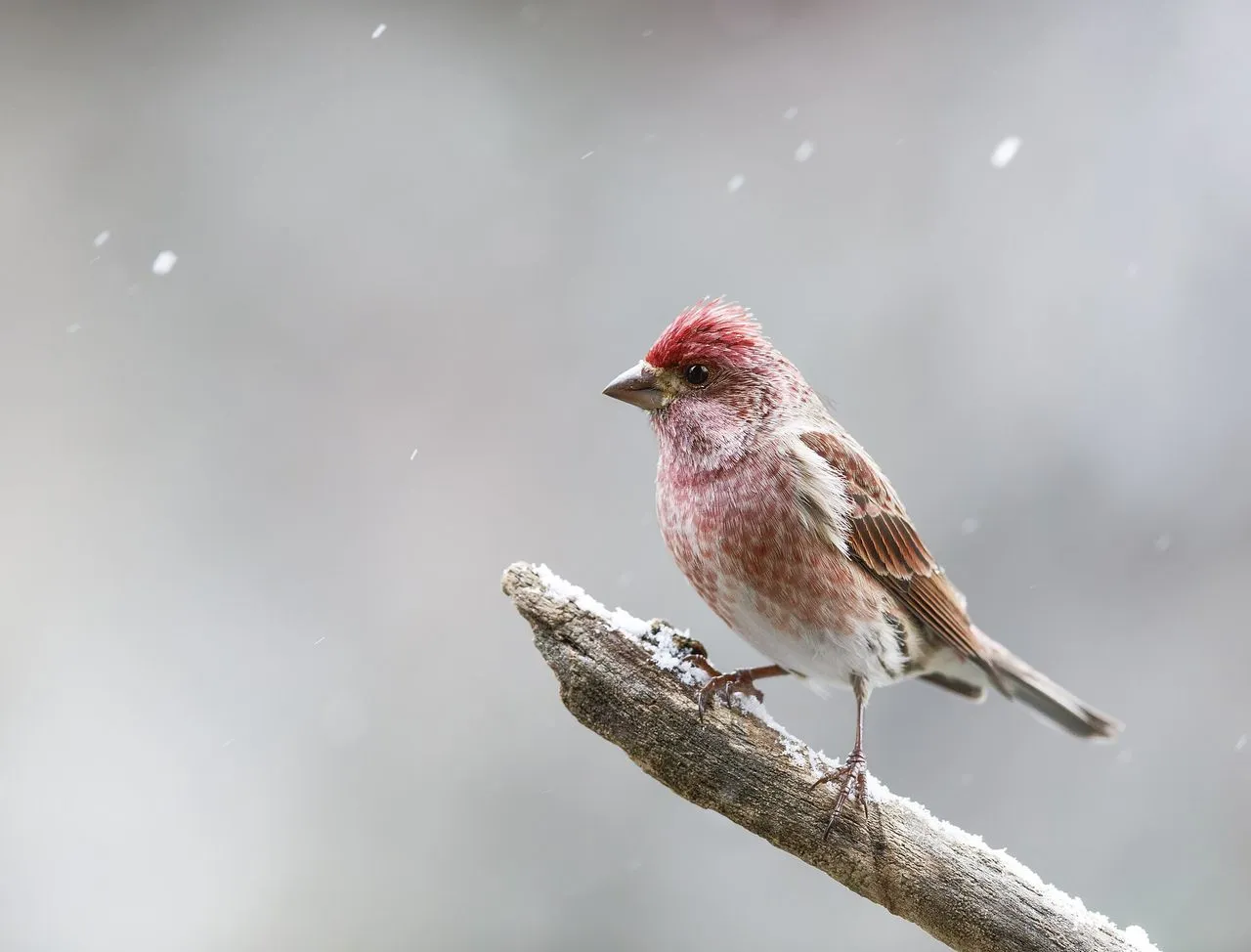
Purple Finch (Haemorhous purpureus) is a declining boreal finch (18–32g). Males have red extending over entire head; females have bold facial stripes. Often confused with House Finch, key difference is head colour extent.
Haemorhous purpureus Gmelin, 1789, the purple finch, weighs about 18 to 32 grams and has declined by more than half in parts of eastern North America since systematic breeding surveys began in 1966.
Part of the Complete Finches & Sparrows Guide.
Identification
Visual
Purple finch is not purple in the ordinary sense. Adult males show a raspberry-red wash over the head, breast, back, and rump, as if pigment has soaked through the brown plumage rather than being placed in discrete patches. The flanks are washed and only weakly streaked. This diffuse colour field is the most useful distinction from male house finch, which shows brighter red restricted mainly to the forehead, throat, upper breast, and rump while retaining strong brown flank streaks.
Structure reinforces the plumage marks. Purple finch is compact, broad-chested, and large-headed, 12 to 16 centimetres long with a wingspan near 22 to 26 centimetres. The bill is deeper and the upper mandible more curved than in house finch. The tail is shorter and more notched. A perched purple finch often looks front-heavy, with the head and bill dominating the profile.
Females and immatures cause most field errors. Female purple finch has a bold whitish eyebrow, a dark ear-covert patch, a strong malar stripe, and heavy triangular streaking below. Female house finch is plainer-faced, greyer, and more evenly streaked, lacking the sharp face pattern. At a feeder, a brown finch with a crisp face and heavy bill should be checked carefully for purple finch even if no male is present.
| Character | Purple Finch (Haemorhous purpureus) | House Finch (Haemorhous mexicanus) |
|---|---|---|
| Body length | 12–16 cm (4.7–6.3 in) | 12.5–15 cm (4.9–5.9 in) |
| Body mass | 18–32 g (0.6–1.1 oz) | 16–27 g (0.6–1.0 oz) |
| Male colour | Raspberry wash over head, breast, back, and rump | Red or orange mostly on face, breast, and rump |
| Female face | Bold eyebrow, dark cheek, strong malar stripe | Plain face, weaker streaking pattern |
| Shape | Compact, front-heavy, notched tail | Slimmer, longer-tailed, flatter-headed |
Audio
Song is rich, rolling, and continuous, often lasting 6 to 15 seconds. It carries musical warbles, slurred phrases, and mimicry-like fragments, delivered from conifer tops or deciduous canopy edges. House finch song is shorter and more hurried, usually ending with a dry rising note; purple finch song sounds fuller and less mechanical. Calls include a sharp metallic pik and a softer conversational tek within flocks.
Distribution
Purple finch breeds across the boreal and mixed forests of Canada, the northeastern United States, the Great Lakes region, and the Pacific coastal forests. The Appalachian population extends southward through suitable high-elevation forest. Winter distribution shifts south into the eastern United States irregularly, with strongest feeder appearances during poor northern seed years. Western birds are more closely tied to coniferous and coastal forests and may move altitudinally rather than across long latitudes.
The species is less urban than house finch and has retreated from many towns where house finch became abundant. Competition probably matters at feeders, but habitat change in breeding forest and winter food variation also contribute. In much of the eastern United States purple finch is now a winter visitor rather than a dependable breeding bird.
Habitat
Breeding habitat centres on moist coniferous and mixed forest: spruce, fir, hemlock, pine, birch, maple, and forest edges with tall singing perches. It also uses orchards and wooded residential areas in the north, but only where mature trees and nearby forest structure remain. During winter it enters gardens, old fields, and towns more readily, especially where sunflower feeders concentrate birds.
Purple finch avoids the open, heavily built suburban matrix that house finch uses so effectively. A line of street trees and ornamental shrubs may hold house finches year-round; purple finches usually require connection to larger woodland or a seasonal food pulse.
Diet and Feeder Behaviour
Diet includes seeds, buds, berries, small fruits, and some insects. Elm, birch, ash, maple, conifer seeds, ragweed, and fruiting shrubs all contribute. In spring, buds and blossoms may form a substantial part of the diet. At feeders purple finch favours black-oil sunflower and hulled sunflower, often feeding deliberately and holding position against smaller finches. It is less tied to nyjer than goldfinch or pine siskin.
Winter feeder occurrence is uneven. Some years bring several birds daily from November into April; other years bring none. These fluctuations reflect northern seed crops, especially birch, ash, and conifers. A garden can be suitable and still miss purple finches for several winters if food conditions farther north remain adequate.
Breeding Biology
Pairs form from late winter into spring, often after males have begun sustained song. Nesting usually starts in May or June in the north. The female builds a bulky cup of twigs, rootlets, grass, moss, and hair, generally in a horizontal branch fork of a conifer 2 to 15 metres above ground. Spruce, fir, pine, and hemlock are frequent nest trees.
Clutch size is commonly 4 to 5 pale greenish-blue eggs marked with brown or black. Incubation lasts about 12 to 13 days and is performed by the female. The male supplies food during incubation and early nestling stages. Young fledge after roughly 13 to 16 days. One brood is usual across the boreal range; second attempts occur after early failure or in southern parts of the range.
Notes
The house finch comparison is unavoidable but can mislead observers into treating purple finch as a colour variant rather than a distinct forest species. The better mental model is ecological. House finch is a dry-country and suburb-adapted bird with streaked flanks and a long tail. Purple finch is a compact forest finch with a stronger bill, richer song, and a winter pattern governed by northern seed crops. When both appear at the same feeder, the purple finch usually looks less like a red house finch than field guides imply.
See Also
- House Finch: the long-tailed, suburb-adapted lookalike most often confused with purple finch.
- American Goldfinch: a common feeder finch that shares winter seed sources but not the same shape.
- Pine Siskin: a smaller irruptive finch that often joins winter feeder flocks.
- Common Redpoll: a northern seed-crop tracker that can overlap purple finch in winter.
- The Complete Finches & Sparrows Guide: full family reference: identification, song, and feeder behaviour.
- House Finch vs Purple Finch: the side-by-side comparison; raspberry wash vs masked red, and the female-face diagnostic.
Frequently Asked Questions
How do I separate Purple Finch from House Finch?
Male Purple Finch has red extending over entire head; House Finch has red only on face/chest. Female Purple Finch has bold white eye stripe and heavily streaked underparts; female House Finch is plainer. The notched tail is also diagnostic.
Why are Purple Finches declining?
Populations have declined over 50% since 1966 in eastern North America. Causes unclear, possibly competition with House Finches, habitat changes, or disease. They need coniferous forest for breeding.
Where does Purple Finch breed?
Coniferous and mixed forests across Canada and the northeastern US. More northern than House Finch. Found in boreal and temperate forest edges with conifers.
What does Purple Finch eat?
Seeds, especially from conifers (pine, spruce). Also eats buds, berries, and insects. Less common at feeders than House Finches but will visit sunflower feeders.