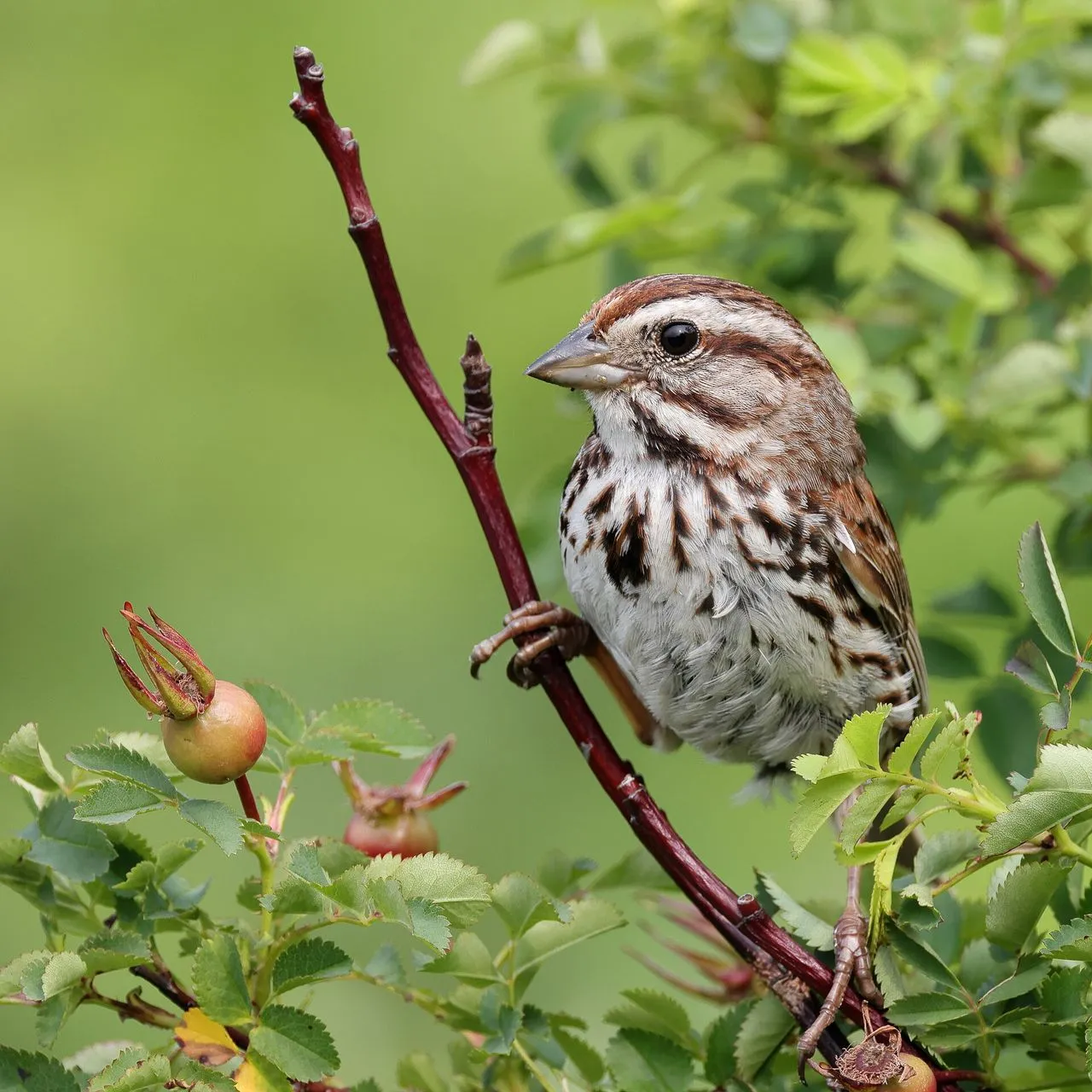
Song Sparrow (Melospiza melodia) has 20+ geographic forms with huge size variation (18–50g). Heavily streaked with dark breast spot. Rich, variable song. Found in thickets, gardens, and wetlands across North America.
Melospiza melodia Wilson, 1810, the song sparrow, has more than 20 recognised geographic forms and varies from 18 gram inland birds to large, dark Aleutian birds approaching 50 grams.
Part of the Complete Finches & Sparrows Guide.
Identification
Visual
Song sparrow is a medium Passerellid, 12 to 17 centimetres long, with a rounded tail, broad streaking below, and a central breast spot formed where the streaks converge. The head shows a greyish supercilium, brown crown stripes, a dark line behind the eye, and a strong malar stripe framing a pale throat. The tail is often pumped downward in cover, a useful behavioural mark when the bird is partly hidden.
Variation is substantial. Eastern birds are medium brown and well streaked. Pacific Northwest birds are darker and sootier. Southwestern birds are paler and greyer. Salt-marsh and island populations can look heavy-billed and unusually dark. The species should therefore be identified by structure and pattern rather than by shade alone: streaked breast with central spot, patterned face, rounded tail, and skulking edge behaviour.
Confusion with female house sparrow occurs at feeders, but song sparrow has a longer tail, finer bill, stronger face striping, and streaked underparts. House sparrow female is plainer-faced and heavier-bodied. Juvenile chipping sparrows are streaked below but slimmer, smaller-billed, and usually show a cleaner line through the eye.
| Character | Song Sparrow (Melospiza melodia) | Chipping Sparrow (Spizella passerina) | House Sparrow (Passer domesticus) |
|---|---|---|---|
| Body length | 12–17 cm (4.7–6.7 in) | 12–15 cm (4.7–5.9 in) | 14–18 cm (5.5–7.1 in) |
| Body mass | 18–50 g (0.6–1.8 oz), regionally variable | 11–16 g (0.4–0.6 oz) | Usually heavier-bodied |
| Underparts | Streaked, often with central breast spot | Adult plain grey; juvenile streaked | Plain buff-grey, no central spot |
| Face | Strong malar stripe and patterned head | Rufous cap and black eye-line in breeding adult | Female plain; male grey crown and bib |
| Behaviour | Skulks low, tail often pumped | Quick ground feeder in open edges | Bold, social feeder near buildings |
Audio
Song is one of the most useful field marks. A typical song begins with two or three clear notes, followed by a variable buzzy or trilled middle phrase and a terminal flourish. The pattern is often rendered as maids, maids, maids, put on your tea-kettle-ettle-ettle, but individuals carry repertoires of several song types. Males switch song types during territorial countersinging and match neighbours in a way that conveys aggressive intent.
Calls include a sharp chimp or tchimp, given from dense vegetation. Alarm calls may continue for minutes when a nest predator or observer remains near the nest.
Distribution
Song sparrow breeds from the Aleutians and Alaska across Canada to Newfoundland and south through much of the United States into northern Mexico. Northern populations migrate south from September through November and return from March through May. Many coastal, southern, and urban populations are resident.
Its range is nearly continental, but abundance depends on low dense vegetation and nearby moist ground. The species is absent or sparse in closed forest interiors, high alpine zones, and the driest desert without riparian cover. In winter it becomes more visible along hedgerows, marsh edges, garden borders, and weedy ditches.
Habitat
Song sparrow is an edge and thicket bird. It uses marsh margins, streamside willow, brushy fields, overgrown gardens, wet meadows, coastal scrub, young clearcuts, and shrubby suburban lots. Water is not mandatory, but many high-density territories occur within a short flight of damp soil or emergent vegetation.
The bird spends much of its time low in cover, moving through stems rather than perching exposed. Singing males use higher shrubs, fence posts, cattails, and small trees, but feeding birds return quickly to dense vegetation. Brush removal can eliminate territories even when seed remains abundant.
Diet and Feeder Behaviour
Seeds and insects form the main diet, with proportions shifting seasonally. In winter song sparrows take grass seed, sedge, smartweed, ragweed, dock, and spilled feeder seed. They visit ground scatter for millet and sunflower fragments but seldom dominate a feeder. They prefer feeding under shrubs or at the edge of a tray where escape cover is close.
In the breeding season insects and spiders become critical. Adults take beetles, caterpillars, flies, grasshoppers, leafhoppers, and small aquatic-edge invertebrates. Nestlings receive mostly animal food during early growth. The species scratches lightly in leaf litter and probes damp soil, using the bill less as a heavy seed-cracker than as a general-purpose tool for small items.
Breeding Biology
Breeding begins as early as February in mild coastal regions and from April or May across northern areas. The female builds a cup of grass, leaves, bark strips, and hair, usually on the ground or less than 1 metre high in dense grass, shrubs, reeds, or marsh vegetation. Higher nests occur after flooding or in heavily grazed sites.
Clutch size is 3 to 5 eggs, greenish-white and heavily spotted. Incubation lasts about 12 to 14 days, mainly by the female. Young fledge after 9 to 12 days, often before full flight. Multiple broods are common, and replacement clutches follow predation quickly. Brown-headed cowbird parasitism is frequent in some regions, but song sparrows may rear cowbird young successfully because their nestling diet includes enough invertebrate protein.
Notes
Song sparrow geographic variation is not decorative taxonomy. Large, dark coastal birds occupy cool, wet, salt-influenced environments where dense plumage and larger body size fit local conditions. Pale interior birds occupy drier, more open habitats. The species gives a competent observer an unusually good lesson in clinal variation: the same song architecture and basic streaked pattern persist while size, darkness, and bill proportions shift across the continent.
See Also
- Dark-eyed Junco: another winter sparrow with a simple song and strong cover preference.
- White-throated Sparrow: a larger, whistled-song sparrow that often shares the same habitats.
- Chipping Sparrow: a slimmer, drier-voiced sparrow of lawns and open edges.
- House Sparrow: the common feeder-side sparrow to separate from native species.
- The Complete Finches & Sparrows Guide: full family reference: identification, song, and feeder behaviour.
Frequently Asked Questions
How do I identify Song Sparrow?
Heavily streaked chest and sides, dark central breast spot, brown upperparts. The breast streaking and spot are more pronounced than other sparrows. Tail is notched.
Why do Song Sparrows vary so much?
Over 20 recognized geographic forms, largest range of any North American sparrow. Aleutian birds are huge (50g); inland birds are small (18g). Each region has distinct characteristics.
What is the Song Sparrow song?
Rich and variable: 'ma-ma-ma-MAXWELL-blackbird-chirp'. Each male has a unique repertoire of 1–6 song types. One of the most familiar backyard songs.
Do Song Sparrows use feeders?
They mostly feed on the ground, eating fallen seed. Common in yards with dense shrubs nearby. Not common on elevated feeders.