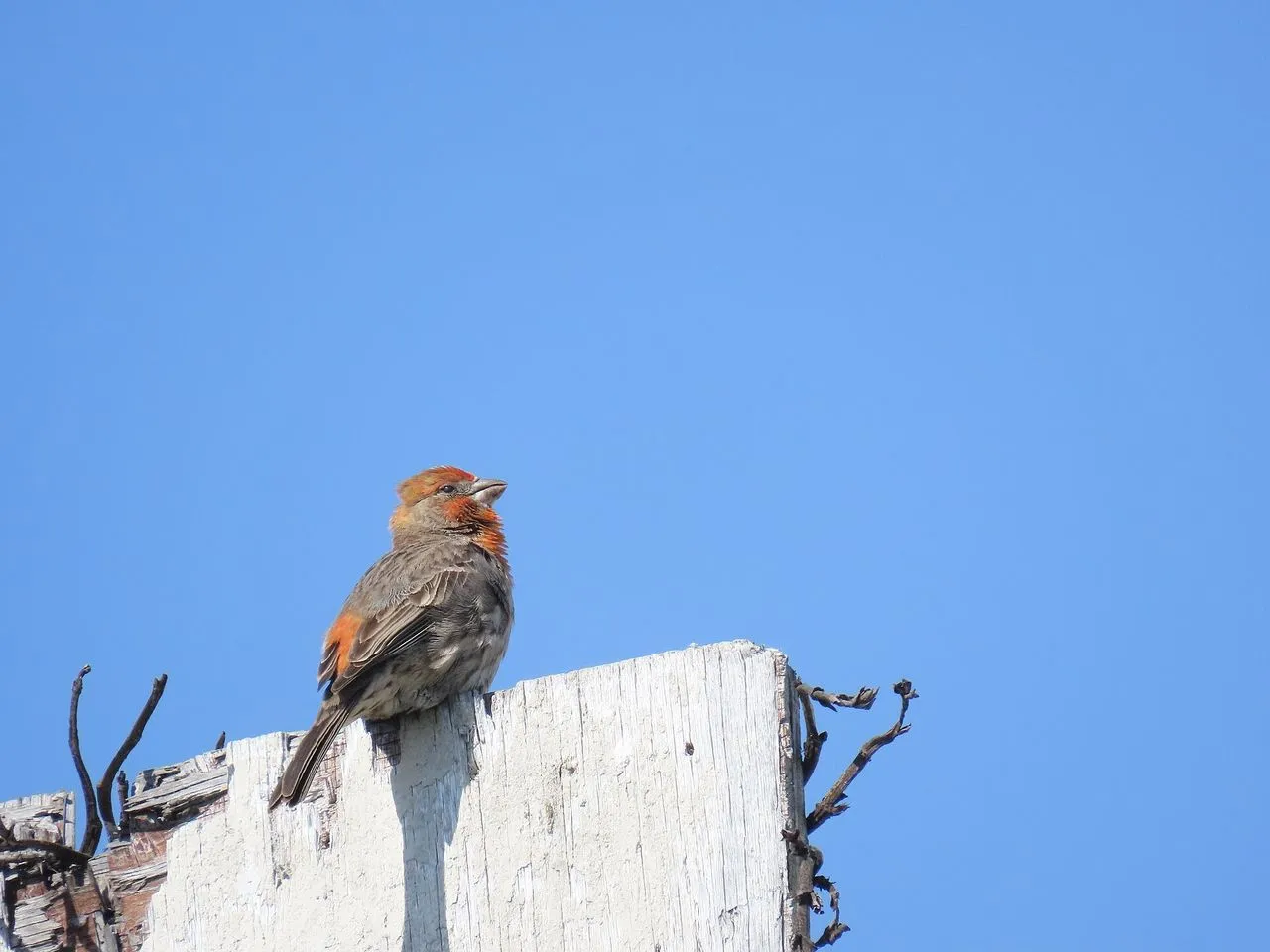
House Finch (Haemorhous mexicanus) is a common feeder finch (12–15cm). Males have red/orange head and chest; females are plain grey-brown. Native to western US, expanded east after 1940 release. Eats seeds, fruit, and buds.
Haemorhous mexicanus Müller, 1776, the house finch, was released from the cage-bird trade on Long Island around 1940 and expanded across eastern North America at rates locally exceeding 60 kilometres per year.
Part of the Complete Finches & Sparrows Guide.
Identification
Visual
House finch is a medium-small Fringillid, 12.5 to 15 centimetres long, with a wingspan of 20 to 25 centimetres and a mass usually between 16 and 27 grams. The bill is short, deep at the base, and bluntly conical, suited to cracking small seeds rather than probing composite heads. The tail is longer and more squared than that of purple finch, giving perched birds a noticeably lankier rear profile.
Adult males show red, orange, or occasionally yellow pigment on the forehead, throat, breast, and rump. The colour comes from dietary carotenoids rather than fixed plumage chemistry, so males in poor condition or on carotenoid-poor diets may appear orange or yellowish. The flanks remain brown-streaked even in bright males. This single mark separates most house finches from male purple finches, whose underparts show a raspberry wash with much less distinct flank streaking. The female is plain brown-grey above and heavily streaked below, with a relatively unmarked face and no strong eyebrow.
At feeders, structure matters as much as colour. House finch looks slim, long-tailed, and slightly flat-headed. Purple finch appears shorter-tailed, broader-chested, and more front-heavy, with a subtly curved culmen. A female house finch can resemble a female purple finch, but it lacks the purple finch's bold whitish supercilium and dark cheek border.
| Character | House Finch (Haemorhous mexicanus) | Purple Finch (Haemorhous purpureus) |
|---|---|---|
| Body length | 12.5–15 cm (4.9–5.9 in) | 12–16 cm (4.7–6.3 in) |
| Body mass | 16–27 g (0.6–1.0 oz) | 18–32 g (0.6–1.1 oz) |
| Male red | Forehead, throat, breast, rump; flanks streaked | Raspberry wash across head, breast, back, and rump |
| Female face | Plain grey-brown, weak face pattern | Bold whitish eyebrow and dark cheek border |
| Structure | Longer-tailed, slimmer, flatter-headed | Shorter-tailed, front-heavy, deeper bill |
Audio
Song is a rapid, jumbled warble of two to four seconds, usually ending in a rising, buzzy wheer. Males sing from exposed perches on wires, roof ridges, shrubs, and tree crowns from late winter into July. The common call is a sharp cheet or weet, given in flight and within feeding flocks. Compared with purple finch, house finch song is less rich, more hurried, and more likely to include the rasping terminal note.
Distribution
The native range lay in the arid and semi-arid west: Mexico, the southwestern United States, and Pacific slope settlements. The eastern population originated from illegally kept cage birds sold as "Hollywood finches" and released around New York when enforcement increased in 1940. By the 1970s the species occupied much of the eastern United States; by the 1990s it had met the western population across the Great Plains.
House finch is now resident through most of the contiguous United States, southern Canada, and Mexico, with local movements rather than long-distance migration. Northern birds may shift southward during hard winters, but many remain wherever feeders and urban food sources persist. In Britain and continental Europe the species is not established as a normal wild bird; records usually involve escapes.
Habitat
This finch is most abundant where human structures break open habitat into edges: suburbs, farms, orchards, desert towns, vineyards, parks, and campus grounds. It tolerates dry heat better than many eastern feeder birds because its western ancestry selected for sparse water and variable seed crops. It avoids closed mature forest and is scarce in extensive boreal habitat.
The eastern expansion succeeded because cities and suburbs supplied nesting ledges, ornamental fruiting shrubs, year-round seed at feeders, and open foraging lawns. House finches rarely need native shrubland if buildings and planted vegetation provide equivalent structure.
Diet and Feeder Behaviour
House finch feeds mainly on seeds, buds, and fruit. At feeders it takes black-oil sunflower, sunflower hearts, safflower, millet, and cracked corn, though sunflower hearts usually produce the longest visits. The species sits at a port and husks seeds one at a time rather than carrying them away. It competes effectively with goldfinches and siskins because it is larger and more persistent, but house sparrows and cardinals can displace it on open trays.
Natural foods include dandelion, mustard, knotweed, elm, mulberry, cherry, and ornamental crabapple. Fruit feeding increases in late summer and autumn. Nestlings receive regurgitated seeds and some soft plant material, with fewer insects than many Passerellid sparrows provide. This seed-heavy diet helps explain the species' close association with feeders outside the breeding season.
Conjunctivitis caused by Mycoplasma gallisepticum has shaped eastern feeder populations since it was first detected in house finches near Washington, D.C., in 1994. Infected birds show swollen eyelids, crusting, impaired vision, and prolonged sitting at feeders. Cleaning feeders does not remove the disease from wild populations, but it reduces local transmission pressure when done consistently.
Breeding Biology
Breeding begins early. In mild regions males sing in January and pairs inspect nest sites by February. Egg laying commonly runs from March through August, with two or three broods possible. The nest is a shallow cup of grass, rootlets, hair, string, and plant fibres, placed on building ledges, hanging planters, conifers, porch lights, ivy, or old nests of other species. Heights range from less than 2 metres on porches to more than 10 metres in trees.
Clutch size is 4 to 5 pale blue eggs, lightly marked at the larger end. The female incubates for 12 to 14 days while the male feeds her. Young fledge after 12 to 19 days and remain dependent for another one to two weeks. Pair bonds may persist across multiple broods within a season, but extra-pair paternity occurs. Male plumage redness influences mate choice because it reflects recent diet and foraging success.
Notes
The eastern house finch is a founder population, yet it became one of the continent's most familiar feeder birds within half a century. Its success did not come from ecological dominance alone. It exploited a human-built niche already stocked with seed, ornamental fruit, and artificial nesting shelves. The later conjunctivitis epidemic showed the cost of that same niche: dense feeder aggregations allow a respiratory pathogen to move through populations far faster than it would in dispersed desert scrub.
See Also
- Purple Finch: the forest finch most often confused with house finch at feeders.
- American Goldfinch: another common feeder bird that overlaps in seed use and backyard range.
- House Sparrow: the bulky commensal species that can dominate open feeders.
- Pine Siskin: a smaller, more nomadic seed-eater that often visits the same feeders.
- The Complete Finches & Sparrows Guide: full family reference: identification, song, and feeder behaviour.
- House Finch vs Purple Finch: the side-by-side comparison; female face pattern is the most reliable separating mark.
Frequently Asked Questions
How do I identify House Finch?
Male: red/orange face and chest, brown-streaked back and belly. Female: plain grey-brown with faint streaking. Often confused with Purple Finch, House Finch has red limited to face/chest, not whole head.
Where did House Finches come from?
Native to western North America. Released on Long Island (NY) around 1940 after being sold as cage birds. They rapidly expanded east, now common across the continent, one of the most successful range expansions.
What do House Finches eat?
Seeds, especially sunflower and nyjer. Also eats fruit, buds, and occasionally insects. Common at feeders year-round. May dominate feeders in areas where they're abundant.
What is House Finch eye disease?
Mycoplasmal conjunctivitis (House Finch eye disease), causes swollen, crusty eyes. Can be fatal. Spread at feeders, clean feeders regularly if you see affected birds. Remove sick birds from feeding area.