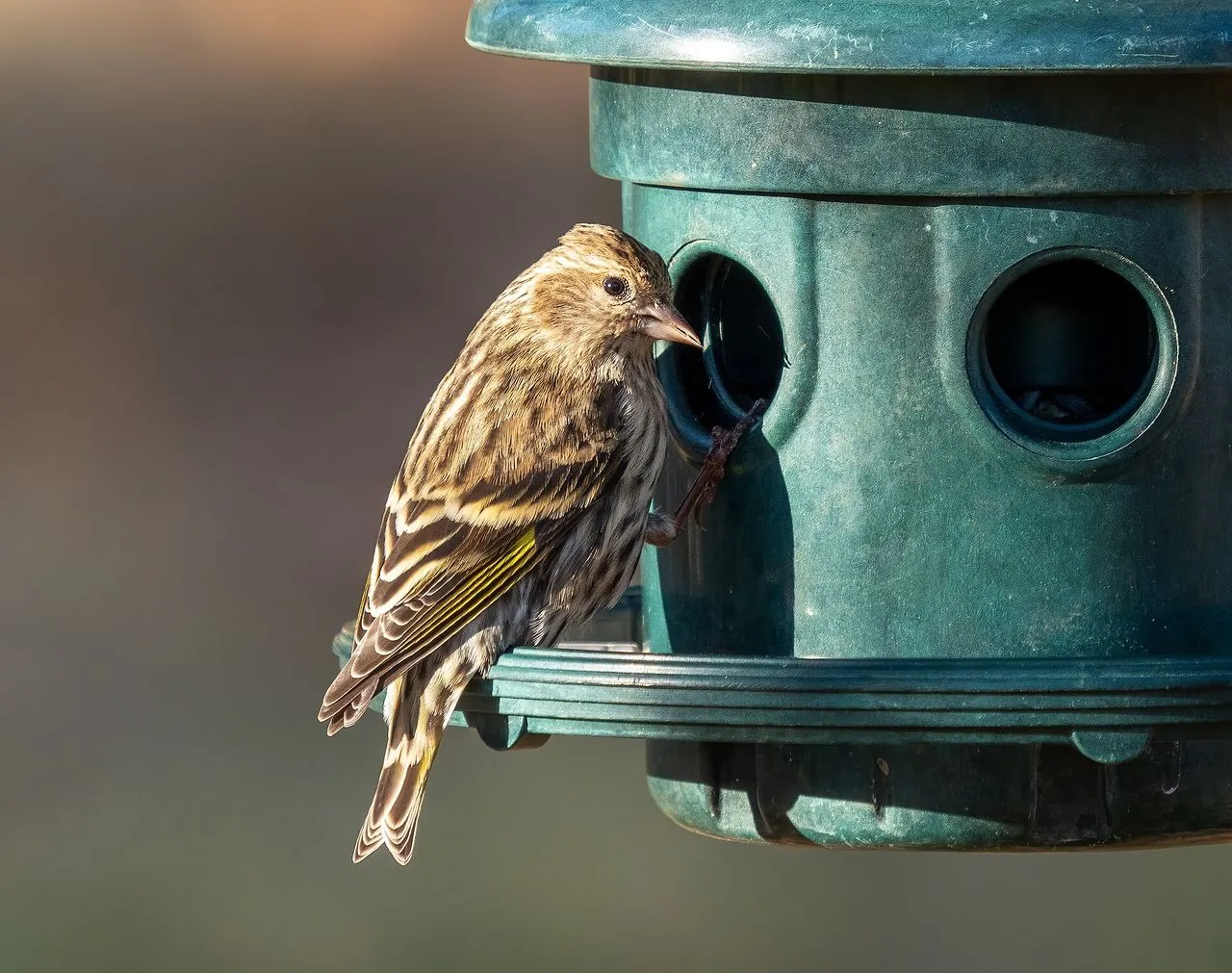
Pine Siskin (Spinus pinus) is a boreal finch (12–18g) with heavy brown streaking and yellow wing bars. Irruptive, invades southern areas in winter when cone crops fail. Eats nyjer and spruce seeds. Can carry salmonella.
Spinus pinus Wilson, 1810, the pine siskin, is a 12 to 18 gram boreal finch whose winter movements can shift hundreds of kilometres in response to conifer and birch seed failure.
Part of the Complete Finches & Sparrows Guide.
Identification
Visual
Pine siskin is small, sharp-billed, and heavily streaked. Length is 11 to 14 centimetres, with a narrow pointed bill finer than that of house finch or purple finch. The plumage is brown and buff with dark streaks across the breast, flanks, back, and undertail. Yellow appears as flashes in the wing and tail, often visible only when the bird opens its wings or turns at a feeder.
Confusion with winter American goldfinch is frequent. Goldfinch is plainer below, shows broader white wing bars, and has a shorter, more conical bill. Siskin is streaked in every plumage and looks slimmer-faced. Female house finch is larger, longer-tailed, and deeper-billed, with less yellow in the wing. Redpolls have a red poll and black chin; siskins do not.
At close range, the siskin's bill is decisive. It is thin and slightly pointed, adapted for extracting small seeds from cones and catkins. The bird often hangs at awkward angles, bracing with strong toes while probing rather than simply cracking seed at a perch.
| Character | Pine Siskin (Spinus pinus) | American Goldfinch (Spinus tristis) | Common Redpoll (Acanthis flammea) |
|---|---|---|---|
| Body length | 11–14 cm (4.3–5.5 in) | 11–14 cm (4.3–5.5 in) | 12–14 cm (4.7–5.5 in) |
| Body mass | 12–18 g (0.4–0.6 oz) | Usually small, goldfinch-sized | 10–16 g (0.4–0.6 oz) |
| Underparts | Heavily streaked | Mostly unstreaked; duller in winter | Streaked flanks, white belly |
| Head mark | No red cap or black chin | No red cap or black chin | Red cap and black chin |
| Wing colour | Yellow flashes in wing and tail | Broad white wing bars, yellow body in male | No yellow wing flash |
Audio
Calls dominate detection. The common flight call is a rising, buzzy zreee or shree, often given repeatedly by flocks passing overhead. Feeding birds produce dry chatter and wheezy notes. Song is a rambling series of twitters, trills, and buzzy phrases, usually delivered from conifer tops or in flight. A flock of siskins in alders can be located by sound long before individual birds become visible.
Distribution
Pine siskin breeds across boreal Canada, Alaska, the western mountains, and coniferous parts of the northern United States. It is present year-round in many western montane areas. Winter distribution is highly variable. In some years birds remain mostly in the boreal forest; in irruption years they spread across the United States, reaching the Gulf Coast and occasionally appearing in large numbers at backyard feeders.
Irruptions are not random migration. They track failure or depletion of cone, birch, alder, and other small-seed crops across northern forests. Large movements often involve mixed flocks with redpolls, crossbills, and goldfinches, though each species responds to different seed signals.
Habitat
Breeding habitat is coniferous or mixed forest, especially spruce, pine, fir, hemlock, and larch. In winter the species follows food into alder swales, birch stands, weedy fields, orchards, gardens, and suburban feeders. It can appear in places that hold no breeding habitat if small seeds are concentrated there.
Siskins are nomadic even within a season. A flock may use one alder stand for several days, exhaust the accessible catkins, and vanish overnight. Gardens with nyjer feeders can hold birds longer, but feeder loyalty remains weaker than in resident house finches.
Diet and Feeder Behaviour
Diet consists of small seeds: conifer seeds, alder, birch, thistle, dandelion, ragweed, grass, and composite seeds. Buds and insects are taken in smaller amounts. At feeders, nyjer is the most reliable food, followed by hulled sunflower chips. The slender bill handles nyjer ports efficiently. Siskins also use mesh socks and cling upside down with ease.
Feeder flocks can be restless and quarrelsome. Birds lunge, wing-flick, and displace one another at close range, producing constant chatter. During irruption winters they may arrive in dozens. Such density increases risk of salmonellosis and conjunctivitis-like disease transmission. Wet seed, faecal contamination, and crowded trays are particularly hazardous; narrow clean tube feeders are safer than damp platforms.
Breeding Biology
Breeding timing is flexible and can begin in late winter where cone crops are strong. In the north, nesting often runs from April through July. The female builds a small cup of twigs, grass, rootlets, moss, lichen, and hair, usually on a horizontal conifer branch 3 to 15 metres high. The nest is well concealed in dense foliage.
Clutch size is typically 3 to 5 pale blue-green eggs with small dark markings. Incubation lasts about 13 days and is mostly female. The male feeds the female on the nest. Nestlings fledge after 13 to 17 days and receive regurgitated seeds mixed with insects. The species may breed opportunistically wherever food conditions permit, a trait consistent with its nomadic winter ecology.
Notes
Pine siskin is best understood as a seed-crop tracker rather than a conventional migrant. The same garden may hold none for five winters, then support 80 birds in February during a boreal crop failure. This does not mean the local habitat suddenly improved. It means the northern food map changed, and the birds solved the problem by moving until they found small seeds at scale.
See Also
- American Goldfinch: the brighter, more familiar seed-eater most often confused with siskins.
- Common Redpoll: another streaked northern finch that appears in irruptive winter flocks.
- Purple Finch: a larger feeder finch that shares the same winter seed pulse in some years.
- Evening Grosbeak: a heavyweight irruptive finch that can arrive alongside siskin waves.
- The Complete Finches & Sparrows Guide: full family reference: identification, song, and feeder behaviour.
Frequently Asked Questions
How do I identify Pine Siskin?
Heavy brown streaking overall, small yellow wing bars, notched tail. Very similar to American Goldfinch in winter, look for streaking on underparts. The yellow is less extensive than goldfinch.
Why do Pine Siskins irrupt?
They move south (irrupt) when conifer and birch seed crops fail in the north. These movements are unpredictable, some winters bring huge numbers south, others almost none. Linked to boreal seed availability.
What do Pine Siskins eat?
Seeds from conifers (spruce, pine), birch, and alder. At feeders, they prefer nyjer. They cling to seed heads like goldfinches. Often feed in flocks.
Are Pine Siskins dangerous at feeders?
They can carry salmonella, which spreads at crowded feeders. Watch for sick birds (fluffed, sluggish). If disease appears, pause feeding and clean thoroughly.