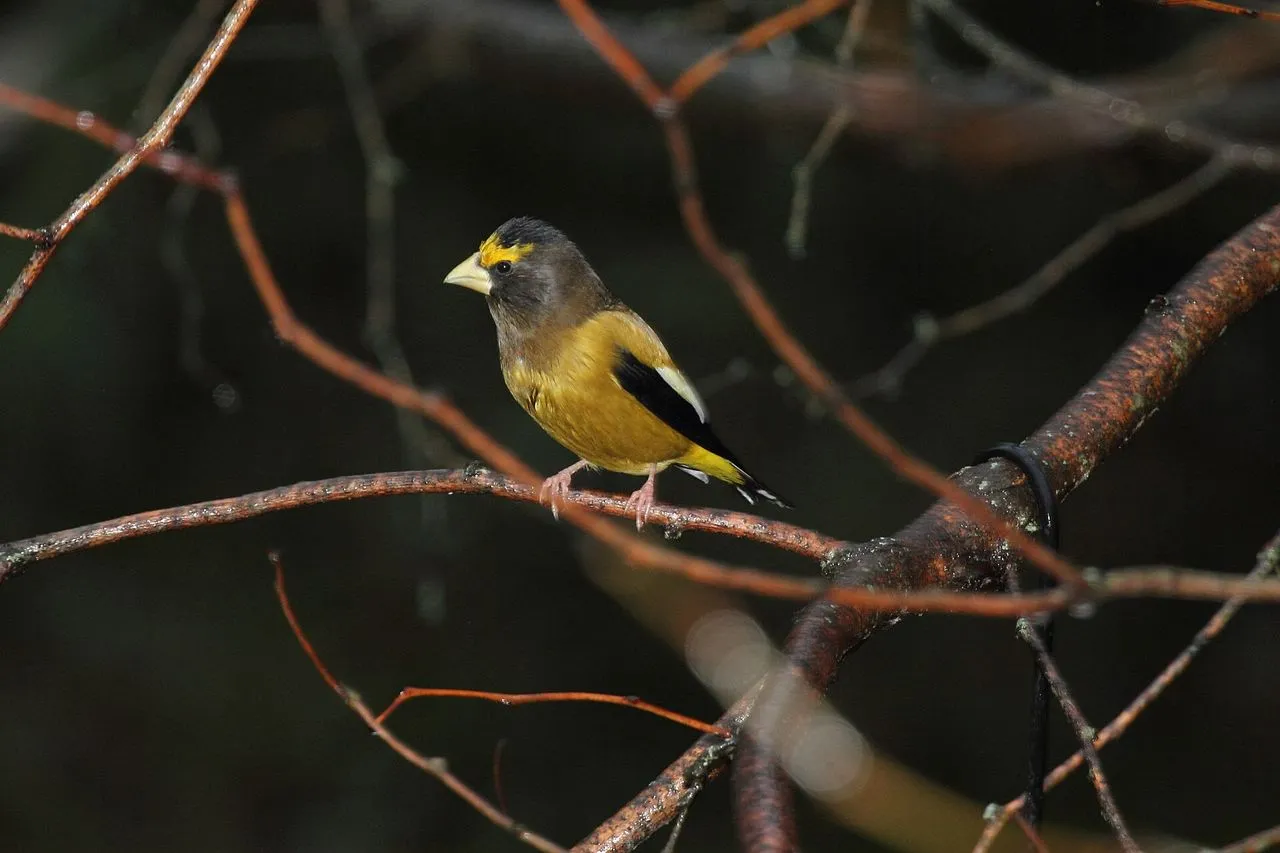
Evening Grosbeak (Coccothraustes vespertinus) is a large finch (16-22cm, 53-74g) with massive pale bill, yellow body, and bold white wing patches. Males have dark head with yellow forehead stripe. Declined ~90% in North America since the late 20th century. Irruptive winter visitor.
Coccothraustes vespertinus Cooper, 1825, the evening grosbeak, is a 53 to 74 gram Fringillid whose North American populations have fallen by roughly 90% since the late 20th century in several monitoring datasets.
Part of the Complete Finches & Sparrows Guide.
Identification
Visual
Evening grosbeak is a large, heavy-headed finch, 16 to 22 centimetres long with a wingspan of 30 to 36 centimetres. The bill is massive, pale, and conical, but not crude: the cutting edges apply enough force to crack cherry pits and large sunflower seeds. The body is bull-necked, the tail short, and the flight direct and bounding.
Adult males are yellow and black with a dark head, bright yellow forehead stripe, yellow belly, black wings, and large white wing patches. Females are grey-brown with yellowish washes on the neck and flanks, black-and-white wings, and a less brilliant but still powerful bill. Immatures resemble females. In all plumages the size, bill depth, and white wing patches distinguish the species from goldfinches, siskins, and house finches.
At feeders, evening grosbeaks look almost parrot-like beside smaller finches. They sit upright, split large seeds rapidly, and often dominate a tray by body size alone. The yellow eyebrow of the male can be visible at considerable distance in winter light.
| Character | Male Evening Grosbeak (Coccothraustes vespertinus) | Female/immature Evening Grosbeak |
|---|---|---|
| Body length | 16–22 cm (6.3–8.7 in) | 16–22 cm (6.3–8.7 in) |
| Body mass | 53–74 g (1.9–2.6 oz) | 53–74 g (1.9–2.6 oz) |
| Head | Dark with yellow forehead stripe | Grey-brown, less contrasting |
| Wing pattern | Black wings with large white patches | Black-and-white wings, duller overall |
| Feeder posture | Upright, bull-necked, dominant | Upright, heavy-billed, still larger than most finches |
Audio
The usual call is a ringing, sharp cleer or peeer, often given in flight by moving flocks. Feeding birds use softer chirps and conversational notes. Song is rarely heard by most garden observers and is a short, uneven series of warbles rather than a prominent territorial performance. Overhead calls are often the first sign of a flock passing through a winter valley.
Distribution
Evening grosbeak breeds across boreal and montane forests from western Canada through the northern United States, with strong associations to spruce, fir, pine, and mixed forests. It expanded eastward during the 19th and early 20th centuries, likely aided by plantings of box elder and outbreaks of spruce budworm. Winter range is irruptive. In some years flocks remain near breeding areas; in others they move far south into the United States and appear at feeders in towns where they may be absent for a decade.
The decline has been broad and serious. Breeding Bird Survey and Christmas Bird Count data both show steep reductions since the 1970s and 1980s, although trends vary by region. Causes probably include reduced spruce budworm outbreaks, forest management changes, collision mortality, disease, and altered winter food availability.
Habitat
Breeding habitat is mature coniferous and mixed forest, especially where spruce budworm or other caterpillar outbreaks provide abundant nestling food. Mountain forests, boreal edges, and open conifer stands are typical. In winter the species uses deciduous towns, orchards, maple and box elder groves, roadsides with seed trees, and feeding stations.
Flocks are mobile. They may feed in a maple grove at dawn, visit a sunflower feeder for 20 minutes, then move several kilometres to fruiting ash or box elder. A garden cannot create breeding habitat for evening grosbeaks, but it can provide a temporary winter refuelling point when birds are already in the region.
Diet and Feeder Behaviour
Diet includes large seeds, buds, berries, maple samaras, ash seeds, box elder seeds, cherry pits, and insects. During breeding, spruce budworm larvae and other caterpillars can be important for nestlings. The bill allows access to foods unavailable to smaller finches.
At feeders, black-oil sunflower is the principal attractant. Hulled sunflower is taken readily but can be consumed quickly by large flocks. Platform feeders work better than narrow tubes because the birds need space for the bill and body. Evening grosbeaks often feed in cohesive groups, with individuals arriving and departing together. They can empty a feeder in minutes, but their irregularity makes such visits notable rather than routine.
Breeding Biology
Nesting occurs from May through July. The nest is a loose cup of twigs, rootlets, and grass, placed on a horizontal branch or near the trunk of a conifer or deciduous tree, often 3 to 15 metres above ground. Clutch size is usually 2 to 5 eggs, pale blue-green or greyish with dark markings. Incubation lasts about 12 to 14 days and is mainly by the female. The male feeds her during incubation.
Nestlings receive insects, seeds, and regurgitated vegetable matter. Fledging occurs after roughly two weeks. Breeding biology is less thoroughly documented than that of common feeder finches because nests are often high, dispersed, and in remote forest. Food pulses, especially budworm outbreaks, appear to influence local breeding density.
Notes
Evening grosbeak decline should not be softened by nostalgia for spectacular winter flocks. The absence of a species from feeders where it was formerly regular is evidence when repeated across thousands of sites. Because the bird is irruptive, a single good winter does not indicate recovery. The better question is whether the frequency, size, and geographic breadth of irruptions match the historical pattern. In many regions they do not.
See Also
- Pine Siskin: a smaller irruptive finch that often turns up in the same winter food webs.
- American Goldfinch: a common feeder species whose sunflower use overlaps, but whose size is far smaller.
- Purple Finch: a larger-bodied winter finch with similar feeder appeal and boreal ties.
- House Finch: the common suburban finch most likely to share sunflower trays with grosbeaks.
- The Complete Finches & Sparrows Guide: full family reference: identification, song, and feeder behaviour.
Frequently Asked Questions
How do I identify Evening Grosbeak?
Large, bull-necked finch with massive pale conical bill. Males: yellow body, dark head, yellow forehead stripe, black wings with large white patches. Females: grey-brown with yellowish neck, black-and-white wings. Size and bill depth are diagnostic.
Why are Evening Grosbeaks declining?
Populations fell roughly 90% since the 1970s-1980s according to Breeding Bird Survey and Christmas Bird Count data. Causes include reduced spruce budworm outbreaks, forest management changes, collision mortality, disease, and altered winter food availability.
Do Evening Grosbeaks use feeders?
Yes, prefer black-oil sunflower on platform feeders (need space for the large bill). Can empty a feeder quickly. Flocks are cohesive; individuals arrive and depart together. Visits are irregular but notable.
Why are their winter movements unpredictable?
Irruptive, they track food availability rather than following a fixed migration. Some years they stay near boreal breeding areas; others they move far south. A decade may pass between visits to the same feeder.