Brambling (Fringilla montifringilla) is a winter finch (14-16cm, 19-29g) from Scandinavia. Males in winter show orange breast and shoulders, scaly head, and white rump, visible in flight. Follows beech mast; winters across Europe in huge flocks when crops are heavy.
Fringilla montifringilla Linnaeus, 1758, the brambling, can form European winter roosts of several million birds when beech mast crops concentrate migrants in favoured valleys.
Part of the Complete Finches & Sparrows Guide.
Identification
Visual
Brambling is close to chaffinch in size, 14 to 16 centimetres long and usually 19 to 29 grams, but the colour pattern is colder and more orange. In winter, males show orange breast and shoulders, white belly, dark spotted flanks, yellowish bill with dark tip, and a scaly dark head formed by pale feather fringes. By spring, wear removes the fringes and the male head becomes glossy black. Females are duller but retain orange tones on the breast and wing coverts.
The white rump is the decisive flight mark. Chaffinch has a greenish rump and cleaner pink or buff underparts. Brambling also shows more heavily spotted flanks and a colder, blacker upperpart pattern. In mixed winter flocks, a brambling on the ground often looks like a chaffinch with orange shoulders and a dirty flank pattern; in flight the white rump confirms it.
Juveniles and first-winter birds can be subdued, but the combination of white rump, orange wing coverts, and spotted flanks remains useful. The bill is stout enough for beech mast fragments and sunflower seed.
| Character | Brambling (Fringilla montifringilla) | Chaffinch (Fringilla coelebs) |
|---|---|---|
| Body length | 14–16 cm (5.5–6.3 in) | 14–16 cm (5.5–6.3 in) |
| Body mass | 19–29 g (0.7–1.0 oz) | 18–29 g (0.6–1.0 oz) |
| Rump in flight | White | Greenish |
| Underparts | Orange breast, white belly, spotted flanks | Pink or buff breast, cleaner flanks |
| Winter head | Scaly dark pattern | Cleaner grey-brown pattern |
Audio
Calls are nasal and buzzing, often rendered zweee or zhraaa, harsher than chaffinch's sharp pink. Flocks give conversational nasal notes while feeding in beech litter. Song on the breeding grounds is a simple buzzing trill, much less elaborate than chaffinch song and rarely heard by most British garden observers because the species breeds far to the north and east.
Distribution
Brambling breeds across the boreal forests of Scandinavia and northern Russia east through Siberia. It winters south and west across Europe and parts of Asia. In Britain it is a winter visitor, arriving mainly from September through November and departing from March into April. Numbers vary enormously between years.
Winter distribution follows beech mast. In years of heavy mast, birds may concentrate in beechwoods and adjacent farmland. When mast fails or snow covers feeding areas, they move more widely into gardens, stubble, hedgerows, and mixed finch flocks. Continental cold spells can produce sudden arrivals on the east coast of Britain.
Habitat
Breeding habitat is northern birch and conifer forest, especially open woodland with access to insects. Winter habitat is governed by food: beechwoods, hornbeam, mixed deciduous woods, stubble fields, hedgerows, orchards, and gardens. Roosts form in dense woodland, conifers, or sheltered valleys, sometimes many kilometres from daytime feeding areas.
At garden scale, brambling occurrence is irregular. A site near beech woodland, winter stubble, or a known chaffinch flock has a better chance than an isolated urban feeder. Snow often pushes birds from woodland floor feeding into gardens where sunflower hearts and mixed seed are accessible.
Diet and Feeder Behaviour
Beech mast is the signature winter food. Bramblings split the triangular nuts and feed on the oil-rich kernels. They also take birch seed, weed seed, grain, berries, and feeder seed. In breeding season insects dominate nestling diet, especially caterpillars and other soft-bodied larvae available during the northern summer flush.
At feeders, bramblings take sunflower hearts, black sunflower, and mixed seed, usually from ground scatter or trays. They often associate with chaffinches and may be overlooked unless the flock is checked carefully. Dominance varies; males can hold position against chaffinches, but the flock usually feeds in a loose, nervous manner, flushing repeatedly into nearby trees.
Breeding Biology
Breeding begins in late May or June after arrival on northern territories. The nest is a cup of grass, moss, bark, and lichen, lined with hair and feathers, placed in birch, spruce, pine, or other trees, often against the trunk or on a horizontal branch. Heights commonly range from 2 to 6 metres but can be higher.
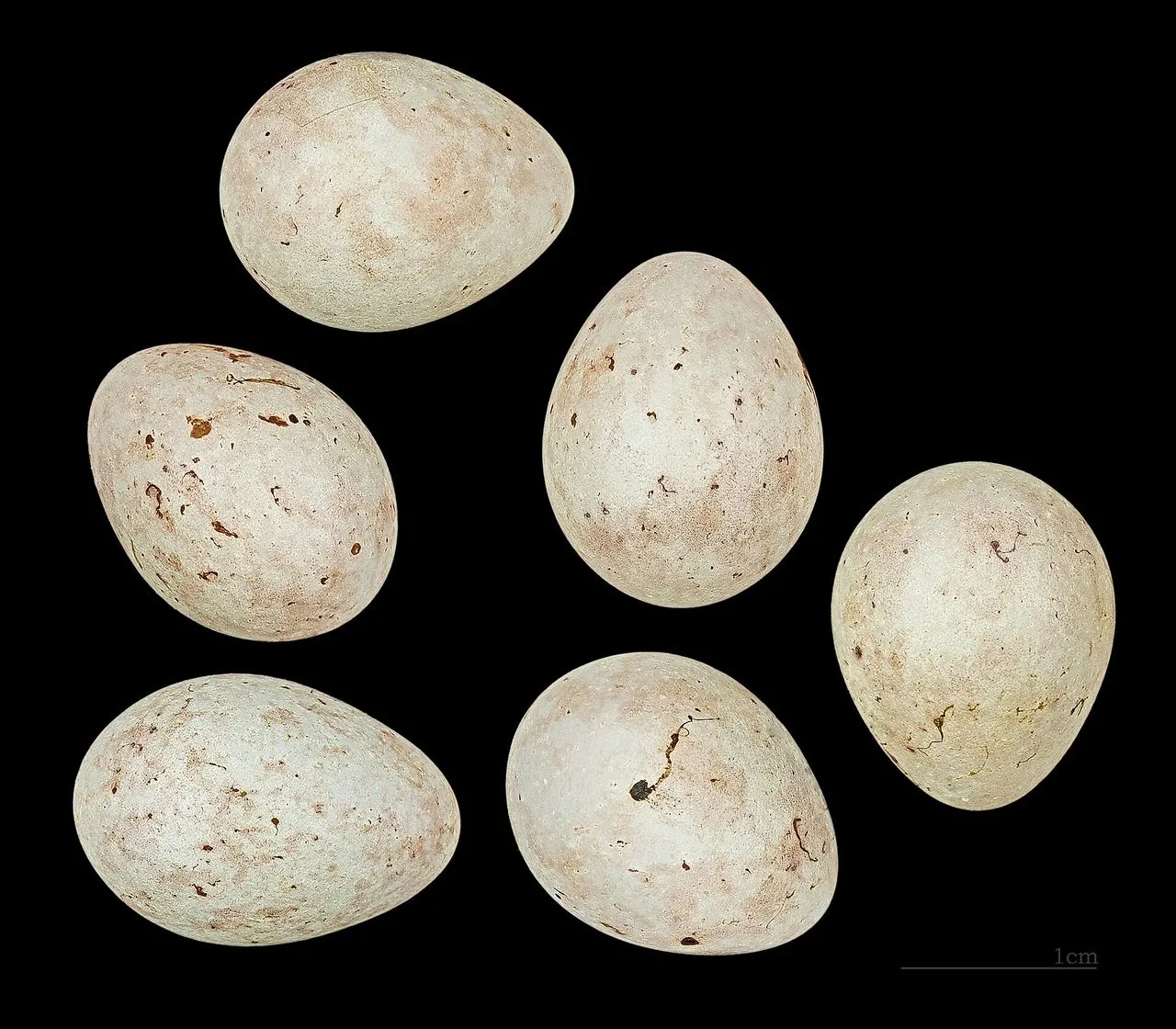
Clutch size is usually 5 to 7 eggs, bluish or greenish with dark markings. Incubation lasts about 11 to 12 days and is mainly by the female. Young fledge after roughly two weeks. The breeding season is short and synchronised with the northern insect peak, which supplies the protein needed for rapid nestling growth.
Notes
Brambling teaches the difference between range and availability. The species winters across Britain annually, but most gardens do not see it annually because birds are distributed by mast, snow, and flock routes rather than by a simple map boundary. A heavy beech crop can hold thousands in woodland and produce few garden records. A mast failure with snow can make the same region suddenly look rich in bramblings at feeders.
See Also
- Chaffinch: the resident counterpart with a greenish rump and no orange shoulder, the most reliable separator from brambling.
- Common Redpoll: another northern winter visitor whose irruptive movements parallel the brambling's mast-driven patterns.
- European Goldfinch: a common garden finch for comparison of flock structure and feeding behaviour.
- Pine Siskin: a boreal seed-crop tracker with overlapping wintering range and similar flocking ecology.
- The Complete Finches & Sparrows Guide: full family reference: identification, song dialects, and feeder behaviour.
Frequently Asked Questions
How do I identify Brambling?
Orange breast and shoulders, scaly dark head in winter, white rump in flight. Males become black-headed by spring. Female is duller but retains orange tones. Main confusion is Chaffinch, Brambling has white rump, Chaffinch has greenish.
Why are Bramblings so variable year to year?
Beech mast drives movements. Heavy mast years concentrate birds in beechwoods; mast failures with snow push them into gardens. Numbers can swing enormously between winters.
What do Bramblings eat?
Beech mast is signature food, birds split the triangular nuts for oil-rich kernels. Also takes birch seed, weed seed, grain, and feeder seed (sunflower hearts). Forages on ground under beech trees.
Do Bramblings breed in Britain?
No, breeds across Scandinavian and Russian boreal forest. Arrives in Britain from September, departs March-April. Breeding areas are far north, rarely heard from British gardens.