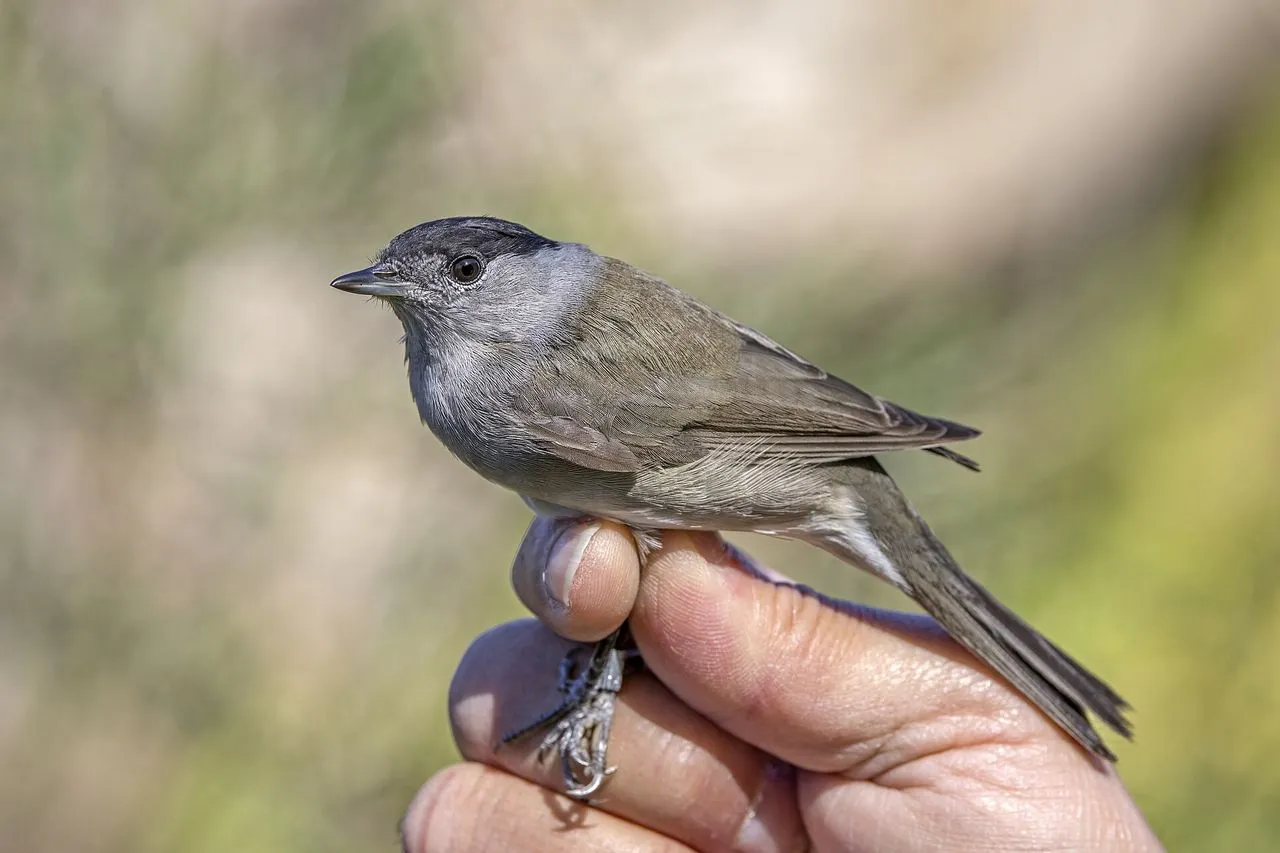
Eurasian Blackcap (Sylvia atricapilla) is a European warbler (13–15cm). Males have black cap, females have rufous cap. Rich, flowing song. Once purely migratory, now wintering in British gardens, behavior change linked to climate.
Sylvia atricapilla Linnaeus, 1758, the Eurasian Blackcap, is a 13 to 15 cm sylviid warbler of 14 to 22 g whose north-west European wintering behaviour has changed measurably within recent decades.
Part of the Complete Warblers Guide.
Identification at a glance
| Species | Key separator |
|---|---|
| Eurasian Blackcap (Sylvia atricapilla) | Male black cap or female chestnut cap; plain grey-brown body; 13 to 15 cm (5.1 to 5.9 in), 14 to 22 g (0.5 to 0.8 oz) |
| Garden Warbler (Sylvia borin) | No cap; plainer warm face; similar rich song but less capped structure |
| Willow Warbler (Phylloscopus trochilus) | Slimmer, finer bill, stronger supercilium, usually yellowish tones |
| Coal Tit (Periparus ater) | Tit structure, white nape patch, stronger legs, feeder behaviour |
| Marsh Tit (Poecile palustris) | Black cap but larger-headed tit shape and heavier bill |
Identification
Visual
The adult male is grey-brown above and pale grey below with a neat black cap extending from the forehead to the rear crown. The female has the same structure but a warm chestnut-brown cap. Juveniles resemble females at first, with brown caps, before young males acquire black crown feathers. The bill is fine but slightly stronger than a Phylloscopus bill, and the body looks fuller than Willow Warbler or Chiffchaff.
Blackcap is deliberately plain. It lacks wing bars, strong supercilium, streaking, and bright yellow tones. Garden Warbler is the main confusion species and is even plainer, with no cap and a warmer, more uniform face. Marsh Tit and Coal Tit may superficially suggest a black-capped small bird at feeders, but both have tit structure, stronger legs, and very different bills.
Audio
The song is rich, fluent, and fluting, beginning with quieter warbling phrases and often ending in clear, loud notes. It is one of the strongest songs in European scrub and woodland edges, more polished and less hurried than Garden Warbler to many ears, though the two can overlap. Males sing from cover in April, May, and June, often only partly visible.
Calls include a hard tak or tack, frequently delivered from dense shrubs, and a thin high contact call. The hard call is a common winter sound in British gardens with ivy, bramble, or feeders.
Distribution
Breeding range covers most of Europe, parts of north-west Africa, the Middle East, and western Asia. It is widespread in Britain and Ireland, continental Europe, and Mediterranean regions, with migratory behaviour varying by population. Northern and eastern birds migrate farther; southern birds may be resident or short-distance migrants.
Spring arrival in Britain and western Europe occurs from March into April, though wintering birds may already be present. Autumn movement runs from August through October. Traditional wintering areas include the Mediterranean basin and Africa, but an increasing number of central European Blackcaps winter in Britain and Ireland, a shift linked to milder winters, garden feeding, and inherited migratory direction.
Habitat
Breeding habitat includes deciduous woodland with shrub layer, hedgerows, scrub, parks, orchards, riparian thickets, and mature gardens. The species needs dense cover for nesting and foraging but also uses edges and clearings for song posts. Ivy, bramble, elder, hawthorn, blackthorn, and hazel provide useful structure.
In winter, gardens become important where shrubs, ivy berries, and supplementary food are available. Blackcaps visit fat blocks, suet, apples, and soft fruit, though individuals vary in boldness. Dense cover near the feeding site matters; a bare lawn with a feeder is less attractive than a feeder beside ivy or evergreen shrubs.
Diet and Foraging
In spring and summer the diet is mainly insects and other invertebrates: caterpillars, beetles, flies, aphids, spiders, and small larvae gleaned from leaves and twigs. Adults feed nestlings largely on soft-bodied prey. Blackcaps forage within shrubs and lower tree canopy, moving methodically and often remaining hidden while picking prey from leaf undersides.
From late summer through winter the diet shifts strongly toward fruit. Elderberries, blackberries, ivy berries, hawthorn, privet, yew arils, and garden apples are taken readily. This seasonal frugivory is more developed than in Phylloscopus leaf warblers and helps explain winter survival in mild urban and suburban settings. The species also defends rich winter food sources, chasing other Blackcaps and smaller birds from favoured shrubs or feeders.
Breeding Biology
The nest is a loose cup placed low in dense vegetation, commonly 0.5 to 2 m above ground in bramble, nettles, hawthorn, blackthorn, ivy, or young shrubs. Males may build display nest foundations, but the female completes the functional nest. Materials include dry grass, stems, rootlets, and hair.
Clutch size is usually 4 or 5 eggs, variable in colour but often buff or greyish with darker blotches. Incubation lasts about 11 to 12 days and is shared by both sexes. Both adults feed nestlings, which fledge at roughly 10 to 14 days. Two broods are possible in favourable seasons. Nests are vulnerable to cats, corvids, squirrels, mustelids, and clearance of garden shrubs during the breeding season.
Notes
The British wintering Blackcap is a well-studied example of rapid migratory change. Birds wintering in Britain are often not local breeders but central European birds with a north-westward autumn orientation. Garden feeding and milder winters improve survival, and these birds return earlier to breeding grounds than individuals wintering around the Mediterranean. A common garden visitor is therefore also evidence of evolution acting on migration within a human-altered landscape.
See Also
- Willow Warbler: the slim leaf warbler that shares migration timing and soft woodland edges.
- Song Thrush: a hedgerow and berry-fed comparison for winter garden habitat.
- European Robin: another familiar garden bird that uses cover-rich edges and feeders.
- Common Blackbird: the larger thrush that also benefits from fruiting shrubs and garden feeding.
- The Complete Warblers Guide: full family reference: taxonomy, migration, and identification structure.
Frequently Asked Questions
How do I identify Blackcap?
Male: black cap, grey-brown plumage. Female: rufous-brown cap, slightly paler underparts. Both have pinkish legs and a slight hook on the bill. The cap colour is the key identification feature.
Why is Blackcap notable in Britain?
Blackcaps were once rare winter visitors; now they're common garden birds in winter (over 30,000). This behavioural change has occurred since the 1960s, likely due to climate change and garden feeding.
What does Blackcap eat?
Insects in summer, fruit and berries in winter. British wintering birds readily eat peanuts, sunflower hearts, and fat. They also eat ripe fruit in gardens.
What is the Blackcap song?
Rich, warbling song, often described as 'full, round, and mellow'. One of the finest songs among British warblers. Sings from high perches in woodland or garden shrubs.