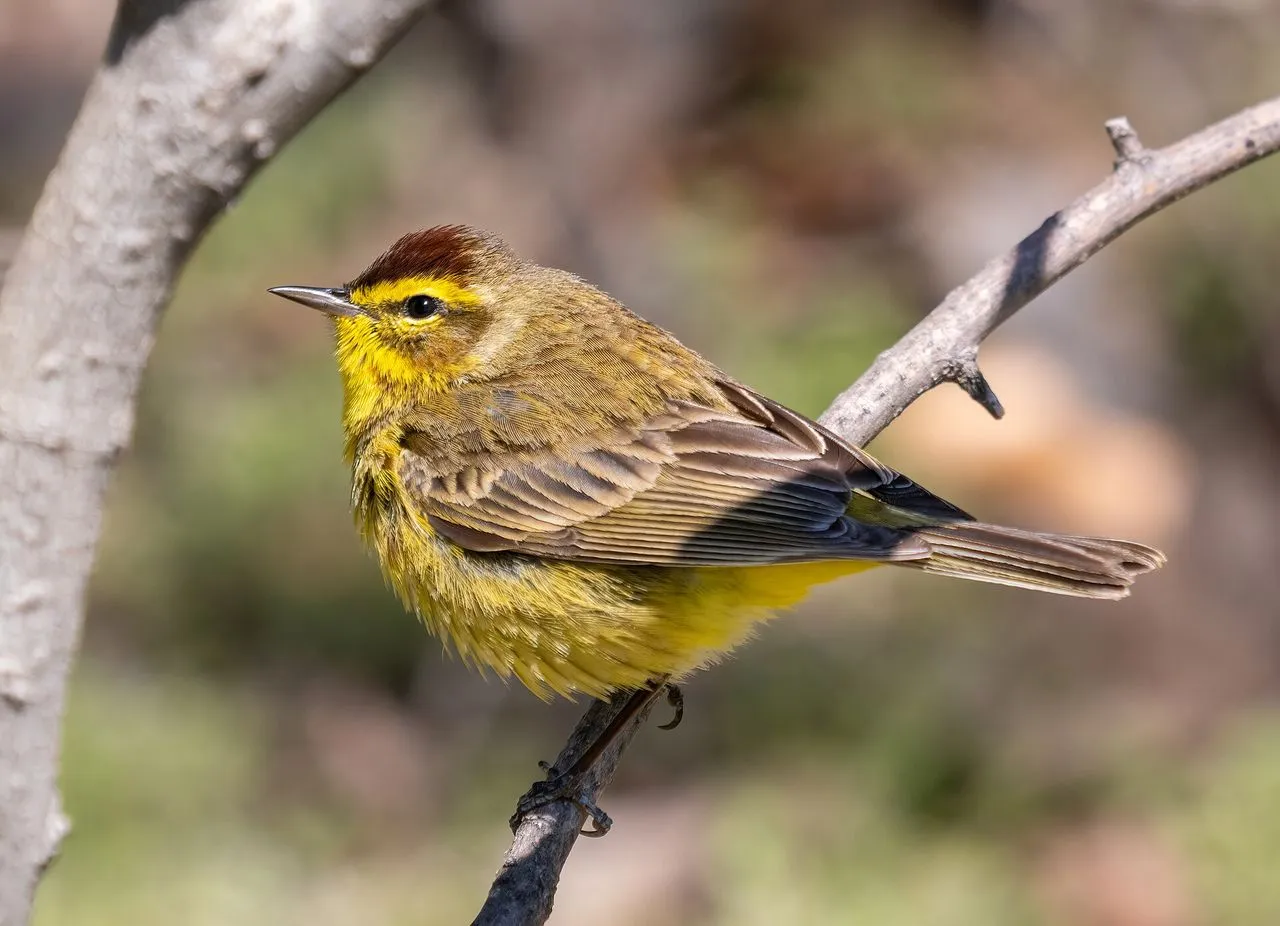
Palm Warbler (Setophaga palmarum) is a boreal bog breeder (12–14cm). Key ID: constant tail-pumping. Two forms: 'western' (yellow underparts), 'eastern' (brownish). Often seen on the ground in open areas during migration.
Setophaga palmarum Gmelin, 1789, the Palm Warbler, is a ground-foraging 12 to 14 cm warbler of boreal bogs whose near-constant tail pumping identifies it before plumage details are visible.
Part of the Complete Warblers Guide.
Identification at a glance
| Feature | Palm Warbler (Setophaga palmarum) | Key separator |
|---|---|---|
| Behaviour | Near-constant downward tail pumping while walking | More diagnostic than colour in migration |
| Eastern form | Brighter yellow below, especially in fresh plumage | Breeds mainly east of James Bay |
| Western form | Whiter or buffier below with yellow concentrated under tail | Migrates more through the interior |
| Size | 12 to 14 cm (4.7 to 5.5 in) | Small ground-foraging warbler of open sites |
| Primary habitat | Boreal bogs, muskeg, peatland edges, and open migration ground | Not a closed-canopy leaf gleaner |
Identification
Visual
Palm Warblers walk more than they hop, forage low, and pump the tail downward repeatedly. This mechanical tail action is the most reliable field character in migration, when birds feed on lawns, muddy pond edges, road verges, and sparse weeds. Plumage varies seasonally and geographically, but the combination of rusty cap, pale eyebrow, streaked breast sides, yellow undertail coverts, and tail pumping is distinctive.
Breeding adults show a chestnut crown, yellow throat and undertail, olive-brown upperparts, and dark streaking across the breast and flanks. The eastern "Yellow" Palm Warbler, breeding mainly east of James Bay and wintering heavily in the south-eastern United States and Caribbean, is brighter yellow below. The western form, breeding west of James Bay and migrating through the interior, is whiter or buffier below with yellow concentrated under the tail. Autumn birds mute the crown and body colour but keep the eyebrow, streaks, and behaviour.
Audio
The song is a dry, weak trill, usually delivered from a small spruce, tamarack, or bog shrub. It is less musical than Yellow Warbler and less forceful than Pine Warbler, a narrow insect-like series that can be overlooked in wind across open peatland. Calls are sharp tsip or chek notes, commonly heard from migrants flushed from ground cover. Voice alone is rarely the easiest route to identification away from breeding bogs; posture and tail action carry more weight.
Distribution
The breeding range lies almost entirely in the boreal zone of Canada and the northernmost United States, from north-eastern British Columbia across the Prairie Provinces, Ontario, Quebec, Labrador, Newfoundland, and locally into northern Minnesota, Wisconsin, Michigan, Maine, and the Adirondacks. It is a bird of peatland rather than palm trees; the English name reflects an early specimen history, not habitat.
Palm Warblers migrate early for a parulid. Spring birds reach the Gulf Coast in March, pass through the Mid-Atlantic and Midwest in April, and arrive on northern breeding grounds in May. Autumn movement begins in late August and peaks from September into October, with stragglers into November. Winter range covers the south-eastern United States, especially Florida and the Gulf Coast, the Bahamas, Greater Antilles, eastern Mexico, and parts of Central America.
Habitat
Breeding habitat consists of open bogs, muskeg, peatland edges, and stunted black spruce or tamarack stands with sphagnum, Labrador tea, sedges, and scattered low conifers. The species avoids closed mature forest and instead uses wet, open, structurally low habitats where it can nest near the ground and sing from short trees.
During migration and winter it becomes conspicuously terrestrial and tolerant of human-modified sites. Short grass, dunes, weedy fields, sewage lagoons, golf-course edges, farm tracks, and coastal scrub all hold birds. Unlike most warblers, Palm Warblers often feed in open places with little overhead cover, walking across bare soil or mown turf and bobbing the tail as they pick prey from the ground.
Diet and Foraging
The diet is dominated by insects and spiders: beetles, flies, caterpillars, grasshoppers, ants, wasps, and small hemipterans. In breeding bogs birds glean from low shrubs, pick along moss surfaces, and work the lower branches of spruce and tamarack. In migration they feed heavily from the ground, taking small arthropods from mud, wrack lines, dung, and short vegetation.
Small fruits and seeds are taken outside the breeding season, but this species lacks the pronounced berry specialisation of the Yellow-rumped Warbler. Wintering birds in Florida often forage with pipits, sparrows, and wagtail-like open-country birds rather than with canopy warblers. The foraging gait is deliberate: walk, pause, pump the tail, pick, then move again. That rhythm separates Palm Warbler from the quicker leaf-gleaning behaviour of many similar-sized parulids.
Breeding Biology
Nesting begins after bog thaw, usually from late May into June. The nest is placed on or just above the ground, concealed in sphagnum, sedge tussocks, Labrador tea, or at the base of a small spruce. Females build a cup of grasses, sedges, moss, bark strips, and rootlets, lined with finer grasses, hair, or feathers.
Clutches usually contain 4 or 5 eggs, pale with brown or reddish markings. Incubation lasts about 12 days. Both parents feed nestlings, which leave the nest before they can fly strongly, a common strategy in ground-nesting passerines where remaining in the nest can become more dangerous than dispersing into cover. One brood is typical across the boreal range because the season between snowmelt and autumn cooling is short.
Notes
Palm Warbler migration is unusually visible to casual observers because birds use open ground and move early. A dull warbler walking across a cemetery lawn in April or a coastal parking margin in October is more likely to be this species than a canopy Setophaga. The tail pump is not a vague flick; it is a repeated downward motion of the entire tail, often continuing while the bird stands still.
See Also
- Yellow-rumped Warbler: the boreal parulid that shares similar bogs and peatland edges and similarly excels at winter berry consumption.
- Magnolia Warbler: the boreal breeder that shares conifer zones and tail-watching identification clues.
- Pine Warbler: the pine canopy specialist that also feeds openly and tolerates modified habitats.
- Blackburnian Warbler: the high-canopy boreal species that shares the boreal breeding zone with Palm Warbler.
- The Complete Warblers Guide: full family reference: taxonomy, migration, and identification structure.
Frequently Asked Questions
How do I identify Palm Warbler?
The near-constant tail-pumping is the best identification clue, visible from far away. Brownish-olive upperparts, pale eyebrow, and yellow undertail (western) or brownish underparts (eastern). Often bobs on the ground.
Why does Palm Warbler pump its tail?
Tail-pumping is a constant, distinctive behaviour, likely related to foraging or communication. It serves as an identification feature and may flush insects from vegetation.
Where does Palm Warbler breed?
Boreal bogs and coniferous wetlands across Canada and the northern US. Found in sphagnum moss, spruce, and tamarack bogs. One of the most northerly breeding warblers.
When does Palm Warbler migrate?
Early spring migrant, arrives in the US in March, one of the earliest warblers. They migrate through the eastern US to breeding grounds in Canada.