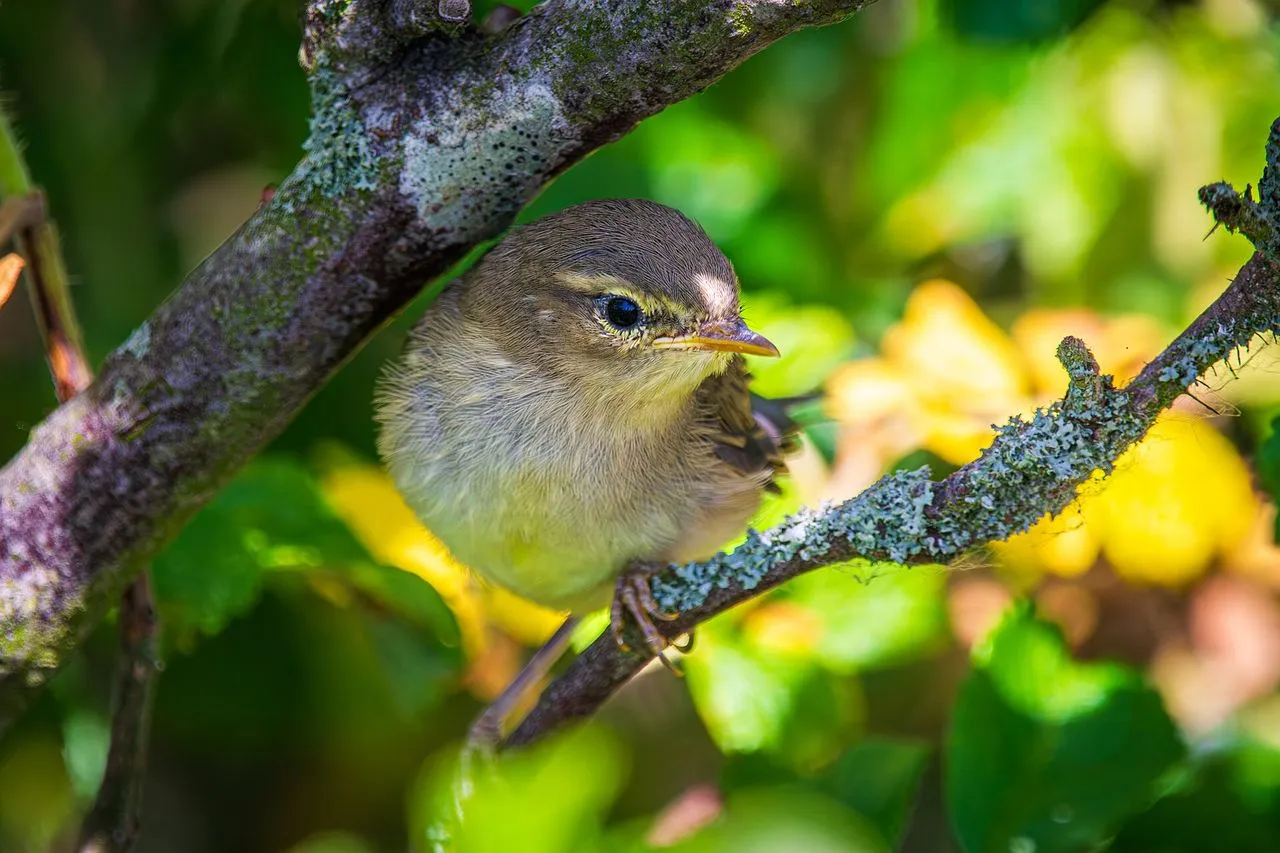
Willow Warbler (Phylloscopus trochilus) is a European leaf warbler (11–12.5cm). Very similar to Chiffchaff, best told by leg colour (pinkish vs dark). Song is a descending scale. Breeds across Europe, winters in Africa.
Phylloscopus trochilus Linnaeus, 1758, the Willow Warbler, is an 11 to 12.5 cm leaf warbler of 7 to 11 g that breeds across northern Eurasia and winters south of the Sahara.
Part of the Complete Warblers Guide.
Identification at a glance
| Feature | Willow Warbler (Phylloscopus trochilus) | Chiffchaff (Phylloscopus collybita) |
|---|---|---|
| Legs | Usually pale brown to flesh-coloured | Usually dark brown to blackish |
| Wing shape | Longer primary projection, longer-winged look | Shorter-winged, more compact look |
| Song | Liquid descending cascade | Repeated two-note chiff-chaff phrase |
| Call | Often soft disyllabic hoo-eet | Often sharper monosyllabic hweet |
| Size | 11 to 12.5 cm (4.3 to 4.9 in), 7 to 11 g (0.2 to 0.4 oz) | Similar size; structure and voice carry more weight |
Identification
Visual
Willow Warbler is a slim, olive-brown and yellowish leaf warbler with pale underparts, a clear supercilium, fine bill, and relatively long primary projection. The legs are usually pale brown to flesh-coloured, though not always safely visible. Compared with Chiffchaff, Willow Warbler tends to look longer-winged, cleaner-faced, paler-legged, and brighter yellow on the throat and breast in fresh plumage.
The bird moves restlessly through shrubs and light woodland, picking insects from leaves and making short hovering movements. It often flicks wings and tail, but usually less persistently than Chiffchaff pumps the tail. Autumn juveniles can be very yellow and fresh; worn spring adults may look greyer. No single visual character should be used alone. Primary projection, face pattern, leg colour, tone, and behaviour should be read together.
Audio
The song is the cleanest field separator: a liquid descending cascade of sweet notes, beginning high and running downward in pitch like a soft falling scale. It is musical, even, and unlike the two-note metronome of Chiffchaff. Males sing from exposed shrubs, birch, willow, and young trees from March or April into early summer.
The call is a disyllabic hoo-eet in many populations, softer and more rising than Chiffchaff's monosyllabic hweet. Calls vary geographically and seasonally, so the full song remains the safest acoustic character during spring.
Distribution
Breeding range extends from Ireland and Britain across Scandinavia, continental Europe, Russia, and Siberia to eastern Asia. It is one of the most numerous summer migrants in northern Europe, though British breeding populations have declined in parts of the south while remaining stronger in Scotland and northern England.
Spring arrival in western Europe begins in March, with broad arrival through April. Northern and eastern breeding areas fill later, often in May. Autumn departure begins in August and continues through September, with stragglers into October. Winter range lies across sub-Saharan Africa, from West Africa eastward and southward depending on breeding origin. The migration requires two Sahara crossings each year.
Habitat
Breeding habitat is open woodland, young birch and willow scrub, heath with scattered trees, coppice, regenerating clearings, upland edges, and riparian shrubs. The species favours early successional structure with light canopy and a developed shrub layer. It is less tied to mature closed woodland than many observers assume.
In Britain and Ireland, upland birch scrub, young plantations, gorse edges with scattered trees, and willow carr can all hold singing males. During migration it occurs in gardens, hedgerows, coastal bushes, reedbed edges, and almost any insect-rich vegetation.
Diet and Foraging
Willow Warblers feed on small insects and spiders: aphids, flies, beetles, moth larvae, sawflies, midges, and leafhoppers. They glean from leaf surfaces, hover at twig tips, and take small aerial prey in short sallies. In late summer and autumn they also consume small berries and aphid honeydew where available.
Foraging is light and continuous, with birds moving through the outer parts of shrubs and young trees. The fine bill suits small soft-bodied prey rather than large beetles or seeds. On African wintering grounds they use acacia, scrub, woodland edge, and riparian vegetation, often joining mixed feeding parties.
Breeding Biology
The nest is a domed structure placed on or close to the ground in grass, moss, bracken, heather, or low vegetation. Females build with dry grass, leaves, moss, and plant fibres, lining the interior with feathers. The side entrance is concealed by surrounding vegetation.
Clutch size is usually 5 to 7 eggs, white with reddish spotting. Incubation lasts about 12 to 14 days, performed by the female. Both adults feed nestlings, which fledge after roughly 12 to 15 days. One brood is usual in the north, while replacement clutches may follow failure. Ground nesting exposes the species to mammals, corvids, snakes in continental areas, and trampling or vegetation clearance.
Notes
Willow Warbler and Chiffchaff are a practical lesson in weighting characters. Leg colour helps, but dirt, shadow, and individual variation reduce certainty. Song is decisive in spring; primary projection and structure become important in silent autumn birds. The long wings of Willow Warbler are not decorative. They are the anatomy of a migrant that links Scandinavian birch scrub with African dry-season woodland.
See Also
- Blackcap: the Old World sylviid that shares European woodland, garden wintering, and singing season in Britain and Europe.
- Common Yellowthroat: the masked North American parulid for comparison of facial pattern and wetland habitat use.
- Magnolia Warbler: the boreal New World Setophaga that shares overlapping migration timing and autumn vagrant potential.
- Palm Warbler: the open-ground boreal forager that shares the Willow Warbler's early spring migration timing.
- The Complete Warblers Guide: full family reference: taxonomy, migration, and identification structure.
Frequently Asked Questions
How do I separate Willow Warbler from Chiffchaff?
Very similar, Willow Warbler has pinkish legs (Chiffchaff has dark brown), slightly brighter plumage, and a more distinct wing bar. The classic test is leg colour. Song is different: descending scale vs repeat 'chiff-chaff'.
Where does Willow Warbler breed?
Across northern Europe from Britain to Siberia. Breeds in open woodland, scrub, and hedgerows. One of the most common breeding birds in Britain and northern Europe.
What is the Willow Warbler song?
A sweet, descending series of notes, 'tea-cher tea-cher tea-cher' that slides down in pitch. Distinct from Chiffchaff's repetitive 'chiff-chaff'.
Does Willow Warbler winter in Europe?
No, long-distance migrant breeding in Europe, wintering south of the Sahara in Africa. One of the longest migration routes of any European songbird.