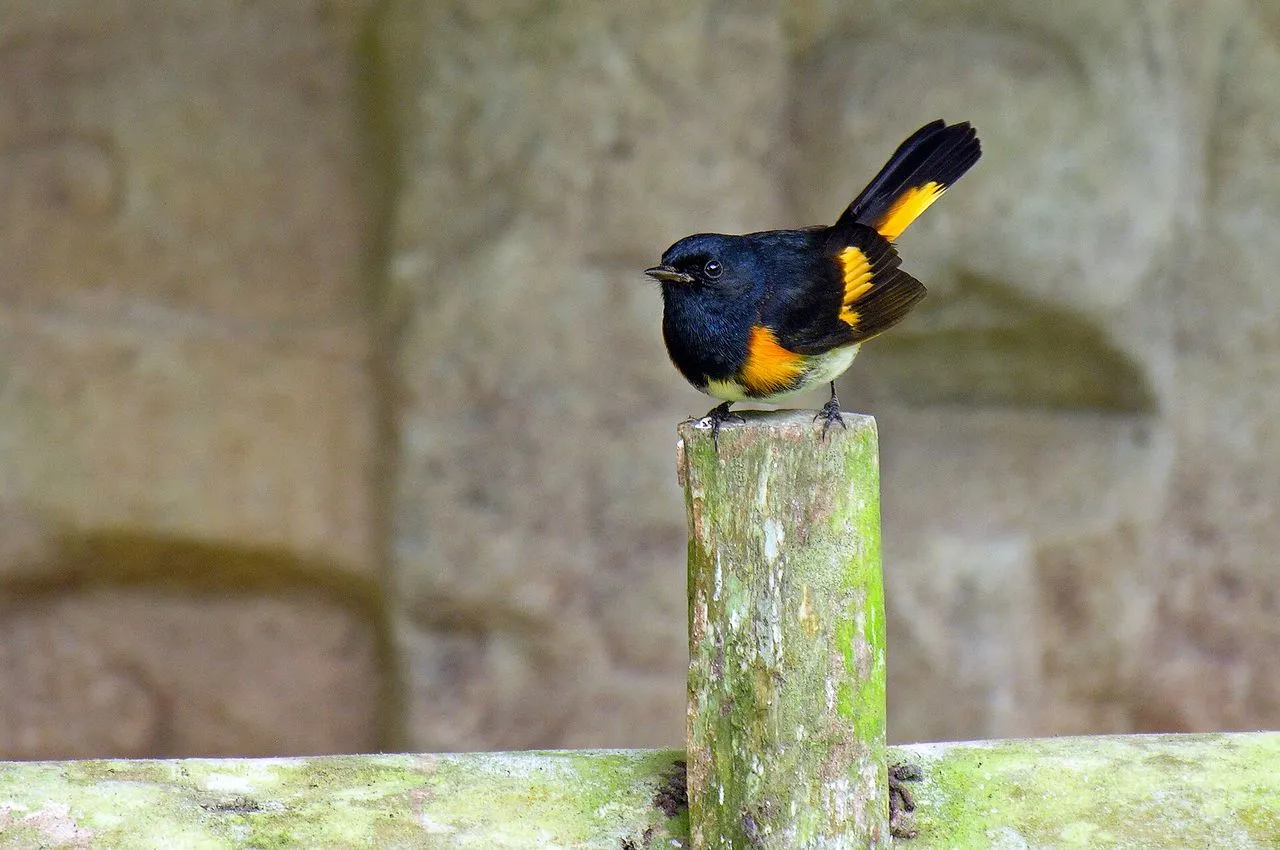
The small, active birds working through your shrubs in September and October are almost certainly migratory wood-warblers (family Parulidae in North America) stopping over to refuel. They breed in boreal forests across Canada and the northern US, then winter in Central and South America. They look nothing like the bright spring males in your field guide because most autumn birds are first-year individuals in subdued first-winter plumage. Your garden is a stopover because it has insects, cover, and possibly water.
A garden that had no warblers in August can have six species moving through it by the first week of October. If you are seeing small, active, insect-gleaning birds in your shrubs and trees in September or October that were absent all summer, you are watching one of the largest migration events in the northern hemisphere.
Quick answer: Those birds are migratory wood-warblers (family Parulidae) on their autumn passage south from boreal breeding grounds to wintering areas in Central and South America. They are using your garden as a stopover, a refuelling station, because it has insects and cover. Most look nothing like the bright spring males in your field guide because they are first-year birds in subdued plumage.
Best first step: Note the behaviour before trying to name the bird. Is it gleaning insects from leaves? Pumping its tail steadily? Hovering at foliage tips? Behaviour narrows the identification faster than colour in autumn, particularly for first-year birds that have never worn the striking adult plumage your field guide illustrates.
Avoid: Dismissing them as "sparrows" because they lack bright colour. A dull, streaky bird on your lawn pumping its tail steadily is a Palm Warbler. The one flashing orange panels in its spread wings is an American Redstart. Colour confusion in autumn is normal; structure and behaviour are reliable.
Why Are Warblers in Your Garden Right Now?
The answer is autumn migration. Most North American parulid warblers breed in boreal or montane forests across Canada and the northern United States, then winter in Mexico, Central America, or South America. The autumn passage runs from late July (early-departing adults) through mid-October (late juveniles), with peak movement across most of temperate North America from early September to mid-October.
Cornell Lab's BirdCast programme tracks this movement in real time using weather radar. Peak nightly migration totals for the eastern United States routinely exceed 300 million individual bird movements on the busiest nights in late September. Warblers are a substantial fraction of that traffic.
Your garden is not on the migration route by accident. Migrants fly at night and come down at dawn to feed. They select stopover sites based on three criteria: insects to eat, cover to shelter in, and water to drink and bathe in. A garden with native trees and shrubs, particularly species that host caterpillars and other invertebrates, becomes a functional stopover. A lawn-only yard with no native planting is a flyover.
Why the Plumage Confusion
Roger Tory Peterson's category of "confusing fall warblers" is not a complaint. It is an accurate description of a real identification challenge rooted in the moult cycle.
Adult warblers breed in their most striking plumage in May and June, which is when most field guides and most photographs were made. After nesting, adults undergo a complete post-breeding moult into duller non-breeding plumage. Simultaneously, the juveniles hatched that summer complete their first moult into first-winter plumage that has never included the bright adult colours.
The result is that in September and October, the majority of migrants passing through your garden are first-year birds in first-winter plumage. Adult males are present but subdued. Only adult females in autumn look roughly similar to their summer selves, and they are often the plainest birds in the flock.
The practical strategy: stop trying to match overall colour and work from structural features instead. Wing bars (one or two, broad or narrow), eye rings (complete, broken, or absent), undertail covert colour, tail pattern (white patches, spots, or plain), and foraging height are all more reliable in autumn than body colour. A first-year Blackpoll Warbler is greenish above and yellowish-white below with fine streaking and pale orange-yellow feet. It looks nothing like the spring male. The feet are diagnostic.
The Most Common Fall Warblers in Temperate Gardens
The species you are most likely to encounter depend on your region.
Eastern North America (East of the Rockies)
The Yellow-rumped Warbler (Setophaga coronata, Myrtle subspecies) is the most numerous and most widespread fall migrant across eastern North America. Its yellow rump patch is visible in all plumages, from vivid spring male to dull first-year female, making it the one warbler that autumn moult cannot render completely anonymous. Peak passage is October. Many birds linger into November and stay the winter along the Atlantic coast.
The Palm Warbler (Setophaga palmarum) is the warbler most likely to be on your lawn rather than in your canopy. Ground-foraging, with a near-constant downward tail pump that identifies it before any plumage detail resolves, it migrates through September and October. The tail pump is the first thing to look for in any small, brownish bird moving across open ground.
The Blackpoll Warbler (Setophaga striata) is the flagship species of autumn identification difficulty. Autumn birds are greenish-yellow above and whitish below with fine flank streaking and pale feet. They are present through September and October, fuelling up before launching one of the most remarkable migrations in the bird world: a non-stop overwater flight from the north-east coast to South America.
The Yellow Warbler (Setophaga petechia) departs early, with most birds moving south from August through early September. An all-yellow warbler with reddish breast streaks in late August is your most likely candidate.
The Common Yellowthroat (Geothlypis trichas) moves through September and October, staying low in dense vegetation. Males still show the characteristic black mask in autumn, but first-year females are plain olive-brown with yellow undertail coverts and are among the more frequently misidentified autumn birds.
Other species expected in the east and Midwest include Magnolia Warbler, Black-throated Green Warbler, and American Redstart, all moving through September and October in woodland-edge gardens.
West Coast
Yellow-rumped Warblers here are predominantly the Audubon's subspecies, identifiable by the yellow throat rather than white. Townsend's Warbler (Setophaga townsendi) is a striking autumn bird with a strong yellow face and dark cheek patch that winters along the Pacific Coast in small numbers. Orange-crowned Warbler (Leiothlypis celata) is the plainest warbler in North America by any measure, olive-green throughout, but it is one of the most regular autumn species in western gardens. Wilson's Warbler (Cardellina pusilla), small and active, with a black cap on adult males, moves through September.
Fall Warbler Calendar: What to Expect When
| Month | Species to expect | Where in the garden | Key field mark |
|---|---|---|---|
| Late August | Yellow Warbler (departing), American Redstart, Common Yellowthroat | Low shrubs, willow edges, fruiting vegetation | Yellow Warbler: all yellow with reddish breast streaks; Redstart: orange tail panels fanned open |
| September | Palm Warbler (early), first Yellow-rumped arrivals, Magnolia Warbler, Common Yellowthroat | Lawn (Palm), mid-shrubs, berry-bearing shrubs | Palm: tail-pumping on ground; Yellow-rumped: yellow rump visible in flight |
| October | Yellow-rumped Warbler (peak), Blackpoll, Palm (still present), Common Yellowthroat | Bayberry, viburnum, dogwood, lawn edges | Blackpoll: yellow-green above, whitish undertail, pale orange-yellow feet; Yellow-rumped: yellow rump |
| November | Yellow-rumped Warbler (East Coast, Pacific Coast) | Bayberry, wax myrtle, suet feeders | Yellow rump diagnostic in any plumage; essentially the only warbler still present |
| December to February | Yellow-rumped Warbler (coastal residents only) | Bayberry, juniper, wax myrtle, suet or fruit at feeders | Myrtle in east (white throat), Audubon's in west (yellow throat) |
Mixed-Species Flocks: The Chickadee Connection
Autumn warblers rarely travel alone. By September, breeding territories have dissolved and migrants begin attaching themselves to mixed-species feeding flocks. In eastern North America, these flocks are anchored by Black-capped or Carolina Chickadees, with warblers, kinglets, nuthatches, and Brown Creepers tagging along.
The chickadees set the flock's pace and direction. The warblers follow because the collective vigilance of a mixed flock means more eyes on potential predators, freeing each individual to spend more time feeding. A single active chickadee flock in October woodland in eastern North America typically holds four to eight warbler species. The complete warblers guide covers this dynamic in more detail: see the complete warblers guide.
The practical implication: when you hear chickadees calling from a tree, stand still and watch. The warblers in the flock are moving faster and foraging more actively than the chickadees but they are in the same canopy. The flock rarely stays in one spot for more than a few minutes; follow it along the shrub line or woodland edge.
The Yellow-rumped Exception: Your Winter Warbler
Every other species on the calendar above will be gone by November. The Yellow-rumped Warbler is different.
It is the only North American wood-warbler that routinely winters in temperate latitudes north of Mexico. The reason is biochemical: it can digest the lipid-rich wax coating on bayberry, wax myrtle, and juniper berries. This diet carries it through intervals when flying insects are completely absent. Other warblers cannot do this; they must leave.
In the east, Myrtle Warblers winter commonly along the Atlantic coast from coastal New England to the Gulf States. In the west, Audubon's Warblers overwinter along the Pacific coast. Both forms visit suet feeders more readily than almost any other warbler in winter. Plant bayberry (Morella pensylvanica) or wax myrtle (Morella cerifera) if you want to hold Yellow-rumped Warblers through November and beyond. A few plants can hold a dozen birds through a cold spell.
Why Your Garden Specifically?
The difference between a garden that gets warblers and one that does not comes down to insect biomass. Warblers need caterpillars, aphids, beetles, and spiders. These invertebrates exist in real numbers only on native plants.
Research by Doug Tallamy and colleagues at the University of Delaware documented that native oak species (Quercus spp.) support over 500 species of Lepidoptera larvae in the eastern United States. A non-native ornamental tree of equivalent size supports almost none. Cherry (Prunus), willow (Salix), viburnum, and dogwood (Cornus) are similarly high-value caterpillar hosts. For specific planting choices that produce results during autumn migration, see native plants for birds and native shrubs for nesting.
Water matters as much as plants. A dripping or moving water feature draws warblers that a dry yard will not hold. The sound of moving water at ground level is a stronger cue to insectivorous migrants than almost any visual element of the garden. Moving water positioned near cover, so birds can bathe and retreat quickly, is more effective than an open birdbath in the centre of a lawn.
Leaf litter under shrubs and trees is foraging habitat, not untidiness. Many autumn warblers, including Palm Warbler, Ovenbird, and Common Yellowthroat, turn over leaf litter for invertebrates. Removing it removes the food supply.
Avoid pesticides entirely during September and October. A systemic pesticide applied to ornamental plants in September depletes the caterpillar population at exactly the moment migrants need it most.
Tracking Migration with eBird
Cornell Lab's eBird platform aggregates millions of bird sightings submitted by observers worldwide. For autumn warbler migration it provides two practically useful tools.
The Explore bar charts show historical peak timing for any species at any location. If you want to know the historical peak week for Palm Warbler in your county, eBird can show it from a decade of submitted checklists. This is more useful than any general guide because migration timing varies substantially across the continent.
The Needs Alerts function tells you which species have recently been recorded nearby. Checking it in mid-September will show you which migrants are currently moving through your area. Submitting your own checklists contributes to the aggregate data that makes the tool accurate for everyone.
A Note for UK and European Readers
If you are reading from Britain or western Europe, the warblers visiting your garden in autumn belong to a completely different family. Blackcap (Sylvia atricapilla), chiffchaff (Phylloscopus collybita), garden warbler (Sylvia borin), and whitethroat (Curruca communis) are Old World sylviid-group warblers, not related to the American Parulidae. The autumn identification challenge is similar, birds are duller and less patterned than in spring, but the species and the migration routes are entirely different.
The blackcap has become a partial winter resident in southern England, with central European birds overwintering in gardens that provide berries, particularly ivy and elderberry. A skulking grey-brown bird with a dark cap in a November garden is this species. The complete family context, including how the two groups differ taxonomically and ecologically, is at the complete warblers guide. For setting up your garden to support migrants through autumn and beyond, the complete attracting guide covers water, cover, and seasonal management in full.
See Also
- The Complete Warblers Guide: full family reference covering Parulidae and Old World sylviid warblers, identification structure, and migration timing.
- Yellow-rumped Warbler: the species most likely in your garden from October through February, and the only wood-warbler that routinely overwinters in temperate North America.
- Palm Warbler: the ground-foraging migrant most often misidentified in autumn; the tail pump is the diagnostic feature.
- Blackpoll Warbler: the flagship for autumn confusion plumage and one of the most remarkable transoceanic migrants in the world.
- Native Plants for Birds: which species carry the caterpillar loads that make a garden a real stopover site rather than a flyover.
- The Complete Attracting Guide: water features, cover, and seasonal planning for year-round bird activity.
Frequently Asked Questions
Why do fall warblers look so different from my field guide?
Most field guides illustrate the adult breeding male in spring plumage, which is the most striking. In autumn, the majority of migrants are first-year birds that have never worn breeding plumage. Adult males also moult into duller non-breeding dress after nesting. Roger Tory Peterson famously grouped them as 'confusing fall warblers', and the category is real. Focus on structural features: wing bars, eye rings, undertail colour, tail pattern, and foraging behaviour rather than overall colour.
How long will fall warblers stay in my garden?
Most migrants use a stopover site for one to five days, long enough to replenish fat reserves before continuing south. A garden with good native insect cover and a water source may hold different individuals across the whole September-to-October window, giving the impression of a sustained visit when the population is rotating through. The Yellow-rumped Warbler is the exception: it can stay through winter in coastal areas where bayberry and wax myrtle fruit persists.
Will fall warblers come to my bird feeder?
Almost none of them. The large majority of parulid warblers are strict insectivores that will not visit seed feeders. The Yellow-rumped Warbler is the main exception: it takes suet, fruit, and occasionally mealworms at winter stations. The best way to attract warblers is a dripping or moving water source, which draws insectivorous species that a dry feeder yard will never hold, combined with native plantings that carry caterpillars through the autumn.
What is the Yellow-rumped Warbler doing in my garden in November?
It is wintering. The Yellow-rumped Warbler is unique among North American wood-warblers in being able to digest waxy fruits, especially bayberry and wax myrtle, which allows it to survive where insects are unavailable for months. Eastern birds (the Myrtle subspecies) overwinter commonly along the Atlantic coast from New England south; western birds (the Audubon's subspecies) overwinter along the Pacific Coast. A warbler still present in December is almost always this species.