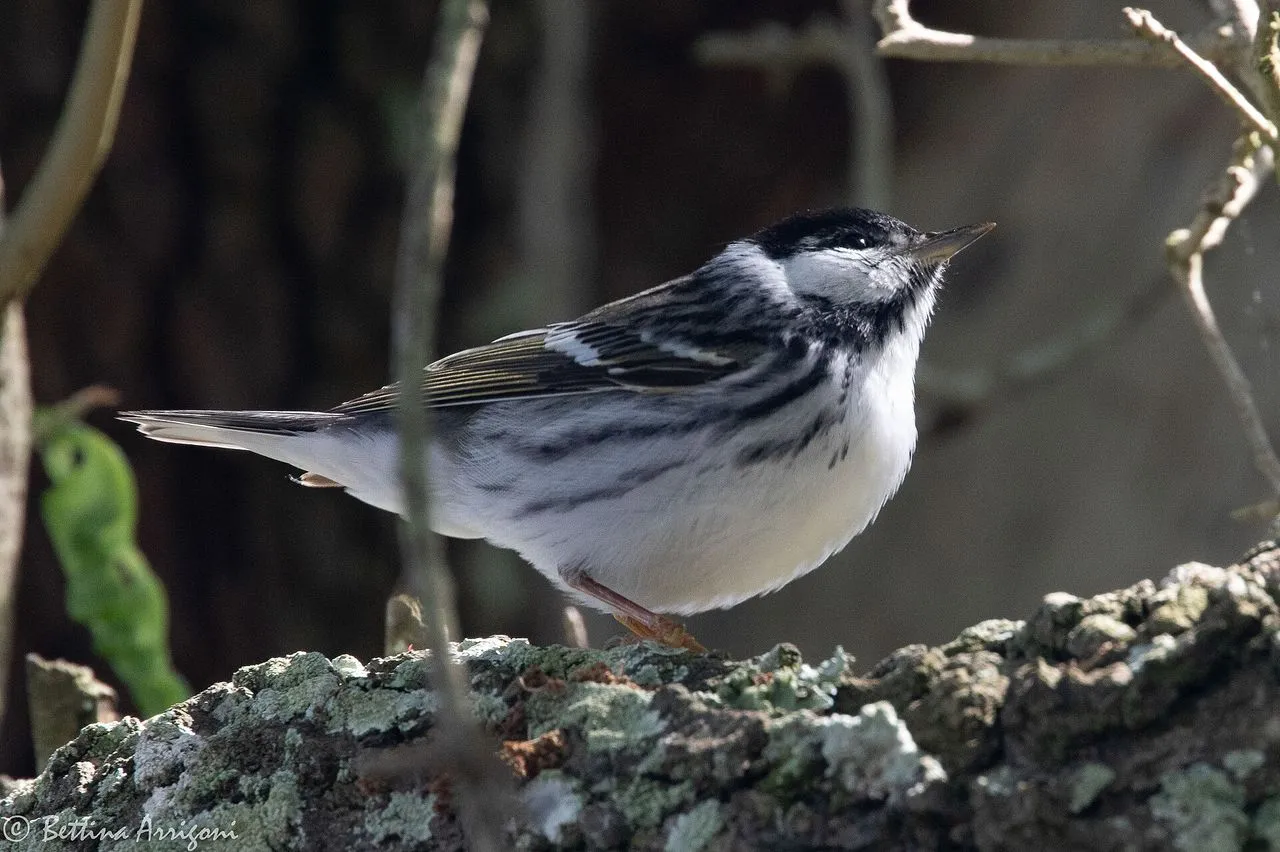
Setophaga striata Forster, 1772, the Blackpoll Warbler, is a 12 to 15 cm boreal parulid of 10 to 15 g that can nearly double its body mass before a non-stop autumn flight over the western Atlantic.
Part of the Complete Warblers Guide.
Identification at a glance
| Species | Autumn separator |
|---|---|
| Blackpoll Warbler (Setophaga striata) | Greenish above, whitish undertail coverts, fine flank streaking, pale orange-yellow feet |
| Bay-breasted Warbler (Setophaga castanea) | Warmer brownish tone, less streaking below, darker legs |
| Black-and-white Warbler (Mniotilta varia) | Bold black-and-white striping and trunk-creeping behaviour, not greenish foliage gleaning |
| Magnolia Warbler (Setophaga magnolia) | Broad white tail patches with dark terminal band; yellow below in most views |
| Size context | Blackpoll is 12 to 15 cm (4.7 to 5.9 in), 10 to 15 g (0.4 to 0.5 oz) |
Identification
Visual
Breeding males are strongly patterned: black cap, white cheeks, white underparts with bold black streaking, two white wing bars, and streaked olive-black upperparts. Females are duller, with a greenish crown and less contrast, but still show white wing bars and streaked underparts. Spring males are among the more distinctive northern warblers when seen well.
Autumn birds cause far more difficulty. They are greenish above, yellowish or white below, with fine streaking on the breast and flanks, pale legs, and two wing bars. Bay-breasted Warbler is the chief confusion species; Blackpoll usually shows brighter yellow-green upperparts, whiter undertail coverts, more obvious streaking below, and pale orange-yellow feet. In late September, when both species are fattening in coastal scrub, careful views of leg colour, flank streaking, and undertail tone are required. The Magnolia Warbler shares boreal breeding habitat and similar white tail pattern in autumn.
Audio
The song is a very high, thin series of repeated notes, often described as tsi-tsi-tsi-tsi-tsi at one pitch. Much of its energy lies near or above the upper hearing range of many older observers. A male may be singing directly overhead while one listener hears it clearly and another hears nothing.
Calls are sharp chips, not usually sufficient for confident identification in mixed migrant flocks. On breeding grounds the high song in spruce or tamarack is a useful clue, but visual confirmation remains important because several boreal warblers give thin, high songs.
Distribution
Breeding range spans the northern boreal forest from Alaska across northern Canada to Newfoundland, with local breeding south into northern New England and high elevations of the Adirondacks and Appalachians. It is one of the northernmost breeding parulids, occupying stunted conifer forest and taiga edge close to the limit of trees.
Spring migration proceeds mainly through the Caribbean, Florida, and eastern North America in April and May, with birds reaching boreal territories from late May into June. Autumn migration is exceptional. Many Blackpoll Warblers move east to Atlantic Canada or the north-eastern United States, accumulate fat, then depart over the ocean on a south-eastward track toward the Caribbean and northern South America. Flights of 2,500 to 3,000 km without landfall have been documented by tracking and physiological studies.
Habitat
Breeding habitat is boreal conifer forest, especially spruce and tamarack with muskeg, bog edges, open taiga, and shrubby wet conifer stands. In the far north it uses low, wind-shaped trees and krummholz-like structure near treeline. In the Appalachians it breeds in high-elevation spruce-fir forest, a habitat now restricted and fragmented.
During migration, Blackpolls use woodland edges, coastal thickets, spruce groves, alder tangles, gardens, and fruiting shrubs. Autumn birds along the Atlantic coast often feed intensively in bayberry, dogwood, and other fruiting vegetation before departure.
Diet and Foraging
The breeding-season diet includes caterpillars, beetles, flies, midges, aphids, sawfly larvae, mosquitoes, and spiders. Birds glean from conifer needles and twigs, hover at branch tips, and work through dense boreal foliage. At northern latitudes, synchrony with insect emergence is critical because the breeding season is compressed.
Before autumn migration the diet broadens to include fruit, and fat deposition becomes the central physiological task. Birds may raise fat stores to more than 40 percent of lean body mass before oceanic departure. This is not casual berry feeding; it is fuel loading for one of the longest overwater flights made by any small passerine.
Breeding Biology
Males arrive on breeding grounds in late spring and sing from conifer tops or exposed branches. The nest is placed low in spruce, fir, tamarack, or shrubs, often 0.3 to 3 m above ground. Females build a cup of twigs, grasses, moss, lichens, and rootlets, lined with feathers or fine fibres.
Clutch size is usually 4 or 5 eggs. Incubation lasts about 11 to 12 days, performed mainly by the female. Both adults feed nestlings, which fledge at roughly 10 days. One brood is normal. The short northern season leaves little room for replacement attempts after nest failure, which makes late snow, cold rain, and insect mismatch important pressures.
Notes
The Blackpoll Warbler's migration is often described as trans-Atlantic, though the route crosses the western North Atlantic rather than the ocean's full breadth. The achievement remains severe: a bird weighing little more than two coins launches from maritime North America and reaches the Antilles or South America after two to three days of continuous flight. Identification in autumn deserves patience because misidentified Blackpolls obscure one of the most remarkable annual movements in the passerine world.
See Also
- Magnolia Warbler: boreal neighbour with a distinctive white tail pattern, overlapping autumn migration window.
- Blackburnian Warbler: another boreal canopy warbler with similar migration timing.
- Yellow-rumped Warbler: the wintering warbler whose fruit diet enables it to overwinter farther north than Blackpoll.
- American Redstart: an agile migrant that also moves through eastern woodland and coastal stopover habitat.
- The Complete Warblers Guide: family taxonomy, migration, and identification structure.
- Why Are Warblers in My Garden in Fall?: a long-distance migrant most likely to appear at stopover gardens in September.
Frequently Asked Questions
How do I identify Blackpoll Warbler in spring?
Breeding males are distinctive with black cap, white cheeks, streaked white underparts, and two white wing bars. Females show greenish crown and less contrast. The combination of wing bars, streaked underparts, and boreal forest habitat in spring separates them from most other warblers.
Why is Blackpoll Warbler migration unusual?
In autumn, many Blackpoll Warblers fly east to Atlantic Canada or the northeastern US, then depart over the ocean on a non-stop flight of 2,500-3,000km to the Caribbean or South America. They can nearly double their body mass in fat before departure, some of the longest overwater flights of any small passerine.
How do I separate Blackpoll Warbler from Bay-breasted Warbler in autumn?
Blackpoll shows brighter yellow-green upperparts, whiter undertail coverts, more obvious flank streaking, and pale orange-yellow feet. Bay-breasted has a more brownish tone, less streaking below, and darker legs. Both have wing bars in autumn.
Where does Blackpoll Warbler breed?
Northern boreal forest from Alaska across Canada to Newfoundland, plus high elevations in the Appalachians. Uses spruce and tamarack with muskeg, bog edges, open taiga, and shrubby wet conifer stands, often near the limit of trees.
Sources & References
- Ehrlich, P.R., Dobkin, D.S. & Wheye, D. (1988). The Birders Handbook. Simon & Schuster.
- Cornell Lab of Ornithology. (2024). All About Birds: Blackpoll Warbler. birds.cornell.edu
- Sibley, D.A. (2014). The Sibley Guide to Birds (2nd ed.). Knopf.
- Elphick, J. (2015). The Birds of Canada. Princeton University Press.