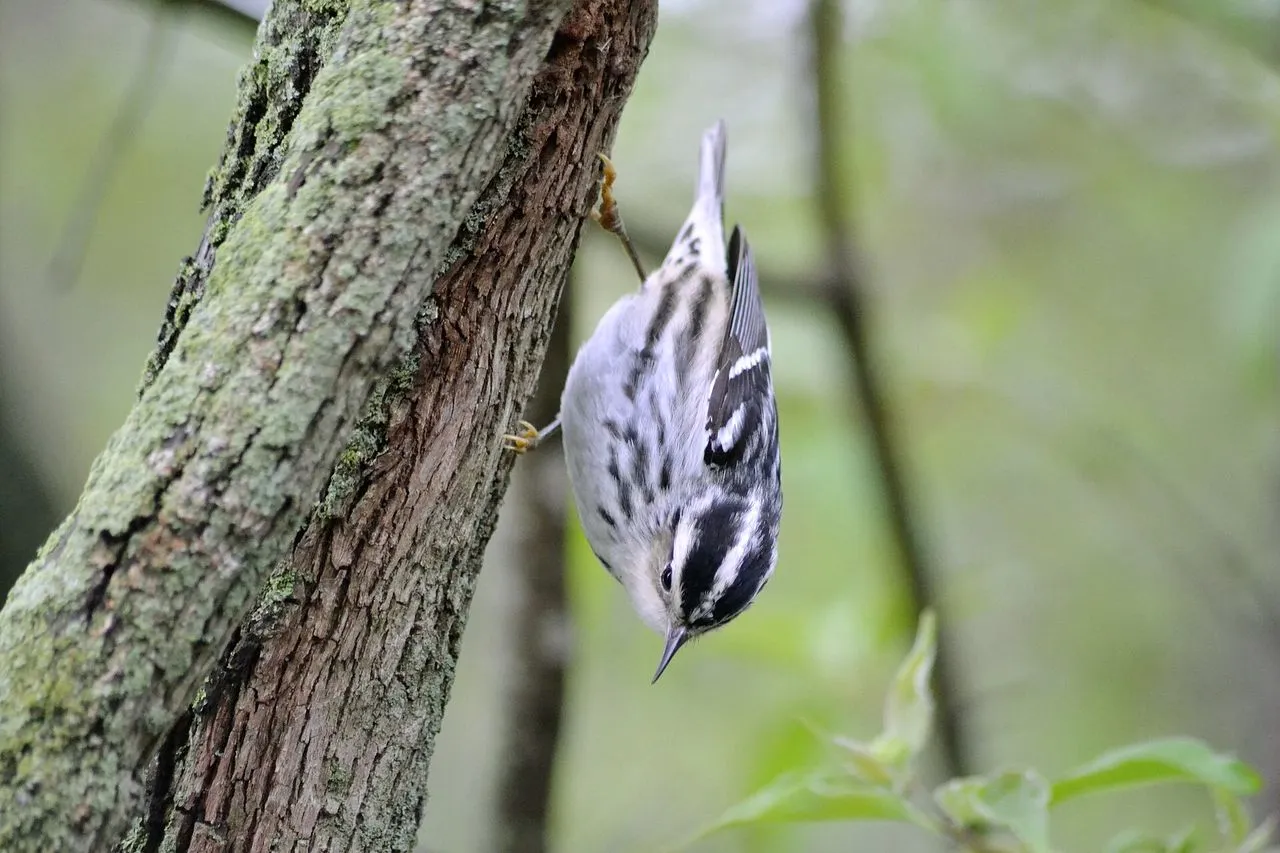
Black-and-white Warbler (Mniotilta vara) creeps along tree trunks and branches like a nuthatch (11–13cm, 8–15g). Striped black-and-white plumage is distinctive. Squeaky song. Found in mature deciduous forests.
Mniotilta varia Linnaeus, 1766, the Black-and-white Warbler, is an 11 to 13 cm parulid of 8 to 15 g that forages along trunks and limbs with a bark-creeping method more typical of nuthatches than warblers.
Part of the Complete Warblers Guide.
Identification at a glance
| Feature | Black-and-white Warbler (Mniotilta varia) | Key separator |
|---|---|---|
| Plumage | Longitudinal black-and-white stripes from crown to tail | No yellow or olive wash dominates the body |
| Behaviour | Creeps up, down, and sideways on trunks and limbs | Nuthatches use a different structure and are not warblers |
| Song | Thin wee-see wee-see wee-see | Higher and squeakier than most woodland warbler songs |
| Size | 11 to 13 cm (4.3 to 5.1 in), 8 to 15 g (0.3 to 0.5 oz) | Compact parulid, not a woodpecker or creeper |
| Nesting zone | Ground nest in mature deciduous or mixed forest | Forages on bark but nests on the forest floor |
Identification
Visual
The plumage is longitudinally striped black and white from bill to tail. Adult males show a black throat and cheek, white eyebrow, white median crown stripe, black crown sides, and heavily streaked flanks. Females and immature birds reduce the black throat to white or greyish white, with buff wash on the flanks in autumn. No other eastern North American warbler combines this zebra-striped pattern with trunk-creeping behaviour.
The bill is slightly downcurved and longer than in many Setophaga, suited to probing bark crevices. The feet and claws are strong for a warbler but not equivalent to a woodpecker's; the bird braces and creeps by rapid foot placement rather than using a stiff tail as a prop. It moves up, down, and sideways along bark, often turning around branches and disappearing behind trunks.
Audio
The primary song is a high, thin, repetitive wee-see wee-see wee-see, often compared to a squeaky wheel. It carries surprisingly well in spring woodland despite its narrow frequency range. Males sing from trunks, large limbs, and mid-canopy perches rather than exposed treetops.
Calls are sharp chip notes, similar in general structure to other warbler calls but often delivered while the bird is moving on bark. The song is much more useful than the call for spring detection. In autumn, behaviour and plumage usually identify the species before vocal evidence is needed.
Distribution
Breeds across eastern and central North America, from south-eastern Canada through New England, the Great Lakes, Appalachians, and much of the eastern United States west to the Great Plains margin. It is scarce or absent from the driest open interiors and the far West as a breeder.
Spring migration begins early for a warbler. Birds reach the Gulf Coast in March, move through the south-eastern states in April, and arrive in northern breeding areas from late April into May. Autumn migration runs from August through October. Winter range includes Florida, the Caribbean, Mexico, Central America, and northern South America, where birds use woodland, shade coffee, mangroves, and forest edges.
Habitat
Breeding habitat is mature or maturing deciduous and mixed forest with abundant trunks, large limbs, and bark surface. The species occurs in oak-hickory forest, maple-beech forest, mixed hemlock-hardwood stands, wooded ravines, and swamp forest. It tolerates some fragmentation but reaches highest densities in larger forest blocks with complex structure and a developed leaf-litter layer.
During migration it appears in almost any wooded habitat: parks, gardens with old trees, shelterbelts, orchards, and coastal woodlots. A single mature oak in a small urban green space can hold a migrant for several hours if bark prey is available.
Diet and Foraging
Black-and-white Warblers feed on insects and spiders hidden in bark, lichen, moss, and branch crevices. Caterpillars, beetles, ants, flies, leafhoppers, and moth eggs are taken by probing and gleaning. The bird's niche reduces direct competition with leaf-gleaning canopy warblers, since much of its prey comes from vertical and underside surfaces that other parulids use less intensively.
Foraging begins low on trunks and extends into the canopy. Birds often spiral upward, cross to a limb, hang briefly underneath, then drop or fly to another trunk. They do not hammer or excavate; prey capture depends on visual inspection and fine probing. On wintering grounds they join mixed-species flocks and may follow woodcreepers or antwrens, exploiting disturbed insects without adopting those species' specialised methods.
Breeding Biology
Despite its tree-trunk foraging, the species nests on the ground. The female places the nest at the base of a tree, beside a log, under roots, or in leaf litter on a slope, where the striped adult can vanish against bark and shadow. The cup is built from leaves, bark strips, grasses, and rootlets, lined with hair and fine fibres.
Clutch size is usually 4 or 5 eggs. Incubation lasts about 10 to 12 days and is carried out mainly by the female. Both parents feed young, which leave the nest at around 8 to 12 days. Ground nesting exposes eggs and nestlings to snakes, chipmunks, raccoons, and other predators, so nest concealment and rapid fledging matter. Brown-headed Cowbird parasitism occurs in fragmented landscapes.
Notes
This species is the only living member of Mniotilta, a genus defined by bark-foraging specialisation. Its behaviour is not merely a field trick for identification; it represents a structural niche within eastern forests. When a spring woodland seems quiet at eye level, checking the trunks and underside of large limbs often produces this species before the leaf-canopy warblers have descended into view.
See Also
- Ovenbird: another ground-nesting warbler that walks forest floors, sharing the black-and-white warbler's mature forest habitat.
- Black-and-white Warbler: the bark-creeping parulid of mature eastern forest; this article is the primary reference.
- Cerulean Warbler: the mature hardwood canopy species that neighbours black-and-white warbler in Appalachian breeding range.
- Pine Warbler: the parulid that forages deliberately in pine canopy, distinct in method but similar in structural adaptation.
- The Complete Warblers Guide: full family reference: taxonomy, migration, and identification structure.
Frequently Asked Questions
How do I identify Black-and-white Warbler?
Black and white striped pattern throughout, streaked crown, striped face, streaked underparts. No other North American warbler looks like this. Creeps up and down tree trunks and branches.
Why does Black-and-white Warbler creep on trees?
Unique foraging method, creeps along bark like a nuthatch, probing crevices for insects and spiders. This niche allows them to coexist with other warblers that feed in foliage or on the ground.
What is the Black-and-white Warbler song?
A thin, squeaky 'wee-see-wee-see-wee-see', similar to a squeaky wheel. The song is higher-pitched and less musical than most warblers.
Where does Black-and-white Warbler nest?
On the ground at the base of a tree or fallen log in mature deciduous or mixed forest. The nest is cup-shaped, well-hidden in leaf litter or vegetation.