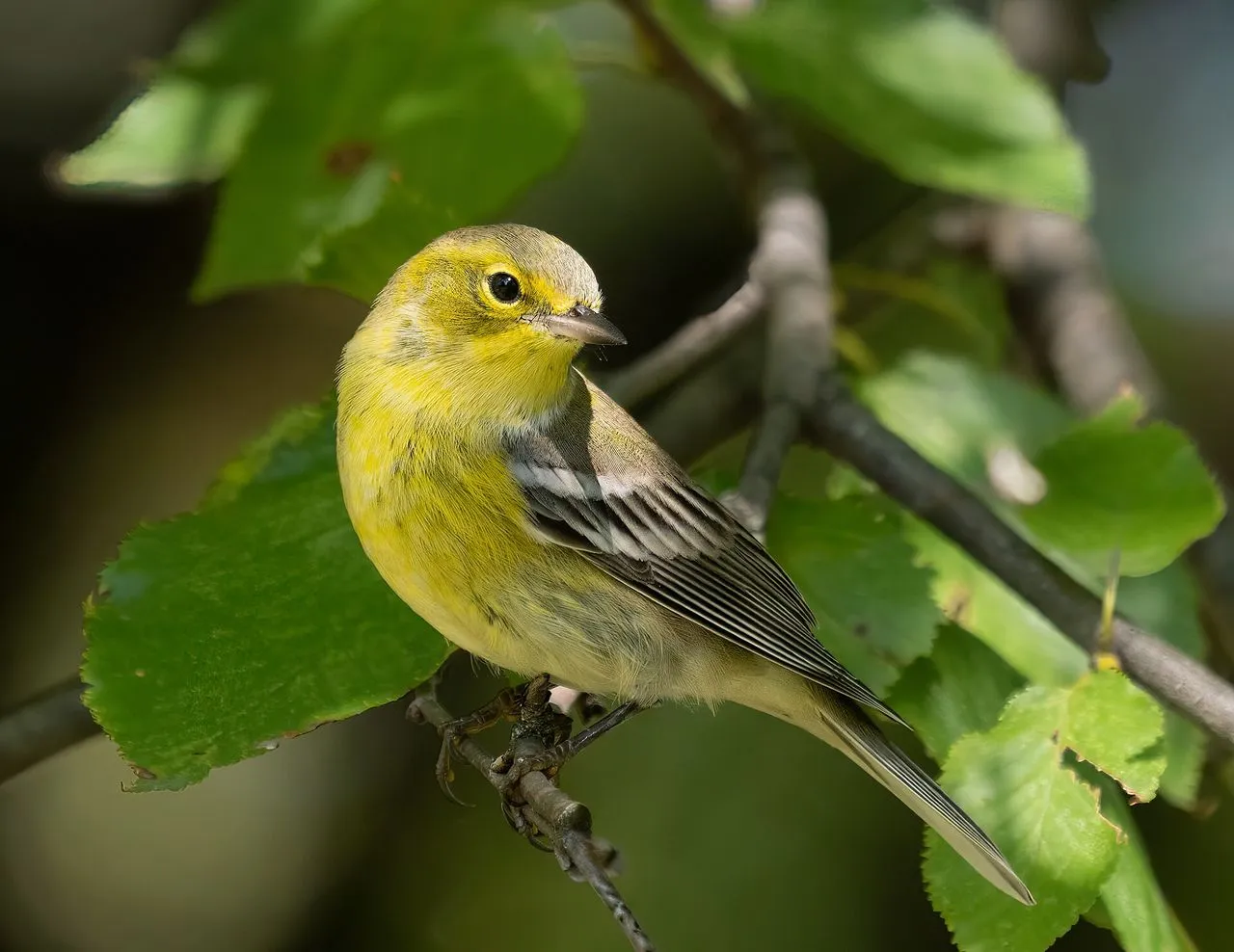
Setophaga pinus Wilson, 1811, the Pine Warbler, is a 13 to 14 cm parulid weighing about 9 to 15 g and one of the few New World warblers that regularly eats seeds and visits feeders.
Part of the Complete Warblers Guide.
Identification at a glance
| Feature | Pine Warbler (Setophaga pinus) | Key separator |
|---|---|---|
| Plumage | Olive above, yellow throat and upper breast, two white wing bars | Duller birds still show wing bars and pine association |
| Bill | Heavier than most Setophaga | Supports regular seed and suet use |
| Song | Clear musical trill from pine crowns | Richer and more liquid than Chipping Sparrow in many cases |
| Size | 13 to 14 cm (5.1 to 5.5 in), 9 to 15 g (0.3 to 0.5 oz) | Stockier than many migrant warblers |
| Primary habitat | Pine forest, pine-oak woodland, pine plantations, mature ornamental pines | Pine presence is the central clue |
Identification
Visual
Adult males are olive above and yellow below, brightest on the throat and upper breast, with two white wing bars, a pale broken eye ring, and diffuse olive streaking along the breast sides. Females and immature birds are duller grey-olive with weaker yellow, sometimes so muted in autumn that they appear almost plain. The bill is heavier than that of most Setophaga, reflecting a broader diet that includes seeds.
The most useful visual context is the bird's position in pines. Pine Warblers move deliberately along pine branches, probing needle clusters, bark flakes, and cones. They do not creep vertically like Black-and-white Warblers, and they lack the bold yellow rump of Yellow-rumped Warblers. In dull plumage, the combination of wing bars, yellowish throat, thick bill, and pine association usually resolves the identification.
Audio
The song is a clear musical trill, delivered at a steady pitch and tempo from pine crowns. It resembles Chipping Sparrow and Dark-eyed Junco songs, but Pine Warbler usually sounds richer and more liquid, with individual notes slightly less dry. Males begin singing early, often in February or March in the south-eastern United States, well before most migrant warblers arrive.
The call is a sharp chip, not strongly diagnostic unless heard in pine habitat from a bird moving through the canopy. Persistent singing from the top of a loblolly, longleaf, or white pine in early spring is often the first field clue.
Distribution
Breeding range follows pine distribution across eastern North America. The species breeds from south-eastern Canada and the north-eastern United States south through the Appalachians, Atlantic coastal plain, Gulf states, and much of the south-east. It is resident in the southern part of the range, especially where pine woodland remains productive through winter.
Northern populations migrate short to moderate distances. Spring arrival reaches the Mid-Atlantic and lower Great Lakes in March and April; northern breeding areas fill by late April or early May. Autumn movement occurs mainly from September through November. Winter birds concentrate in the south-eastern United States, but small numbers appear irregularly at feeders and sheltered pine stands farther north.
Habitat
Pine is the central requirement. The species uses longleaf, loblolly, shortleaf, slash, pitch, red, white, and jack pine, varying by region. It occurs in open pine savanna, mature pine forest, mixed pine-oak woodland, pine plantations, and suburban neighbourhoods with mature ornamental pines. Stand structure matters less than the presence of sufficiently large pines for foraging and nesting.
In the south-east, open longleaf pine systems with a grassy understory hold breeding birds, especially where fire maintains an open structure. In the north, mixed pine-hardwood stands and mature white pine groves are typical. During winter, birds expand into gardens, feeders, and deciduous edges but usually remain near conifers.
Diet and Foraging
Breeding-season diet includes caterpillars, beetles, leafhoppers, ants, flies, scale insects, and spiders, most taken by gleaning pine needles and bark. Pine Warblers also probe cones and needle bases, and they occasionally hover at branch tips. They forage more slowly and heavily than many warblers, with less restless flitting.
Seeds form a meaningful part of the non-breeding diet. Birds eat pine seeds, grass seeds, cracked corn, millet, sunflower fragments, suet, and peanut pieces. At feeders they may appear with chickadees, titmice, and nuthatches, taking suet from cages or picking fragments beneath seed feeders. This behaviour is not incidental; the bill and digestive flexibility permit use of foods that most parulids ignore.
Breeding Biology
Males establish territories in pine stands and sing from high perches. The nest is almost always placed in a pine, commonly 8 to 20 m above ground on a horizontal limb or in a cluster of needles. This height makes nests difficult to observe directly, which partly explains why the species' breeding behaviour is less familiar to many observers than that of low-nesting warblers.
Females build a compact cup of bark strips, pine needles, grasses, and plant fibres, lined with feathers, hair, and fine rootlets. Clutch size is usually 3 to 5 eggs. Incubation lasts about 10 to 13 days and is performed by the female. Both parents feed young, which fledge at about 10 days. In the southern United States two broods may occur, aided by the long breeding season and early nesting start.
Notes
Pine Warbler is a useful corrective to the assumption that warblers are uniformly delicate insect specialists. In winter a bird feeding on suet in a Carolina garden may still be a warbler, but the structural clues remain: slimmer than a finch, finer-tailed than a sparrow, with white wing bars and a deliberate pine-associated foraging style. Its ability to bridge insect and seed diets helps explain why it can remain resident where other parulids must leave.
See Also
- Black-and-white Warbler: the bark-creeping parulid for comparison of foraging methods on conifer versus deciduous bark.
- Yellow-rumped Warbler: the berry-eating parulid that also survives winters north of Mexico and occasionally visits feeders.
- Blackburnian Warbler: the boreal conifer canopy specialist that overlaps in pine and spruce zone foraging height.
- Magnolia Warbler: the boreal conifer breeder that shares young-spruce nesting habitat with Pine Warbler.
- The Complete Warblers Guide: full family reference: taxonomy, migration, and identification structure.
Frequently Asked Questions
How do I identify Pine Warbler?
Look for yellow throat and upper breast, olive upperparts, two white wing bars, and pale broken eye ring. The combination of wing bars, yellowish throat, relatively thick bill, and association with pines is diagnostic. Duller autumn birds still show wing bars and pine habitat association.
Does Pine Warbler actually eat seeds?
Yes, it's one of the few warblers that regularly consumes seeds. In winter it eats pine seeds, grass seeds, cracked corn, millet, sunflower fragments, suet, and peanut pieces. At feeders it may appear with chickadees and nuthatches, taking suet from cages or picking beneath seed feeders.
Where does Pine Warbler breed?
Pine forests across eastern North America, from southeastern Canada and the northeastern US south through the Appalachians, Atlantic coastal plain, and Gulf states. Uses longleaf, loblolly, shortleaf, slash, pitch, red, white, and jack pine depending on region. Nests are placed high in pines, often 8-20m above ground.
How does Pine Warbler song compare to similar birds?
The musical trill resembles Chipping Sparrow and Dark-eyed Junco, but Pine Warbler sounds richer and more liquid with notes slightly less dry. Males begin singing early, often February or March in the southeastern US, before most migrant warblers arrive.