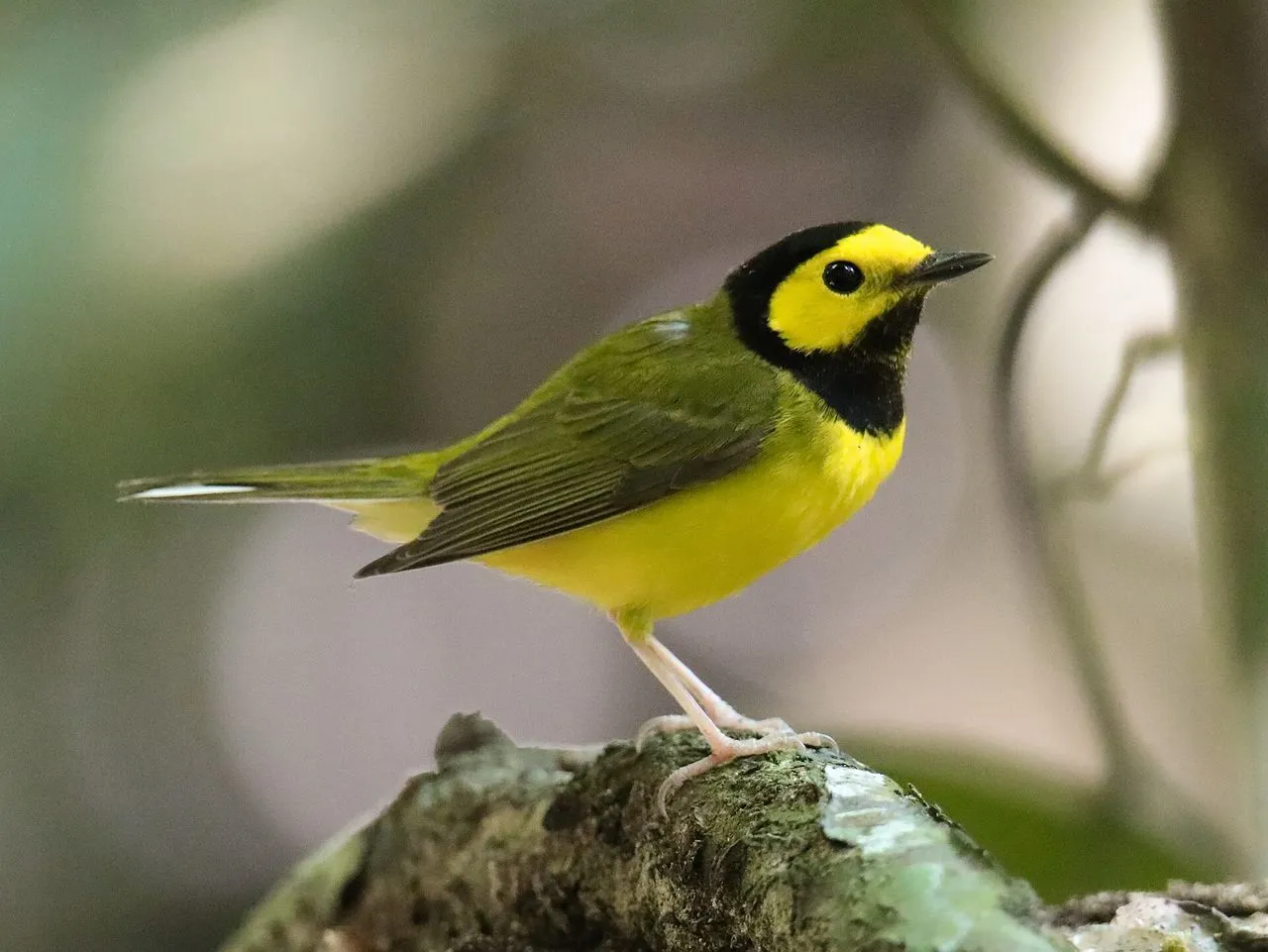
Setophaga citrina Boddaert, 1783, the Hooded Warbler, is a 13 cm understory warbler of about 9 to 12 g whose adult male combines a black hood with a bright yellow face and underparts.
Part of the Complete Warblers Guide.
Identification at a glance
| Species | Key separator |
|---|---|
| Hooded Warbler (Setophaga citrina) | Yellow face enclosed by black hood in adult male; large white outer tail feathers |
| Wilson's Warbler (Cardellina pusilla) | Black cap only; no full hood and no large white tail flashes |
| Common Yellowthroat (Geothlypis trichas) | Black mask across the face, not a hood; wetter and more open low vegetation |
| Prothonotary Warbler (Protonotaria citrea) | Plain golden head, blue-grey wings, flooded forest and cavities |
| Size context | Hooded Warbler is about 13 cm (5.1 in), 9 to 12 g (0.3 to 0.4 oz) |
Identification
Visual
Adult males are unmistakable when seen well: olive-green upperparts, yellow face and underparts, and a complete black hood encircling the head and throat while leaving the face yellow. The tail is dark with large white outer feathers, often flashed as the bird moves through low vegetation. Females vary. Some lack most of the hood and show only olive crown and nape; older females may develop a partial or extensive black hood, so sexing by hood alone can be unsafe.
The species stays low, usually below 3 m, and moves through dense understory with frequent tail spreading. Wilson's Warbler has a black cap rather than a hood and lacks large white tail flashes. Common Yellowthroat has a black mask in males, not a hood, and occupies wetter, more open low vegetation.
Audio
The song is loud, ringing, and emphatic, often rendered ta-wit ta-wit ta-wit tee-yo or weeta-weeta-weet-tee-o. The terminal phrase is accented and carries through humid forest. Males sing from low saplings, shrubs, and midstory perches, often remaining hidden despite the volume.
Calls include a sharp chip. The song is the most reliable way to find territorial birds in May and June. In late summer and migration, tail flashes in dense cover become more useful than voice.
Distribution
Hooded Warblers breed mainly in the eastern United States, from the lower Midwest and southern Great Lakes east to the Atlantic states and south to the Gulf Coast. The core range includes the Appalachians, Ozarks, Mississippi Valley forests, and mature woodlands of the south-east. The species has expanded northward in parts of the north-eastern United States over recent decades as forest age and understory conditions changed.
Spring migrants arrive in the Gulf states in March and April and reach northern breeding areas in late April and May. Autumn migration occurs from August through October. Winter range includes Mexico, Central America, the Caribbean, and parts of northern South America, where birds occupy lowland and foothill forest understory.
Habitat
Breeding habitat is deciduous or mixed forest with dense understory beneath a relatively closed canopy. Rhododendron thickets, mountain laurel, cane, spicebush, young saplings, and vine tangles all provide structure. The species often uses forest gaps, stream ravines, and edges within large forest blocks, but it is not a bird of open scrub.
Canopy cover and understory density must occur together. A shaded forest with bare ground offers too little cover; a sunny thicket without forest canopy is usually too open. During migration Hooded Warblers appear in coastal hammocks, hedgerows, garden shrubbery, and any dense low cover that allows concealed movement.
Diet and Foraging
Diet consists of insects and spiders, including caterpillars, beetles, moths, flies, ants, and small orthopterans. Birds forage low, taking prey from leaf undersides, stems, and the ground surface. They also make short sallies to capture flushed insects.
Tail spreading is frequent. The white outer tail feathers flash in the dim understory, and the movement may help startle prey as well as communicate with rivals or mates. Foraging is deliberate rather than frantic: the bird pauses, fans the tail, shifts position, and picks from a leaf or twig.
Breeding Biology
Females build nests in shrubs, saplings, or vine tangles, usually 0.3 to 1.5 m above ground. The nest is an open cup of dead leaves, grasses, bark strips, and plant fibres, lined with fine grasses and hair. Low placement makes concealment essential.
Clutch size is usually 3 or 4 eggs. Incubation lasts about 12 days and is performed by the female. Both parents feed young, which fledge at around 8 or 9 days. Cowbird parasitism can be significant near edges and in fragmented habitat. Males may attract additional females where territories contain dense, high-quality understory.
Notes
Hooded Warblers often reveal the condition of the forest understory more accurately than the canopy. A mature stand with no shrub layer may hold canopy warblers but lack Hooded Warblers entirely. Where deer browsing suppresses saplings and shrubs, territories decline even if the overstory remains intact. Restoration, in this case, means allowing the lower metre of the forest to recover.
See Also
- Prothonotary Warbler: the golden swamp warbler that shares southern forest understory habitat and overlapping range.
- Common Yellowthroat: the masked wetland warbler, a useful comparison for separation from Hooded Warbler.
- Ovenbird: the ground-walking forest warbler whose habitat indicator role parallels the understory condition that Hooded Warblers require.
- Wood Thrush: a forest-interior species that also signals mature, well-structured eastern woodland.
- The Complete Warblers Guide: family taxonomy, migration, and identification structure.
Frequently Asked Questions
How do I distinguish Hooded Warbler from similar warblers?
The black hood framing a yellow face is distinctive in males. Wilson's Warbler has a black cap instead of a hood. Common Yellowthroat shows a black mask across the eyes. The white outer tail feathers are also distinctive and often flashed in low vegetation.
Where does Hooded Warbler nest?
Breeds in deciduous or mixed forest with dense understory, rhododendron, mountain laurel, cane, spicebush. Nests are placed 0.3-1.5m above ground in shrubs or vine tangles. Requires closed canopy above dense shrub layer.
What does Hooded Warbler eat?
Insects and spiders including caterpillars, beetles, moths, flies, and small orthopterans. Forages low, gleaning from leaf undersides, stems, and ground. Makes short sallies after flushed insects.
Does Hooded Warbler use feeders?
Rarely, they stay in forested understory and do not visit traditional feeders. Best observed by learning their song in mature woodland or by watching for white tail flashes in dense vegetation.
Sources & References
- Ehrlich, P.R., Dobkin, D.S. & Wheye, D. (1988). The Birders Handbook. Simon & Schuster.
- Cornell Lab of Ornithology. (2024). All About Birds: Hooded Warbler. birds.cornell.edu
- Sibley, D.A. (2014). The Sibley Guide to Birds (2nd ed.). Knopf.
- Rising, J.D. (1995). A Guide to the Identification and Natural History of the New World Warblers. Academic Press.