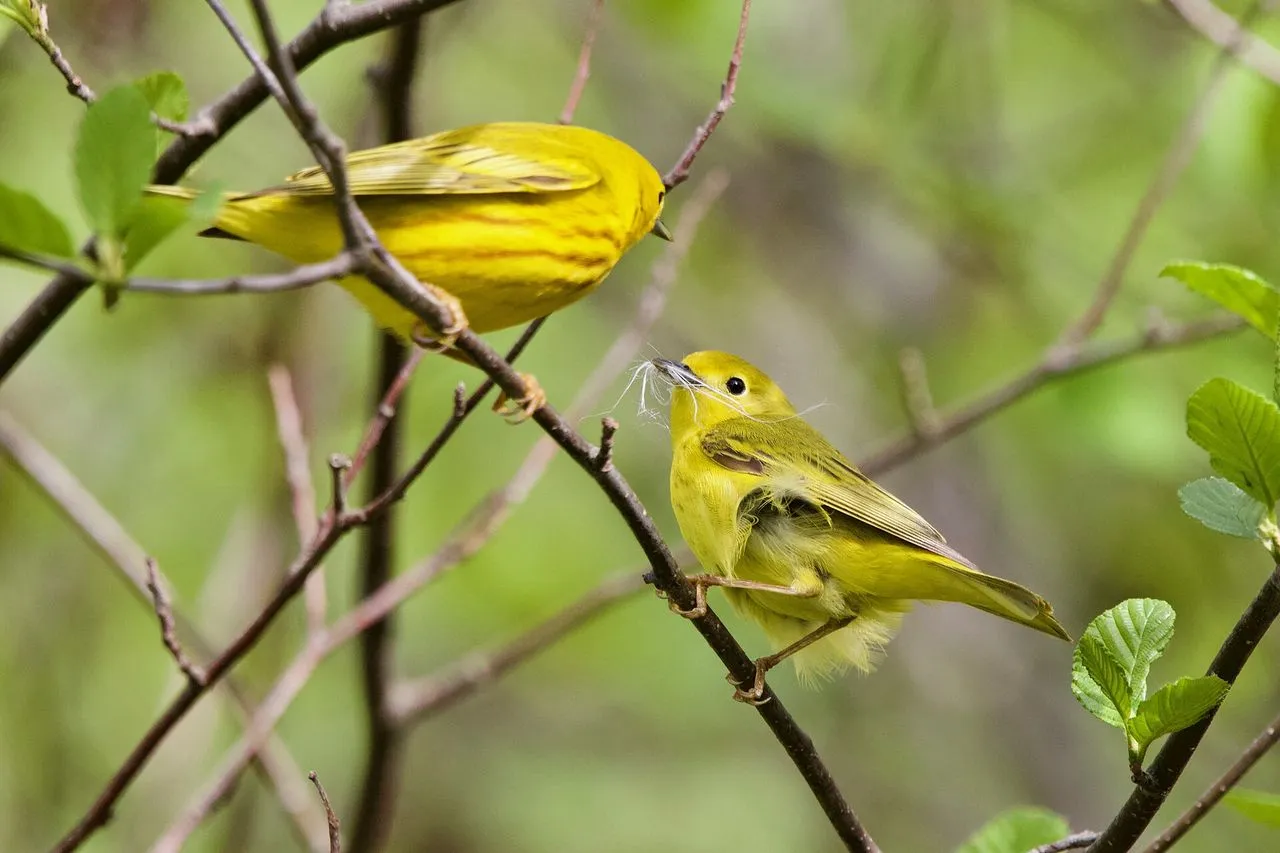
The names mislead. Yellow Warbler is an almost entirely yellow bird, with red breast streaks on the male and uniformly yellow underparts. Yellow-rumped Warbler is a patchy grey-and-yellow bird with four discrete yellow patches (crown, throat in Audubon's subspecies, sides, and the eponymous rump) but with grey or brown elsewhere. Yellow Warbler is summer-only across most of North America; Yellow-rumped is winter-only or year-round depending on subspecies and region.
Yellow Warbler and Yellow-rumped Warbler share a family, a continent, and just enough superficial similarity to confuse beginners at the start of every spring. The confusion rarely survives a close look: one bird is almost entirely yellow; the other is mostly grey with yellow restricted to four distinct patches. Understanding the separation also opens up two very different ecological stories, one a long-distance neotropical migrant of wet shrublands, the other a berry-eating winter specialist uniquely adapted for cold North American winters.
Both species are profiled individually on this site: Yellow Warbler and Yellow-rumped Warbler. This guide focuses on the comparative identification and the ecological differences behind it. Both are part of the Complete Warblers Guide.
Quick answer: Yellow Warbler is predominantly yellow across the entire body, with reddish-brown breast streaks on the adult male and duller but still largely yellow plumage on females and immatures. Yellow-rumped Warbler is predominantly grey or grey-brown with four discrete yellow patches: crown, sides, rump, and (in the Audubon's subspecies only) throat. If the bird looks yellow overall, it is almost certainly Yellow Warbler. If the bird looks grey with yellow accents, it is Yellow-rumped.
Best first step: Check the back. Yellow Warbler has a uniformly yellow or olive-yellow back. Yellow-rumped Warbler has a grey or grey-brown back in all plumages. Back colour alone resolves the ID in most lighting conditions before any other mark is needed.
Avoid: Relying on the rump alone. While the yellow rump of Yellow-rumped Warbler is diagnostic and visible in every plumage, Yellow Warbler also shows pale yellowish uppertail spots in flight. The rump is the clinching mark for Yellow-rumped; overall body colour is the clinching mark for Yellow Warbler.
The Big Comparison Table
| Character | Yellow Warbler (Setophaga petechia) | Yellow-rumped Warbler (Setophaga coronata) |
|---|---|---|
| Scientific name | Setophaga petechia | Setophaga coronata |
| Body length | 12 to 13 cm (4.7 to 5.1 in) | 12 to 15 cm (4.7 to 5.9 in) |
| Body mass | 8 to 10 g (0.3 oz) | 10 to 14 g (0.4 to 0.5 oz) |
| Adult male plumage | Bright yellow throughout; reddish-brown breast streaks; yellow tail spots | Grey, black, and white with yellow crown, yellow sides, yellow rump; white or yellow throat by subspecies |
| Adult female plumage | Duller olive-yellow overall; faint or absent streaking; yellow tail spots | Dull grey-brown; yellow rump retained; reduced yellow on crown and sides |
| Key yellow extent | Entire body | Four discrete patches: crown, throat (Audubon's only), sides, rump |
| Back colour | Yellow to olive-yellow | Grey or grey-brown |
| Subspecies | Up to 35 subspecies; northern migrants form the aestiva group | Two main groups: Myrtle (coronata; white throat) and Audubon's (auduboni; yellow throat) |
| Song | Rapid, high series: "sweet-sweet-sweet-I'm-so-sweet" | Loose, even trill lasting 4 to 8 seconds; weaker and less patterned |
| Call | Soft, musical "chip" | Hard, dry "chek" |
| Breeding habitat | Willows, alders, and dense shrub edges near water | Coniferous or mixed forest; spruce, fir, tamarack, pine |
| Breeding range | Alaska and Yukon south through Mexico; broadest breeding range of any North American warbler | Boreal forest across Canada; western mountains south to New Mexico and Arizona |
| Winter range | Mexico, Central America, northern South America | Pacific Coast, southern and eastern United States, Mexico, Caribbean; uniquely cold-hardy among warblers |
| Fall migration timing | Early: adults depart territories from late July; mostly gone by September | Late: peaks in October across much of North America; extends into November and beyond in coastal areas |
| Diet specialty | Caterpillars and insects year-round | Insects in breeding season; waxy fruits (bayberry, wax myrtle, juniper) in winter |
Yellow Extent: The Diagnostic
The single most useful identification concept is how much of the bird is yellow.
Yellow Warbler is a yellow bird. The adult male has no grey, no brown (except in the reddish streaks on the breast), and no white. From bill to tail the plumage is some shade of yellow: bright gold on the underparts, more olive-yellow on the back and wings. The reddish-brown breast streaks run from the throat to the lower chest, but they are thin enough that the overall yellow impression holds at normal viewing distances. Females are duller, olive-yellow above and paler yellow below, with little or no streaking, but still register as a yellow bird with no grey component.
Yellow-rumped Warbler is a grey bird with yellow accents. At rest, a breeding male appears largely black, grey, and white, with bright yellow interrupting at four points: a crown patch, a patch on each side of the breast, and the rump. The rump becomes visible as a bright flash when the bird moves or is flushed. Non-breeding birds lose much of the contrast but retain the yellow rump across all ages and sexes, even in the dullest winter plumage. On a overcast day in a leafy hedge in November, the rump flash can be the first and only useful mark.
A practical shortcut: if you need to look for the yellow parts on the bird, it is Yellow-rumped Warbler. If you need to look for the non-yellow parts, it is Yellow Warbler.
Yellow-rumped Subspecies
Yellow-rumped Warbler is not one uniform bird across its range. Two subspecies groups are widespread enough to encounter regularly, and they differ in ways that are relevant to the comparison with Yellow Warbler.
The Myrtle Warbler group (Setophaga coronata coronata), which breeds across the eastern and central boreal zone and winters through the eastern United States, has a white throat in all plumages. Breeding males show a sharply defined dark auricular patch and strong black-and-white facial contrast. The white throat persists as the subspecies mark even in dull winter birds.
The Audubon's Warbler group (Setophaga coronata auduboni), which breeds in western mountains and winters along the Pacific Coast and in the Southwest, has a yellow throat, a greyer face, and more yellow on the face overall. The yellow throat makes Audubon's appear more similar to Yellow Warbler than Myrtle does, but the grey body and the restricted four-patch yellow pattern still separate it clearly. Any bird with a yellow throat and a grey back is Audubon's, not Yellow Warbler.
A hybridisation zone in the Canadian Rockies produces intergrades with mixed throat and face patterns. For most field situations, throat colour resolves the subspecies without difficulty. Both groups share the yellow rump patch and yellow side patches, which are the characters that matter for separation from Yellow Warbler.
Seasonal Patterns
Seasonal timing is as useful as plumage for a confident identification, particularly in fall and winter when the two species largely do not overlap in temperate North America.
Yellow Warbler is a long-distance neotropical migrant. Adults begin leaving breeding territories in late July, among the earliest departures of any warbler. By mid-September most birds have crossed into Mexico or further south. The species winters from Mexico through Central America to northern South America. A Yellow Warbler in a temperate North American garden in October or later is unusual enough to warrant careful documentation and a second opinion.
Yellow-rumped Warbler is built differently for a warbler. It is the only North American wood-warbler that winters north of Mexico in large numbers, and it does so because it can digest waxy, lipid-rich fruits such as bayberry, wax myrtle, and juniper berries. This dietary flexibility allows birds to remain as far north as coastal New England, the mid-Atlantic coast, and the Pacific Coast through intervals of cold when flying insects are unavailable. The result is the opposite seasonal profile from Yellow Warbler: Yellow-rumped peaks in October across most of the continent and can be the dominant warbler in hedges and scrub through November and December.
In fall and winter, if you see a warbler anywhere in temperate North America, the probability strongly favours Yellow-rumped Warbler. For more on fall warbler occurrence patterns in gardens, see Why Are Warblers in My Garden in Fall?.
Habitat Differences
The habitat preferences of the two species are distinct enough that location alone narrows the identification before the bird is in the binoculars.
Yellow Warbler is a specialist of dense, low, wet shrubland. Willows (Salix), alders (Alnus), and cottonwoods along stream margins, pond edges, and wetland borders form the core breeding habitat throughout its range. The species is rarely found in closed canopy forest or away from water during the breeding season. In suburban settings, dense native shrubs within 50 metres of standing or moving water are enough to attract a territorial male in May.
Yellow-rumped Warbler breeds in coniferous and mixed forest, using spruce, fir, tamarack, and pine stands across the boreal zone, and pine, fir, and Douglas-fir in western mountains. Outside the breeding season it becomes the most habitat-flexible warbler in North America, using coastal bayberry scrub, juniper edges, orchards, golf courses, gardens, open woodland, and mangroves. The winter association with wax myrtle is strong enough that a single line of bayberry shrubs will often hold a small flock when adjacent woodland appears empty.
In spring, a yellow warbler in a streamside willow thicket is almost certainly Yellow Warbler. In winter, a warbler in bayberry scrub or a suburban hedgerow is almost certainly Yellow-rumped.
A Note on Pine Warbler and Palm Warbler
Two other warblers enter the comparison when light is poor or birds are in worn plumage.
Pine Warbler is the closest visual match to Yellow Warbler among the warblers that winter in temperate North America. Male Pine Warbler has yellow underparts and an olive-yellow head, but the back is olive-grey, the wingbars are prominent and white, and the bill is longer and stouter than Yellow Warbler's fine, decurved bill. Pine Warbler is a year-round resident of pine woodland and does not breed in wet shrubland. It lacks both the all-yellow back of Yellow Warbler and the yellow rump of Yellow-rumped.
Palm Warbler is another yellow-tinged warbler that shares open and semi-open wintering habitat with Yellow-rumped Warbler. Palm Warbler shows a rusty cap, yellow undertail coverts, and a persistent tail-bobbing habit. It lacks the yellow rump of Yellow-rumped and the all-yellow body of Yellow Warbler. In fall and winter flocks at field edges and garden borders, the tail-bobbing behaviour separates it from both species before any plumage mark is needed.
See Also
- Yellow Warbler: full species account covering the reddish breast streaks, the sweet song, and the distinctive cowbird burial response.
- Yellow-rumped Warbler: full species account covering Myrtle and Audubon's subspecies, the berry-digesting diet, and winter range.
- Pine Warbler: the pine-forest specialist and the yellow warbler most likely to be confused with Yellow Warbler during winter.
- Palm Warbler: the rusty-capped, tail-bobbing open-country warbler that shares winter flocks with Yellow-rumped Warbler.
- Why Are Warblers in My Garden in Fall?: seasonal patterns of warbler occurrence in temperate gardens.
- The Complete Warblers Guide: full family reference covering taxonomy, migration, and identification structure.
Frequently Asked Questions
What is the most reliable mark?
Look at the body as a whole. If the bird is predominantly yellow from bill to tail, it is almost certainly a Yellow Warbler. If the bird is mostly grey or grey-brown with yellow confined to discrete patches (rump, sides, crown), it is a Yellow-rumped Warbler. The yellow rump patch on Yellow-rumped is visible in every plumage, including dull winter birds, and is diagnostic.
Why are they both called yellow?
Both species carry yellow in their plumage, but in very different proportions. Yellow Warbler earned its name because the entire plumage is yellow. Yellow-rumped Warbler is named for its single most reliable field mark, the yellow rump patch that shows in all ages and seasons. The common names do not imply similar overall colouration.
What about Pine Warbler?
Male Pine Warbler shows yellow underparts and an olive-yellow head but has prominent white wingbars and a longer, stouter bill. It lacks both the reddish breast streaks of Yellow Warbler and the yellow rump of Yellow-rumped Warbler. Pine Warbler is a year-round resident in pine forests; see the full account at /warblers/pine-warbler for details.
Which is more likely in fall?
Yellow-rumped Warbler by a wide margin. Yellow Warbler adults begin departing breeding territories in late July and most have left temperate North America before the main fall birding season. Yellow-rumped Warbler peaks in October across much of the continent and can be the dominant warbler in hedges, bayberry scrub, and garden edges through November and into winter.