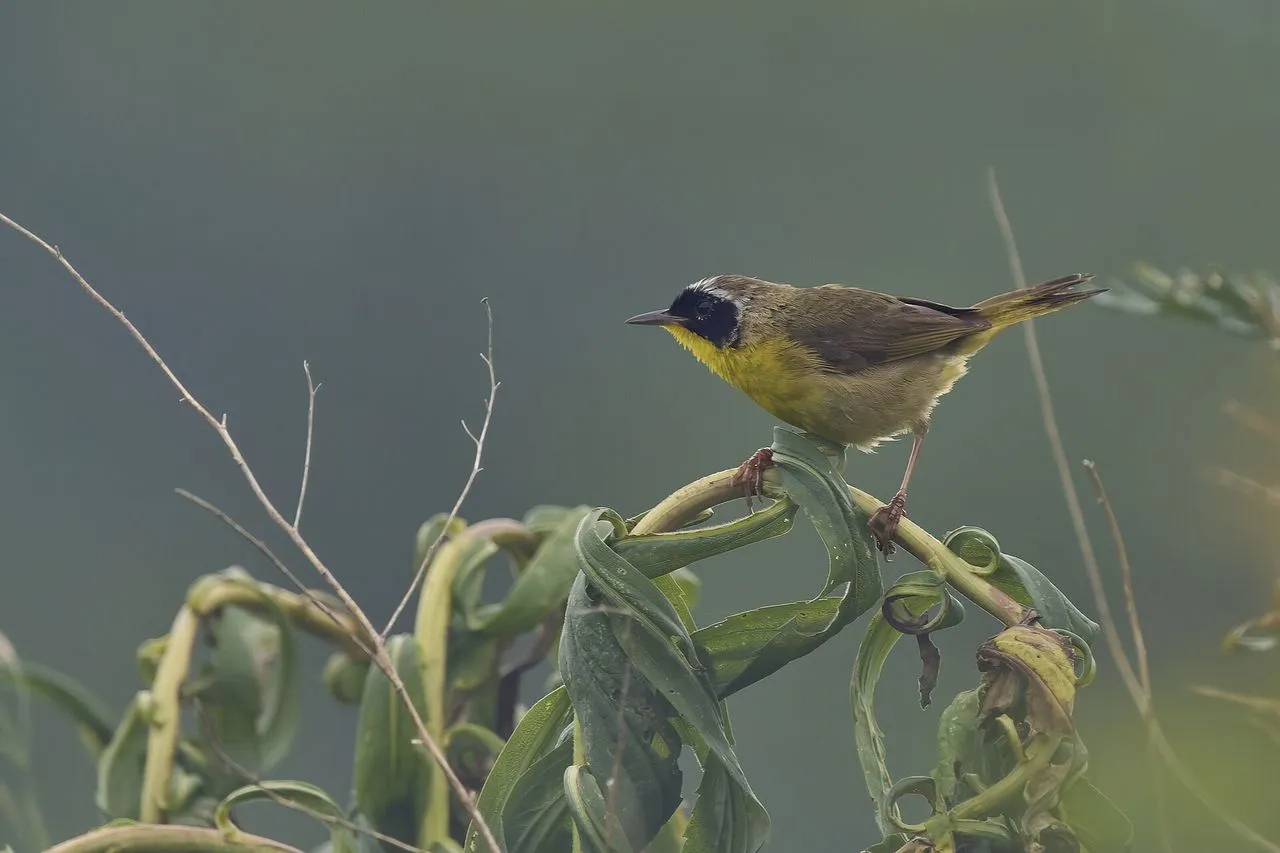
Northern Parula (Setophaga americana) is one of the smallest North American warblers (10-12 cm). Adult males show blue-grey upperparts with a distinctive yellowish-green back patch, a yellow throat and breast crossed by a chestnut-and-blue chest band, and a broken white eye ring. Females are duller. The species breeds in mature forest with abundant epiphytes (old-man's beard lichen in the north, Spanish moss in the south) and winters in the Caribbean and Central America.
Setophaga americana Müller, 1776, the Northern Parula, is one of the smallest North American wood-warblers at 10 to 12 cm and 5 to 11 g, instantly recognised by its rising buzzy trill and the distinctive chestnut-and-blue chest band crossing its yellow breast.
Part of the Complete Warblers Guide.
Identification at a glance
| Species | Key separator |
|---|---|
| Northern Parula (Setophaga americana) | Blue-grey above with yellowish-green back patch; yellow breast with chestnut-and-blue chest band; broken white eye ring |
| Nashville Warbler (Leiothlypis ruficapilla) | Complete bold white eye ring; no chest band; olive-green (not blue-grey) upperparts |
| Blackburnian Warbler (Setophaga fusca) | Orange or yellow-orange throat; extensive white wing panel; no back patch |
| American Redstart (Setophaga ruticilla) | Male black with vivid orange patches; no eye ring or back patch; persistent tail-fanning display |
| Yellow Warbler (Setophaga petechia) | Entirely yellow; reddish breast streaks rather than a chest band; no blue-grey tones |
| Size context | Northern Parula is 10 to 12 cm (3.9 to 4.7 in), 5 to 11 g (0.2 to 0.4 oz) |
Identification
Visual
Adult males have blue-grey upperparts with a narrow but striking yellowish-green back patch in the centre of the mantle. The throat and upper breast are yellow, interrupted by a two-part chest band: a bar of dark chestnut above and a band of dark blue-grey below, which together frame the yellow breast from the white belly. The face shows a broken white eye ring, split fore and aft, rather than the complete ring seen in Nashville Warbler. Two white wing bars are present on the folded wing.
Adult females share the basic pattern but are considerably duller throughout. The yellowish-green back patch is present but less vivid, the blue-grey upperparts are washed with olive, and the chest band is reduced or almost absent. The broken eye ring and white wing bars remain. At close range the back patch remains a useful mark even on females.
Immature birds in autumn resemble adult females. First-autumn males may show only a faint suggestion of the chest band and have a less saturated back patch than adults. The broken eye ring and the contrast between the yellowish throat and pale belly help separate them from other small warblers at this season.
Audio
The song is diagnostic. Northern Parula delivers a rising, insect-like buzzy trill that climbs steadily in pitch before ending in a sharp, abrupt downward note, often represented in print as zzzzzip or zreeeee-up. The combination of ascending buzz and terminal downstroke is unlike any other eastern warbler and carries well through the canopy. Males sing persistently in the breeding season, often from high in the canopy where they are difficult to locate visually.
A second, quieter song type is sometimes given later in the breeding season, but the main ascending buzz with abrupt terminal note is the reliable field character. The call is a sharp, dry chip.
Distribution
Northern Parula breeds across eastern North America from the Gulf Coast north to maritime Canada, and west to the edge of the Great Plains. Two broadly disjunct breeding populations exist, separated by a gap in the mid-Atlantic states and lower Midwest where suitable habitat has been substantially reduced by forest loss and air pollution damage to lichen communities.
The northern population breeds from maritime Canada, Quebec, and Ontario south through New England and the Appalachians. This population depends on old-man's beard lichen (Usnea spp.) for nest material and is concentrated where mature humid forest carries substantial lichen loads: coastal Maine, the Maritimes, and the northern hardwood and mixed forests of the Great Lakes region.
The southern population occupies the Gulf Coast and southeastern coastal plain, where Spanish moss (Tillandsia usneoides) grows on live oaks and baldcypresses in bottomland forest, swamp edges, and river gallery forest.
Winter range extends through the Caribbean islands, the Yucatan Peninsula, Mexico, and south into Central America. Northern Parulas use forest edge, shade plantings, and mature trees on wintering grounds rather than open scrub.
Spring migration brings birds north through the Gulf States from late March, with northern territories occupied from May. Autumn movement runs August through September.
Habitat
Breeding habitat in both northern and southern populations is defined by the presence of abundant arboreal epiphytes rather than by any particular tree species. The common requirement is mature, humid forest with a high epiphyte load. In the north this means old-growth or mature second-growth forest where Usnea lichen drapes the branches of conifers and hardwoods in sufficient quantity to build a concealed nest. In the south, flooded swamp forest and bottomland hardwoods draped with Spanish moss provide the equivalent structure.
Forest continuity matters. Northern Parulas favour large tracts of mature woodland over small isolated fragments, partly because epiphyte loads develop only on trees that have grown large and old enough, and partly because fragmented forest edge is poorer nesting habitat. The species forages primarily in the mid to upper canopy of deciduous and mixed forest, working the foliage of maples, beeches, and oaks in the north.
The Epiphyte Connection
The Northern Parula's dependency on hanging epiphytes as nest material is one of the more ecologically specific requirements among North American warblers. In the northern breeding range, the bird weaves a suspended cup nest into a hanging mass of Usnea lichen, forming a pocket within the lichen that is nearly invisible from below. In the southern range, Spanish moss (Tillandsia usneoides) performs the same structural role, with the nest cavity formed by a woven pouch within the drooping festoons.
The two plant substrates belong to unrelated groups (foliose lichen and a bromeliad), but they share a growth form: long, fine, pendant strands that hang from branches in humid forest. The parula exploits this shared growth form in both regions, treating the epiphyte mass as both building material and concealment.
Where Usnea populations have declined due to air pollution, acid rain, or forest simplification, Northern Parula has retreated from parts of its former northern range. The partial recovery of lichen communities in some areas following reduced sulphur dioxide emissions has been accompanied by modest range recovery, making this bird an indirect indicator of forest air quality.
Diet and Foraging
Northern Parulas forage almost exclusively in the mid to upper canopy. The diet is predominantly small insects including beetles, flies, caterpillars, gnats, and leafhoppers, supplemented by spiders. Small berries are occasionally taken outside the breeding season.
Foraging style is noticeably acrobatic. Northern Parulas regularly hang upside down from terminal branches and leaf clusters to glean prey from the undersides of leaves, a posture shared with chickadees and titmice but less common among warblers. They work systematically through foliage tips and small branches at the outer edge of the canopy. Short hover-gleans are frequent, with the bird briefly suspending flight to reach prey on a leaf surface. Flycatching sallies occur but are secondary to systematic gleaning.
The species forages at higher average heights than most other warblers during the breeding season, which contributes to the difficulty of obtaining clear views. Binoculars and familiarity with the song are often more useful than waiting for the bird to descend.
Breeding
The nest is a woven cup suspended within a hanging epiphyte mass, either Usnea lichen or Spanish moss depending on location. The female builds the nest alone, constructing a pouch-like structure that is entered from the side or top and is largely hidden by surrounding epiphyte material. The interior is lined with fine plant fibres, grasses, and occasionally feathers.
Clutch size ranges from 3 to 7 eggs, typically 4 to 5. Eggs are white or creamy white with reddish-brown spots concentrated at the larger end. Incubation lasts approximately 12 to 14 days, carried out by the female. Both parents feed nestlings, which fledge at around 10 to 11 days. One or two broods per season depending on latitude.
Northern Parula occasionally hybridises with Yellow-throated Warbler (Setophaga dominica) in areas of sympatry in the Southeast, producing intermediate offspring with mixed field marks from both parent species.
Conservation
Northern Parula is one of the few North American warblers showing a stable or slightly expanding population over recent decades, in contrast to the declines recorded across many long-distance migrants. The range has expanded northward in some areas where Usnea lichen communities have recovered following improvements in air quality.
The species is sensitive to forest fragmentation that eliminates mature trees with sufficient epiphyte load. Stands of mature bottomland hardwood with intact Spanish moss in the South, and humid mixed forests carrying Usnea in the North, represent priority habitat. Small woodlots rarely develop the epiphyte loads necessary to support breeding pairs.
Brown-headed Cowbird parasitism occurs but does not appear to be a primary population driver at present. Regional water and air quality, which affect tree health and therefore lichen and bromeliad growth, link indirectly to Northern Parula population health at the landscape scale.
See Also
- Magnolia Warbler: a canopy warbler with a similarly striking breast pattern, breeding in boreal conifers.
- Yellow Warbler: the widespread riparian warbler sharing the yellow breast but lacking the chest band and blue-grey upperparts.
- Blackburnian Warbler: the orange-throated canopy specialist of boreal and montane spruce-fir, sharing high-canopy foraging habitat.
- American Redstart: the active flycatching warbler with bold tail display, often found in the same eastern woodland habitats.
- The Complete Warblers Guide: full family reference covering taxonomy, migration, and identification across Parulidae.
- Why Are Warblers in My Garden in Fall?: stopover ecology and autumn plumage for September-October garden visitors.
Frequently Asked Questions
What does it sound like?
A rising, insect-like buzzy trill that climbs steadily in pitch and ends in a sharp, abrupt downward note, commonly written as 'zzzzzip' or 'zreeeee-up'. The ascending buzz with downstroke terminal note is diagnostic among eastern warblers and carries well through the canopy.
Where does it nest?
In a woven cup suspended within a hanging mass of old-man's beard lichen (Usnea) in northern populations, or Spanish moss (Tillandsia usneoides) in the Gulf coast south. The epiphyte mass conceals the nest from below and provides much of its structural material.
How does it differ from other warblers?
The combination of blue-grey upperparts, a yellowish-green back patch, yellow throat and breast crossed by a chestnut-and-blue chest band, and a broken white eye ring is unique among North American warblers. Nashville Warbler shares a yellow throat and eye ring but has a complete (not broken) eye ring, olive-green upperparts, and no chest band.
When can I see it in my area?
Spring migration peaks across the eastern United States in late April to mid-May. Southern breeding territories are occupied from late March; northern territories from May onward. Autumn movement is more diffuse, running August through September. Wintering birds are present in the Caribbean and Central America from October through March.